South Australia’s Housing Trust has apologised to a public-housing tenant after the state Ombudsman found the authority took an unreasonable four years to properly address repeated reports of black mould at her home.
Ombudsman Emily Strickland found the Housing Trust failed to ensure the property met reasonable standards of health and safety and erred in the way it handled the tenant’s complaints. The findings relate to one tenant and one property and should not be read as evidence that all Housing Trust homes have the same problem.
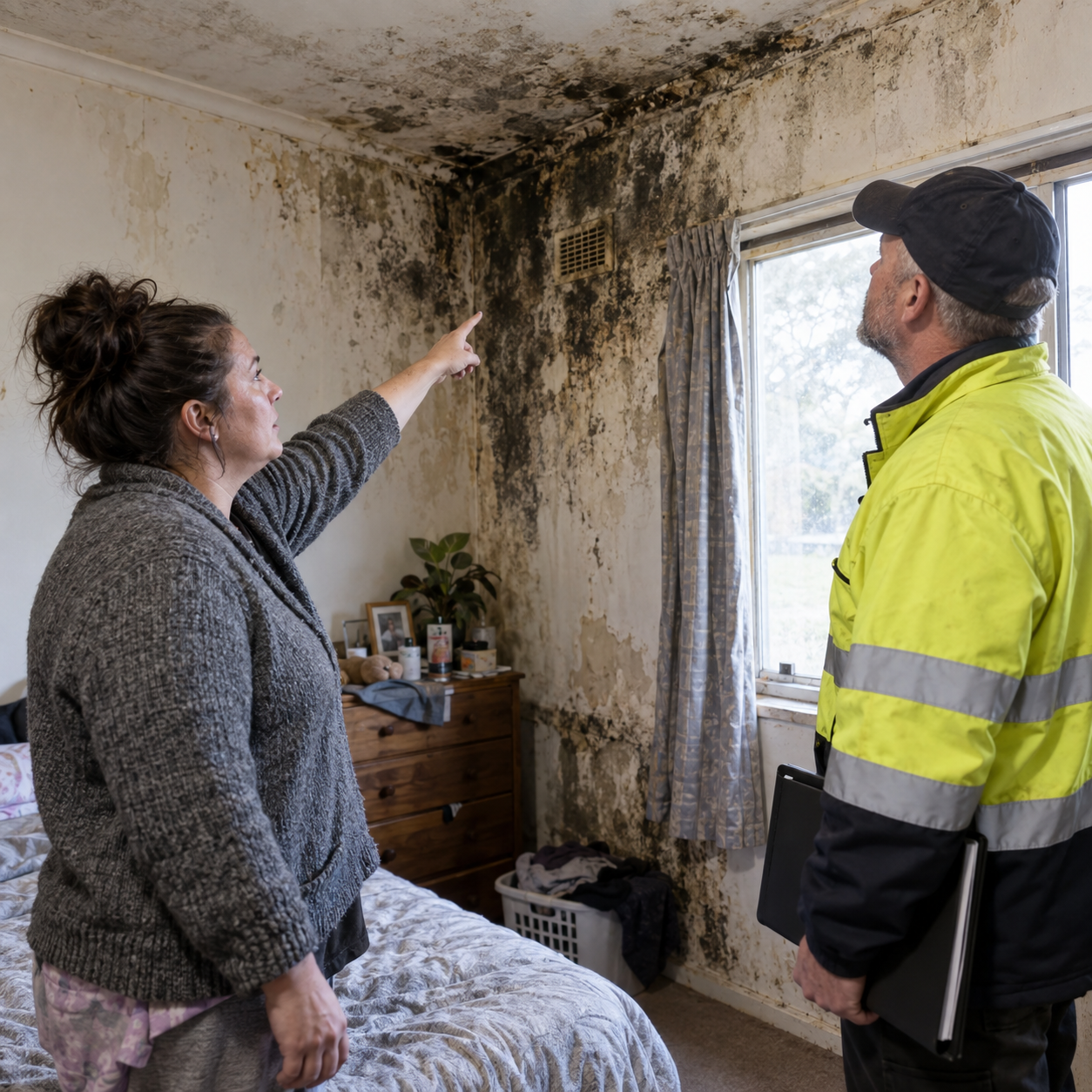
The tenant first reported mould in February 2021. The Housing Trust did attempt to arrange work at that stage, but contractors had difficulty gaining access to the property. The tenant was told to contact maintenance so the work could be rearranged and, according to the Ombudsman’s report, she did not return to the authority about the mould until 2022.
That early access problem is an important part of the timeline because the case is more complicated than a claim that the Housing Trust did nothing for four years. Some action was attempted in 2021. The Ombudsman’s criticism focuses on what happened after the issue was raised again and remained unresolved.
From 2022 onwards, Strickland identified a pattern in which work orders were created after the tenant reported mould, but the work was either not carried out or the orders were cancelled without the underlying contamination being fixed.
By February 2026, when the Ombudsman began investigating, the mould problem had persisted for years. Strickland said the contamination had worsened significantly and noted that the tenant had repeatedly told the Housing Trust the condition of the property was affecting her health.
The tenant had also told the authority she had a lung condition. The Ombudsman expressed concern that she had continued living in a property with high levels of mould contamination despite those health concerns being raised.
The property was not tested until April 2026. According to the report, testing found active mould contamination on the bathroom ceiling and in the hallway carpet. Strickland concluded that the level of contamination would not have met minimum housing standards.
The finding was therefore not based only on the appearance of mould. The investigation considered the tenant’s complaint history, the Housing Trust’s maintenance records, the repeated work orders and the later test results showing active contamination.
Strickland concluded that the four-year delay in addressing the safety concerns was unreasonable and that the Housing Trust had failed to meet its obligations to the tenant. She also found the authority had erred in the way it handled multiple reports made over the period.
The administrative record was central to the case. Raising a work order can show that a complaint entered the maintenance system, but it does not mean the underlying repair was completed. The Ombudsman found repeated instances where the process generated an order without producing a final resolution.
That gap matters because maintenance systems can appear active on paper while a tenant continues to live with the same unresolved problem. A closed or cancelled work order is not the same as a repaired property if the condition that triggered the complaint remains.
The case also shows why repeated complaints may need escalation. When the same health or safety issue returns over a long period, the history of previous failed work becomes relevant to deciding whether another routine maintenance request is enough.
Strickland made four recommendations to the Housing Trust. They included taking action to address the mould contamination and changing the authority’s complaints-handling procedure so unresolved matters are followed through more effectively.
The Housing Trust accepted the recommendations. A spokesperson acknowledged the Ombudsman’s findings and confirmed that the authority had apologised to the tenant.
The Trust also said it had been engaging with the tenant to arrange access for remedial work and was relocating her to another property while the required work was carried out.
That response addresses the immediate need to remove the tenant from the affected home and complete repairs, but the Ombudsman’s recommendations extend beyond this single remediation job. They also focus on the internal process that allowed the problem to remain unresolved despite repeated reports.
The report itself was published in July and became public on Wednesday. Its release has drawn attention because black mould can raise serious health concerns, particularly for people with respiratory conditions, but the Ombudsman’s legal and administrative findings are specific to how this complaint was managed.
The report did not find that the Housing Trust deliberately harmed the tenant. Its conclusion was that the authority failed to maintain the property to a reasonable health and safety standard and took too long to resolve a problem it had repeatedly been told about.
The timeline also matters when assigning responsibility. The Ombudsman acknowledged that access problems affected the first attempted response in 2021 and that the tenant did not reapproach the authority until the following year. From 2022, however, the repeated cycle of complaints, work orders and unresolved contamination became the central concern.
That distinction avoids oversimplifying the case. The problem was not a complete absence of administrative activity. It was the failure of that activity to produce an effective repair within a reasonable period.
For public-housing tenants, the practical lesson is the importance of keeping records of maintenance requests, dates, job numbers and follow-up conversations, especially where a condition is affecting health or safety. If work is cancelled or incomplete, the unresolved issue needs to remain visible rather than disappearing with the work order.
For housing authorities, the case highlights the need to track outcomes rather than only processes. A system should be able to identify when the same problem has been reported repeatedly and trigger a higher level of review when ordinary maintenance steps are not fixing it.
The Ombudsman’s findings also underline the importance of testing where the seriousness of contamination is uncertain. In this case, testing in April provided objective evidence of active mould and helped establish that the condition of the property did not meet the required standard.
The Housing Trust has now accepted the recommendations, apologised and begun relocating the tenant while remedial work is arranged. The next measure of the response will be whether the physical problem is fully repaired and whether the complaints process changes in a way that prevents similar unresolved cases from continuing for years.
For the tenant involved, the investigation has produced an official acknowledgment that the delay was unreasonable. For the Housing Trust, it has produced a clear administrative requirement: repeated health and safety complaints must be followed through to an actual resolution, not simply recorded as a sequence of maintenance jobs.
The report also shows why access problems and tenant follow-up need to be recorded clearly. Where contractors cannot enter a property, the authority still needs a reliable way to distinguish between a job that cannot proceed temporarily and a health or safety issue that has been resolved. In this case, the later complaint history showed the mould had not gone away.
That makes the complaints procedure as important as the physical repair. A robust system should preserve the history of repeated reports, identify cancelled or incomplete work and trigger further review when the same problem keeps returning. The Ombudsman’s recommendations are aimed at closing that administrative gap as well as dealing with the mould itself.
Because the Housing Trust has accepted the findings, the case now moves from investigation to implementation. The practical test will be whether the tenant is safely relocated, the contamination is remediated and the revised complaint process creates a clearer path from first report to completed repair.