An ABC NEWS Verify investigation has traced the presenter used by a popular Australian political commentary channel to Brazil and found that artificial intelligence was used to alter his voice and appearance, while the political party frequently promoted by the channel says it has no association with the account.
The YouTube channel, Oceania Unfiltered, has attracted millions of views with videos about Australian and New Zealand politics delivered in a strong Australian accent. It frequently praises One Nation and its leader Pauline Hanson while criticising Prime Minister Anthony Albanese and the broader political establishment. A One Nation spokesperson told the ABC the channel and its creator were not associated with the party.
ABC NEWS Verify reported that the channel had accumulated more than 3 million views across dozens of videos and, after publication of the investigation, had more than 45,000 YouTube subscribers. Its audience includes people who appear to believe they are watching an Australian commentator speaking from within the country.
The presenter appears to be Brazilian content creator Junior Lutero De Alcantara, also known as Junior Lutero. ABC journalists located older videos and other channels featuring his likeness, many of them in Portuguese, and used visual landmarks in footage that did not appear manipulated to trace him to a town in Brazil’s São Paulo state.
However, the investigation does not establish that Lutero personally operates every account using his likeness. ABC NEWS Verify said it remained unclear whether he controls Oceania Unfiltered and the other channels or whether another person is using his image and recordings. Multiple attempts to contact him before publication received no response.
That uncertainty is important. The evidence supports a finding that the presenter’s likeness and voice have been manipulated with AI and that related account information points to Brazil, but it does not prove a wider political organisation or coordinated relationship with One Nation.
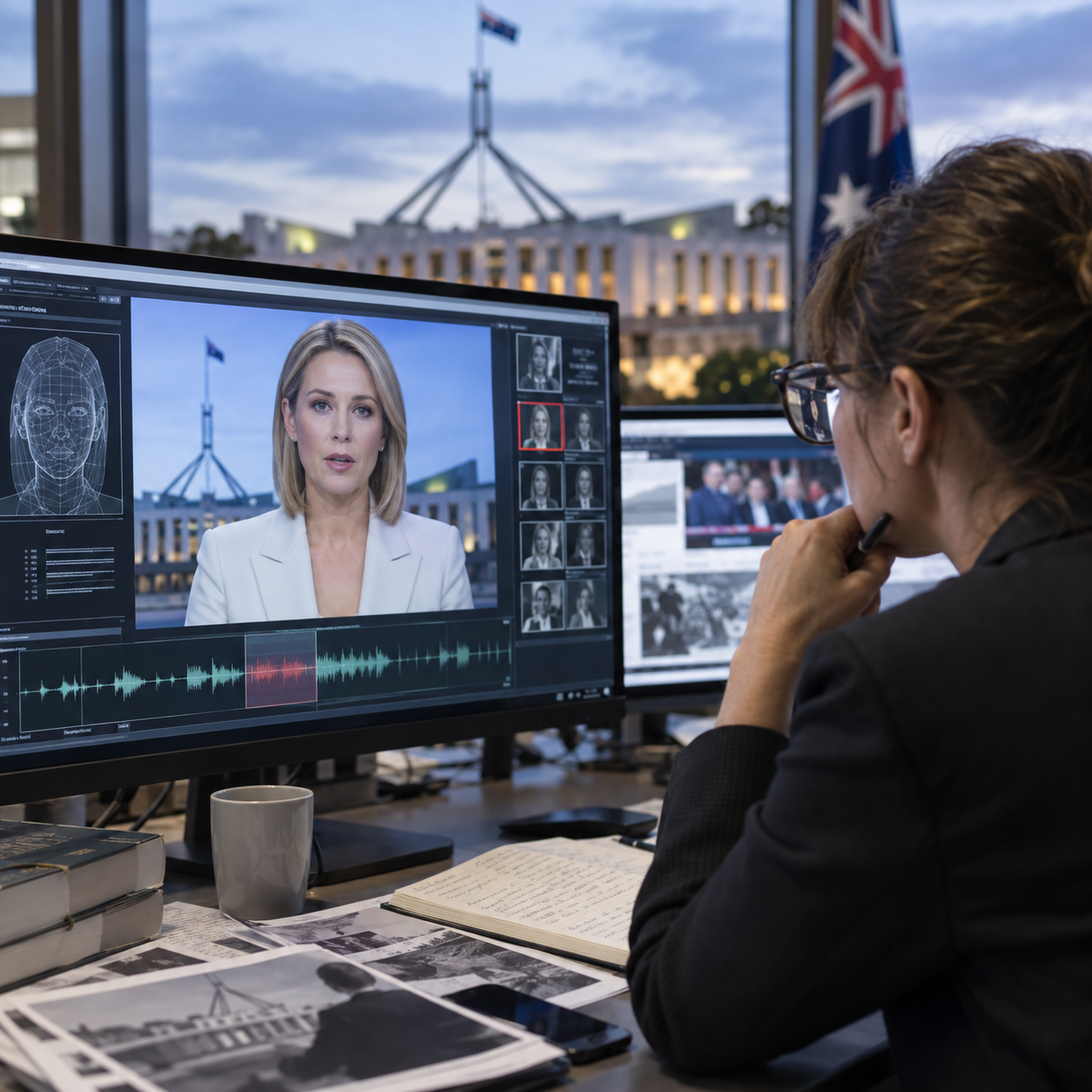
Independent technical analysis commissioned by ABC NEWS Verify found signs consistent with synthetic manipulation. Researchers at the University at Buffalo’s Media Forensic Lab examined one video in detail and described it as a lip-sync deepfake in which synthetic speech had been matched to footage of a real person.
The researchers identified visual anomalies around the presenter’s face and neckline, as well as texture changes and other inconsistencies across footage. They concluded that AI had been used to alter both speech and visual presentation.
ABC NEWS Verify also located a 2021 video in which the same man speaks English with a Latin American accent. The outlet said that clip did not show the same signs of AI alteration, providing a comparison with the distinctly Australian voice used by Oceania Unfiltered.
After ABC journalists first attempted to contact the presenter in May, some videos began carrying notices that sounds or visuals had been altered or generated with AI. After the ABC sent questions to YouTube, the platform added AI disclosure labels across the channel’s videos.
YouTube said its policies apply to all creators regardless of whether content is made with artificial intelligence and that users are required to disclose realistic synthetic or meaningfully altered material. The platform said disclosure labels are intended to give viewers context about what they are seeing and hearing.
After the ABC investigation was published, Oceania Unfiltered posted its own explanation. The channel said the videos were originally recorded by the presenter and that AI was then used to modify his accent. It also said the presenter was Brazilian and claimed that fact had not been deliberately hidden.
That statement adds important context because it gives the account’s own explanation for how the videos are produced. It does not remove the broader transparency question raised by the investigation: how clearly ordinary viewers understood that the Australian-sounding presenter was based overseas and that his voice had been synthetically altered.
The Facebook page associated with Oceania Unfiltered provided another piece of evidence about location. Transparency information reviewed by ABC NEWS Verify showed the page was managed from Brazil. The page had also been monetised, according to disclosure data examined by the outlet.
The page’s history showed repeated changes in name over many years before it became Oceania Unfiltered in March. Earlier posts covered a range of subjects before the account shifted its focus toward Australian politics.
After ABC NEWS Verify asked Meta about the page, the company disabled it for breaching its inauthentic behaviour policy. Meta said its rules prohibit people from misrepresenting who they are or where they are located and require disclosure when realistic content has been created or altered with AI.
Meta’s action was a platform enforcement decision, not a finding that the page was acting on behalf of a political party or foreign government. The ABC investigation reported no evidence of an association between the channel and One Nation, and the party expressly denied any connection.
The investigation instead places Oceania Unfiltered within what researchers describe as an online “slop economy”: a business model in which creators use low-cost, high-volume content, including AI-generated or AI-altered material, to capture attention and earn revenue from advertising or platform monetisation.
ABC NEWS Verify identified Facebook groups and pages where creators discussed ways to find profitable content niches, improve engagement and generate income. One post promoted Australia as a comparatively under-served market for YouTube content.
The outlet also examined large numbers of Facebook posts using Australian political terms and found pages apparently operated from countries including Indonesia, Sri Lanka, Vietnam and Bangladesh. The material ranged from basic engagement bait to more sophisticated AI-generated political imagery.
Those findings do not mean all foreign-run pages are coordinated or share the same political objective. Researchers interviewed by the ABC said financial incentives can be enough to explain much of the behaviour: content that produces attention can generate money regardless of whether the operator has a genuine ideological commitment to the subject.
Queensland University of Technology researcher Timothy Graham said the likely commercial motive did not eliminate the possibility of political effects. Content designed for maximum engagement can still influence public discussion, especially when it is framed in partisan terms and distributed inside communities of genuine Australian users.
David Hobson, a researcher with Canada’s Center for Media, Technology and Democracy, similarly pointed to the economics of platform monetisation. For creators in countries with lower local incomes, revenue earned in Australian or North American currencies can make highly engaging foreign-targeted content commercially attractive.
The ABC investigation also referred to earlier international research into commercial disinformation networks. Those studies have described operators using fabricated or highly emotional stories about politics, celebrities and sport to drive traffic and advertising revenue. The Australian examples fit some of the same commercial patterns, although each account needs to be assessed on its own evidence.
For viewers, the core problem is transparency. A political opinion does not become illegitimate merely because the speaker lives overseas, and AI tools can be used for legitimate translation, accessibility or production. The concern arises when synthetic presentation makes it difficult for an audience to understand who is speaking, where they are based and how the content has been altered.
That distinction is especially important in political content because cues such as accent, location and apparent identity can affect how viewers interpret a speaker’s credibility or connection to local events.
Oceania Unfiltered’s later statement that the presenter is Brazilian and uses AI to change his accent provides a clearer explanation than many viewers may have had before the investigation. The platform disclosures now attached to the videos also make the use of synthetic media more visible.
What remains unresolved is who controls every related account and how the broader network of foreign-run Australian political pages is organised. ABC NEWS Verify did not establish that Lutero personally operates all accounts using his likeness, and it did not find evidence linking Oceania Unfiltered to One Nation.
The verified findings are narrower but still significant: the channel used AI-manipulated audio and visuals, its presenter appears to be based in Brazil, millions of people viewed its Australian political commentary, Meta disabled a related Facebook page for inauthentic behaviour, and YouTube added synthetic-media disclosures. The political intent behind the operation remains less certain than the technology and business model used to produce the content.
The channel’s post-publication explanation also illustrates why disclosure quality matters. Saying that a creator is Brazilian somewhere in a channel’s history is different from making that information clear at the point where viewers encounter an Australian-accented political video. Platforms are increasingly trying to close that gap with visible labels for synthetic or altered media.
For political audiences, the most useful response is therefore not to infer a hidden party relationship that has not been demonstrated, but to assess the content with fuller context: who appears to be behind it, where the account is managed, what parts of the presentation are synthetic and what financial incentives may be driving production.
That approach keeps the evidence in proportion. The investigation documents a real transparency problem and a commercial ecosystem capable of producing large volumes of persuasive political content, while leaving open important questions about authorship, intent and coordination that the available evidence does not answer.