Nearly half of Victoria’s state-managed roads were rated poor or very poor in 2024, according to data released by the Victorian Auditor-General’s Office, while thousands of reported potholes remained unresolved in June and some of the worst conditions were concentrated in regional areas and Melbourne’s outer suburbs.
The audit data shows the share of state roads rated poor or very poor rose from 39 per cent in 2021 to 48 per cent in 2024. The figures provide a statewide measure of deterioration that had previously been difficult for the public to see in one place.
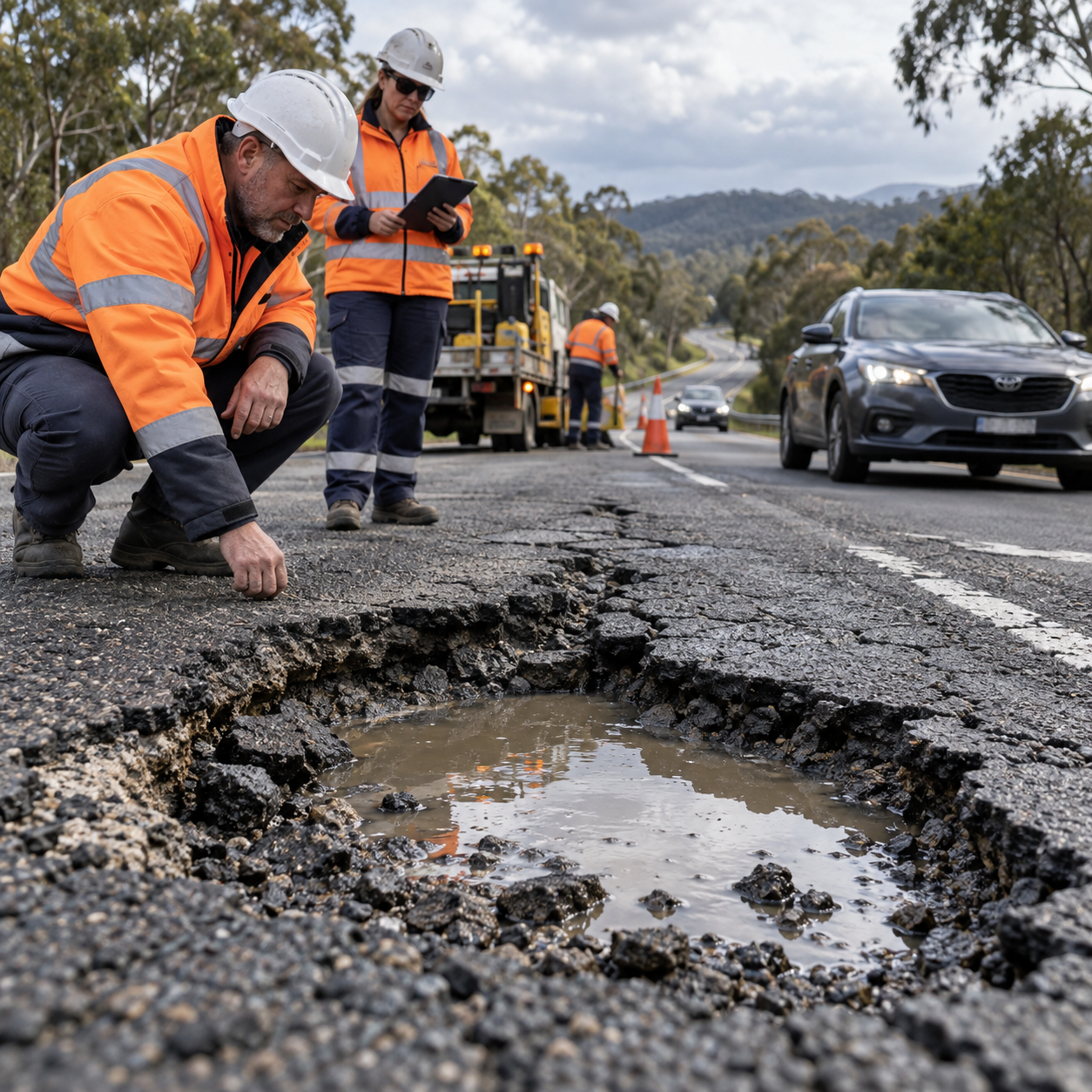
The roads covered by the audit are the state-managed highways and arterial roads maintained by the Victorian government. They account for about 29,000 kilometres, or roughly 15 per cent of Victoria’s road network by length, but carry a large share of the state’s traffic and freight.
The network is heavily regional. About 82 per cent of state-managed roads are outside metropolitan Melbourne, which helps explain why many of the worst-performing areas identified in the audit are in country Victoria.
In 2024, 30 council areas had at least half of their state-managed roads rated poor or very poor. The strongest concentration of those areas was in the state’s north, although the pothole data also showed significant problems in the south-west and on the suburban fringe of Melbourne.
The number of unresolved pothole defect reports has increased across the state. The audit data records reports raised through contractors, public complaints and road surveys, and one defect report can cover more than a single pothole, meaning the raw count is not necessarily the same as the number of individual holes on the road network.
In regional Victoria, Towong in the north-east and Moyne in the south-west were among the council areas with the highest numbers of unresolved pothole reports. In metropolitan Melbourne, Melton and Hume recorded high numbers, while the Mornington Peninsula had the largest unresolved total among metro areas and a sharp increase over the previous 18 months.
The data also shows that most reported pothole defects were repaired. The problem is that new defects are appearing quickly enough that maintenance crews are struggling to keep pace in some parts of the network.
Premier Ben Carroll has promised the government will repair 500,000 potholes during the current financial year, about double the number repaired in the previous year. The government wants most of that work completed by the end of January, taking advantage of drier summer conditions.
Meeting that target would require an average of more than 3,000 pothole repairs a day between now and then. The figure illustrates the scale of the maintenance task, particularly when crews are also dealing with broader pavement deterioration rather than only isolated surface defects.
Road engineers say potholes are often a symptom of deeper maintenance needs. Cracks allow water to enter the pavement, and repeated traffic loads can then break apart weakened sections. Heavy rain and flooding can accelerate that process, especially on older roads already in poor condition.
Victoria’s network has been hit by several major wet-weather events in recent years. Widespread flooding affected northern parts of the state in 2022, followed by further flooding in December 2023 and January 2024. Those events added pressure to a network that the audit says was already deteriorating.
The state has committed an additional $352 million to pothole repairs, on top of more than $1 billion already budgeted for road maintenance. The debate now is not only about how much money is being spent, but whether maintenance is being prioritised early enough to prevent smaller defects from becoming expensive reconstruction jobs.
Swinburne University vehicle-engineering academic Ambarish Kulkarni said preventive and predictive maintenance could reduce long-term costs and keep roads in better condition for longer. He suggested technologies such as road scanning, drones and automated defect detection could help authorities identify cracking before it develops into major potholes.
The auditor-general also raised concerns about the quality and use of road-condition data. Although the Department of Transport collects extensive information, the audit found some data was inadequate, was not always used effectively to prioritise work and was not routinely made available to the public.
That problem is visible in the Western Highway data. In the Pyrenees council area near Trawalla, 1,055 pothole defects were recorded between July 2024 and June 2026 and the database showed all of them as fixed. Local residents, however, have continued to complain about the condition of the highway.
The difference does not necessarily mean the repair data is false. A reported pothole can be repaired while the surrounding pavement remains badly deteriorated or develops new defects nearby. It does show why counting closed work orders alone may not provide a complete picture of the overall condition of a road.
The Western Highway has become a major focus after 71-year-old motorcyclist Peter “Tiki” Mason died following a crash near Trawalla. He was reported to have hit a pothole, but the investigation into the crash is continuing and authorities have not established a final causal finding.
Some local residents have described the crash as preventable and have blamed poor road conditions, while opposition politicians have used the incident to criticise the government’s maintenance record. Nationals leader Danny O’Brien has called for potholes to be repaired urgently and accused the government of neglecting the network.
Those political claims should be separated from the confirmed audit findings. The VAGO data establishes that the overall condition of state-managed roads worsened between 2021 and 2024 and that pothole backlogs increased in a number of locations. It does not establish that a particular government decision caused an individual crash.
The government says it is responding with additional maintenance funding and the 500,000-pothole repair target. The effectiveness of that response will depend not just on the number of individual repairs completed, but on whether the underlying road surface is restored well enough to stop defects recurring.
That is particularly important on major freight routes such as the Western Highway, which links Melbourne’s western suburbs with South Australia and carries large numbers of heavy vehicles. Roads under sustained heavy loads can deteriorate quickly when water enters cracks or when pavement layers are already weakened.
The newly public audit data gives residents a clearer way to compare local experience with the state’s own records. It also exposes the limits of relying on one measure alone: a council area can have many completed repairs and still contain long stretches of road rated poor or very poor.
For road users, the immediate concern is safety and vehicle damage. For government, the longer-term challenge is deciding how much to spend on reactive pothole repairs versus planned resurfacing and reconstruction that can extend the life of the network.
The audit’s central finding is therefore broader than a simple pothole count. Victoria is dealing with a state-road network in which deterioration has become more widespread, maintenance demand is rising and the data used to manage that work needs to be clearer and more effectively linked to repair priorities.
The audit also highlights why different road statistics can appear to tell different stories. A defect register measures individual problems reported and closed, while a condition rating measures the broader quality of the pavement. A council area can therefore show a high repair completion rate and still contain long sections of road assessed as poor or very poor.
That difference is important when governments report progress. Completing hundreds of thousands of pothole repairs can reduce immediate hazards, but it does not automatically reverse the long-term deterioration identified by the auditor. Resurfacing, rehabilitation and reconstruction may still be needed where the pavement itself has reached the end of its useful life.
VAGO’s findings therefore put pressure on the state to demonstrate not only that crews are responding to complaints, but that maintenance spending is improving the underlying condition of the network over time. Future condition data will show whether the current repair campaign slows or reverses the rise from 39 per cent to 48 per cent recorded between 2021 and 2024.
That makes the next round of public condition data especially important. If the repair blitz is working at a network level, future audits should show more than a fall in open pothole reports; they should also show a smaller share of state-managed roads being rated poor or very poor. Without that broader improvement, Victoria would still be treating symptoms faster without fully reversing the deterioration underneath them.