US artificial intelligence company Anthropic has signed an agreement to use part of a proposed $32 billion data-centre development near Dalby in Queensland’s Western Downs, adding a major technology customer to a project that could become Australia’s largest data-centre precinct.
The agreement is a significant commercial step, but the development is not yet an operating data centre. The lease involving Anthropic is subject to Foreign Investment Review Board approval, and the broader Western Downs Digital Park still has to progress through development and infrastructure approvals.
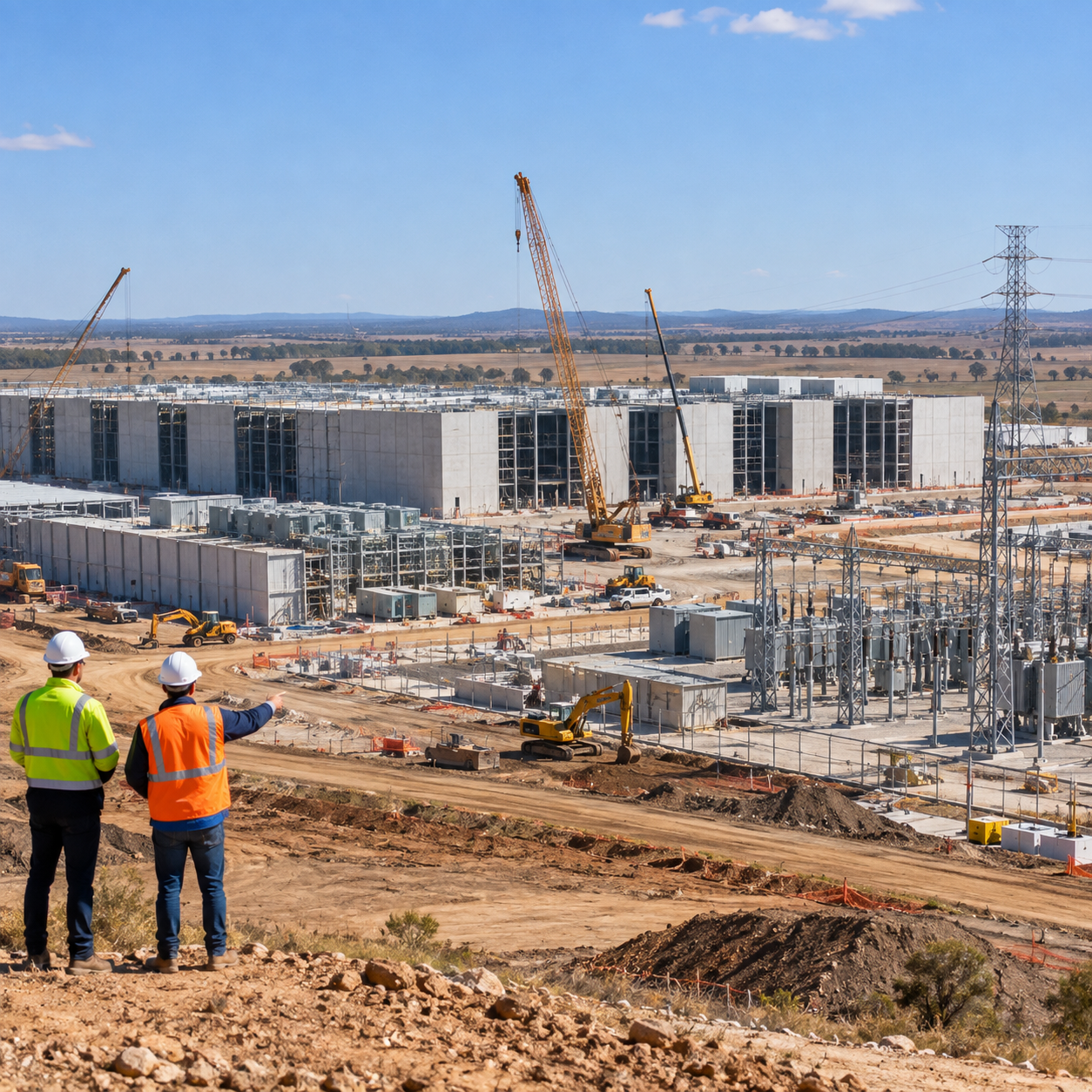
The proposed precinct is being developed on a large site northwest of Dalby. ABC News reports the project has a planned power demand on a scale comparable with about 1.5 million average Australian households when fully developed, illustrating the enormous electricity requirement attached to the next generation of AI infrastructure.
Anthropic is best known as the developer of the Claude family of AI models. Under the agreement, capacity at the Queensland site is expected to support inference — the computing work performed when an AI model receives a user’s request and generates a response — rather than simply acting as conventional corporate data storage.
That distinction helps explain why AI data centres can be so power intensive. Large language models require clusters of specialised processors working in parallel, supported by high-capacity networking, cooling systems and a reliable electricity supply. Once millions of users and business applications are making requests, the computing load can be continuous.
The Western Downs proposal has been associated with an investment value of about $32 billion. ABC reporting on planning material says the project is designed for staged development over several years and could ultimately have peak electrical demand measured in gigawatts.
For perspective, Queensland’s entire electricity system serves households, businesses, industry, transport and mining across the state. A single digital precinct drawing power on this scale would therefore become a material participant in the energy market rather than just another large commercial building.
That does not mean the project would necessarily draw its maximum design load every minute, nor does a comparison with household consumption mean homes will directly lose electricity to the centre. The relevant questions are how new generation, transmission, storage and network capacity are built to support the load and who pays for the required upgrades.
The developers have promoted plans involving renewable power-purchase agreements, grid connections and battery-backed infrastructure. Those arrangements will be central to whether the project can meet its energy needs without placing unacceptable pressure on the broader system.
Location is part of the strategy. The Western Downs is already a major energy region with coal, gas, solar, wind and transmission infrastructure. The proposed site near Dalby is also close enough to established grid assets to make a very large connection technically conceivable.
At the same time, a data centre of this scale creates local impacts that go well beyond electricity. Construction can require large workforces, heavy vehicle movements and temporary accommodation. Once operating, the project can affect land use, noise, water planning, emergency services and local roads even though the permanent workforce may be much smaller than the construction peak.
Some residents have already raised concerns through a Queensland parliamentary petition about the proposed development, including electricity demand, water, noise, traffic, fire risk and the conversion of agricultural land. Those concerns are submissions from opponents of the project, not findings that the development will cause the harms alleged.
The approval process is where those claims are supposed to be tested against technical assessments and proposed mitigation measures. Planning authorities can require studies on noise, traffic, water, environmental impacts, hazard management and infrastructure before allowing construction to proceed.
Water is often a contentious issue around data centres because traditional cooling systems can consume large volumes. Planning material for the Western Downs proposal has described air-cooled and closed-loop approaches intended to reduce direct water use, alongside the use of captured rainwater or treated sources for some needs. The final operating design will determine the actual demand.
Foreign investment scrutiny is another important step. Anthropic’s lease is subject to FIRB approval, which means the Australian government can assess the foreign investment implications before the arrangement takes effect as proposed.
FIRB review is not a finding that an investment is problematic. It is a standard national-interest and national-security screening mechanism that applies to certain foreign investments, particularly large or sensitive transactions.
AI infrastructure is increasingly treated as strategically important because data centres host systems used across government, business and communications. Questions can include ownership, control, access to data, cybersecurity, supply chains and resilience as well as the normal economic benefits of investment.
For Queensland, the project is being presented as an opportunity to capture part of a rapidly expanding global market. AI companies are looking for regions with available land, high-capacity power, network connectivity, political stability and a pathway to build at enormous scale.
The economic case can include construction spending, specialist jobs, local procurement, rates and taxes, and new demand for renewable generation and grid infrastructure. It can also create a cluster effect if suppliers and other technology companies choose to locate nearby.
But the size of the capital investment should not be confused with the number of long-term jobs. Modern data centres can cost billions because of servers, electrical systems and construction while employing fewer permanent workers than a similarly expensive labour-intensive industrial project.
That makes the local value proposition broader than a simple job count. Communities will want to know what infrastructure is upgraded, how much local contracting occurs, whether energy projects are additional to existing supply, and what protections apply to nearby landholders.
The Anthropic agreement strengthens the commercial credibility of the Western Downs proposal because it identifies a major prospective user of the computing capacity. It does not remove the development risks or approval steps.
The project still has to move from plans and agreements to approved construction, grid connection, staged commissioning and ultimately operation. Large data-centre projects can change in size or timing as technology, electricity markets and customer demand evolve.
For Australians, the development is also a glimpse of the physical footprint behind generative AI. Services that appear on a phone or laptop depend on very large industrial facilities, vast quantities of computing hardware and substantial electricity infrastructure.
The next milestones will be FIRB consideration of the Anthropic arrangement, progress through Queensland’s planning system and more detail on the project’s grid and energy contracts. Until those steps are completed, the Western Downs Digital Park remains a proposed $32 billion development with a high-profile customer agreement — not a finished or operating facility.