A long-running effort to stabilise the future of the central Queensland mining town of Glenden has been thrown into uncertainty after the state government introduced legislation to remove a requirement for workers at the nearby Byerwen coal mine to live in the town.
Isaac Regional Council says it was blindsided by the reversal. The Queensland government argues the previous workforce-accommodation law was rushed and did not adequately account for local services and infrastructure. The change is proposed legislation and has not yet turned Glenden into a closed town or completed any transfer of its assets.
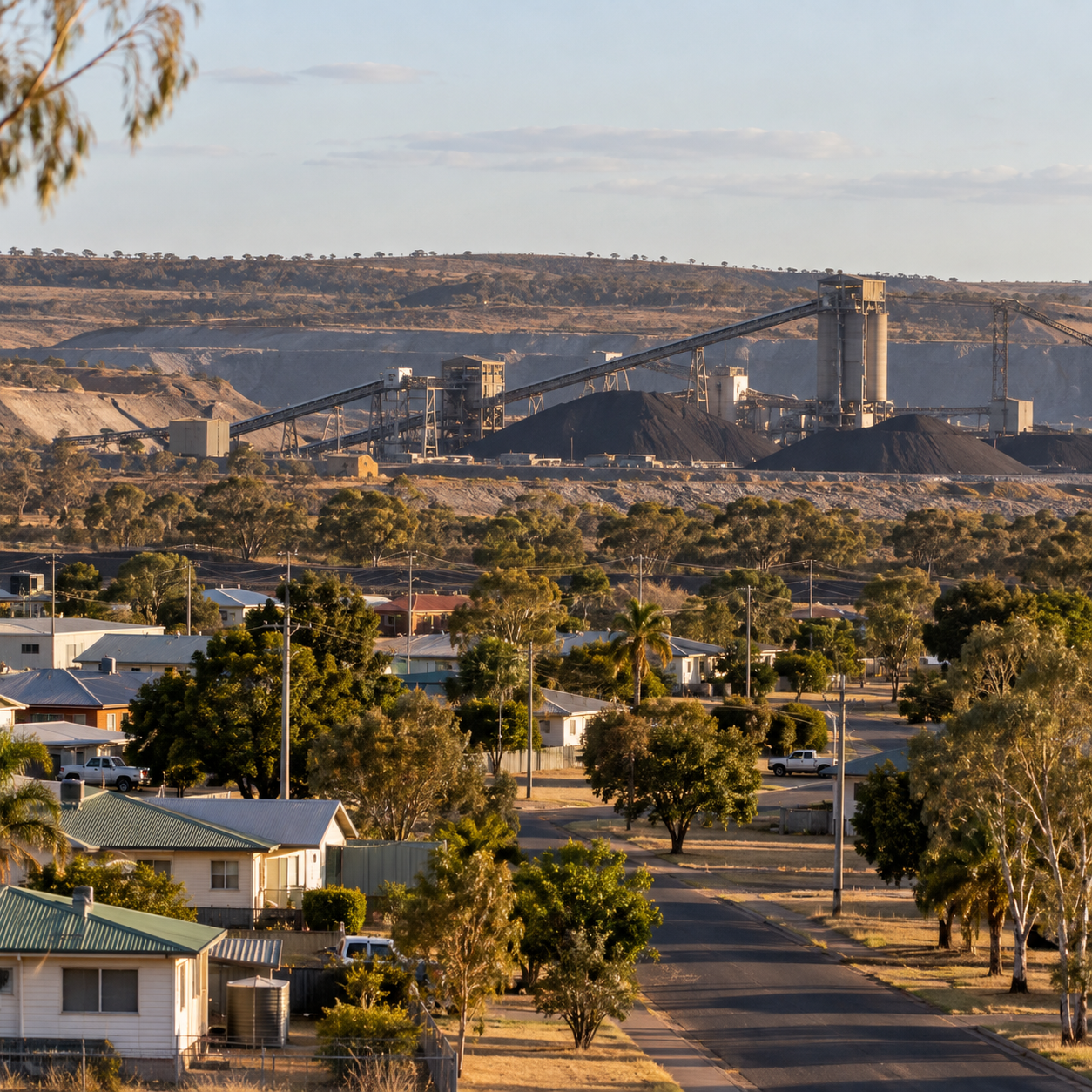
Glenden, about 160 kilometres west of Mackay, was built in the 1980s to house mine workers. Its future became increasingly uncertain as the Newlands mine moved toward closure and the community faced the prospect of losing the workforce that had supported local homes, shops and services.
In 2023, the former Labor government legislated a staged plan requiring QCoal’s Byerwen mine to move workers from a mining camp into Glenden. The scheme was intended to put a new population base into the town rather than allow it to empty as the older mine wound down.
The 2023 framework set progressive accommodation targets. It provided for 10 per cent of the Byerwen workforce to be accommodated in Glenden in the first stage, then 25 per cent, 50 per cent and 75 per cent over later stages, before the full workforce requirement was due to take effect from 31 March 2029. At least part of the workforce was to live in residential dwellings rather than simply another camp-style arrangement.
Those dates had already been adjusted. Resources Minister Dale Last delayed elements of the transition last year, citing problems with water infrastructure and the practical readiness of the town.
The new Mineral Resources and Other Legislation Amendment Bill 2026 goes further. The government says it will repeal the Byerwen worker-accommodation obligations and replace the previous approach with a market-led process for Glenden’s future.
Registrations of interest are being sought for houses, commercial buildings, land parcels and potentially a lease covering the town. The government says the process is intended to attract new investment and find uses for assets that do not depend on compelling a single mine workforce to relocate.
Isaac Regional Council Mayor Kelly Vea Vea has criticised the abrupt change, saying the council and community were not prepared for the legislation and warning that the accommodation rule was the main legal mechanism underpinning Glenden’s population strategy.
From the council’s perspective, the risk is straightforward. A town needs enough residents to sustain a school, shops, health services, sport, community organisations and basic infrastructure. If the population falls below a critical level, each service becomes harder to justify and each departure can make the next one more likely.
The state government’s argument is different. Mr Last told parliament the earlier laws were introduced without enough consultation or consideration of water, services, worker fatigue and the practical effect on the community. The government says a forced relocation model is not the right long-term solution.
Those are competing policy judgments rather than settled facts about which model will succeed. Requiring mine workers to live in town may support population numbers, but it also constrains where workers and companies can arrange accommodation. A market-led process may attract different industries or residents, but there is no guarantee private demand will be strong enough to replace a mine workforce.
Ownership arrangements add another layer. Glenden sits on land associated with the Newlands mining operation, which is owned by Glencore after it acquired the assets in 2013. The town’s housing and infrastructure history is therefore closely tied to the resources sector rather than being a conventional freehold town that grew independently over generations.
That makes transition planning unusually important. When a mine closes, the economic effect is not limited to jobs at the pit. Housing occupancy, retail turnover, school enrolments and local-government service demand can all fall at once.
Glenden has spent years trying to avoid that outcome. The 2023 legislation was one attempt to use the nearby Byerwen operation as an anchor for a new phase of the town’s life. The 2026 bill represents a clear shift away from that approach.
The expression-of-interest process could produce several outcomes. Individual homes and commercial properties could attract buyers; an operator could seek to lease a larger group of assets; or another industry could identify the town’s existing housing and infrastructure as useful for a new project.
But an expression of interest is not the same as a completed investment. The strength of the process will only become clear when the government publishes the level of interest, the conditions attached to the assets and any credible proposals that proceed to negotiation.
Residents will also want clarity about essential services during the transition. A town cannot wait indefinitely for a future investor if water, waste, roads, emergency response, health access or schooling become uncertain in the meantime.
The government has pointed to water infrastructure as one reason the previous relocation timetable was problematic. That concern makes it important to identify who is responsible for upgrades and ongoing service costs under any new ownership or leasing model.
For mine workers, the debate also involves fatigue and commuting. Resources companies commonly argue that accommodation close to a mine can reduce travel time and simplify rostered operations. Regional councils counter that fly-in, fly-out or camp-based workforces can extract value from an area without sustaining nearby towns.
Both concerns can be real. The policy question is how to balance worker safety and operational efficiency with the economic survival of resource communities that were created to support mining in the first place.
The proposed repeal still has to move through Queensland’s parliamentary process. Until that occurs, it is inaccurate to describe the workforce requirement as already abolished or Glenden as destined to close.
Likewise, the council’s warning of a potential ghost town is a statement of risk, not a prediction that has already come true. People continue to live in Glenden, and the government is actively seeking alternative uses for the town’s assets.
What has changed is the policy foundation. The previous plan relied on a legal obligation to bring Byerwen workers into Glenden over time. The new plan relies on voluntary investment and asset transactions to create a viable future.
The next milestones will therefore be the progress of the bill, the response to the registrations of interest and the detail of any proposals that emerge. Those steps will show whether a market-led transition can deliver a stable population and service base before the mining transition removes more of the town’s traditional economic support.