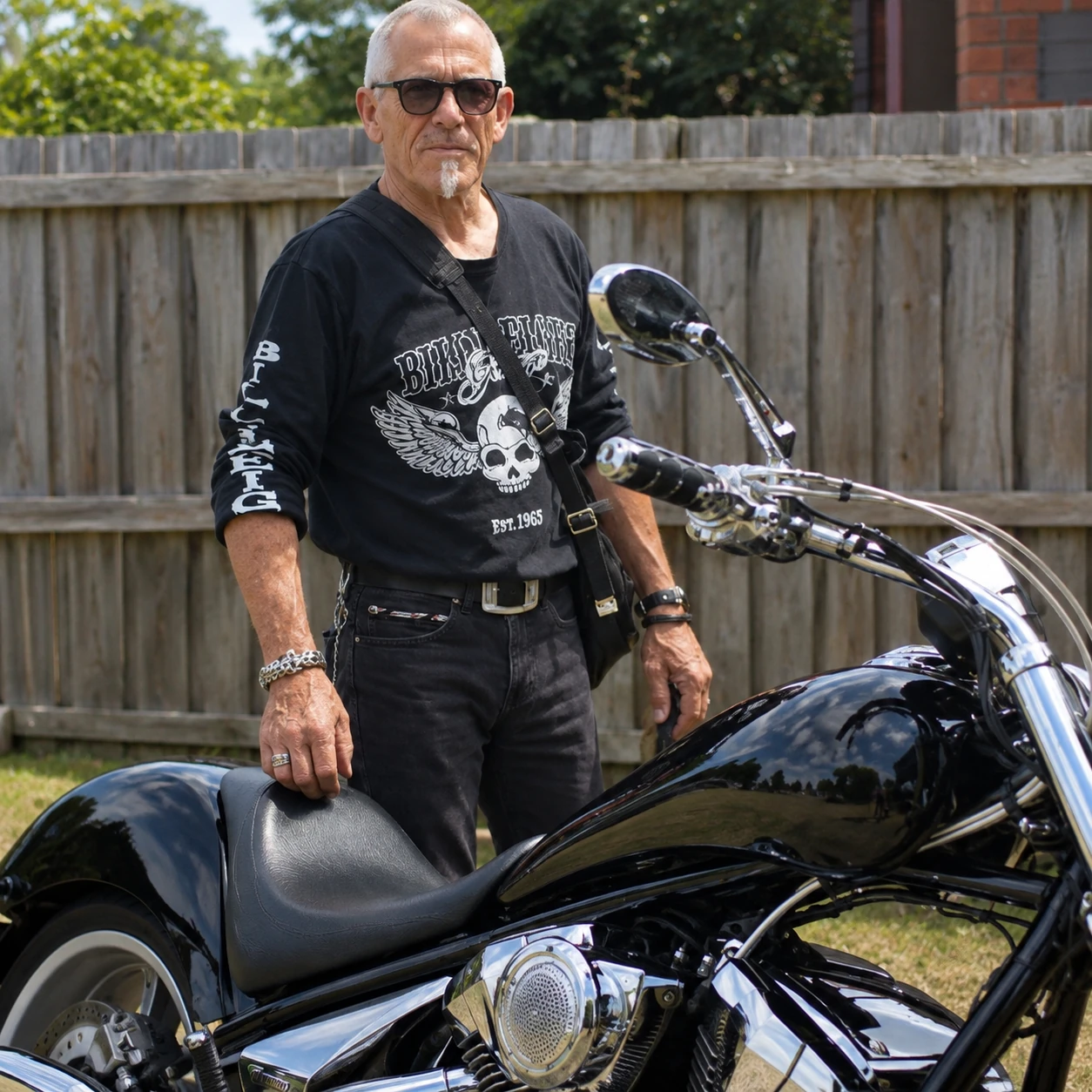
Peter “Tiki” Mason, a 71-year-old Ballarat motorcyclist and president of the Eureka Social Riders Club, has been remembered as a generous and deeply respected figure after he was killed in a crash on the Western Highway near Trawalla.
Victoria Police said emergency services were called to the Western Highway near Trawalla Road just before 12.50pm on Sunday after reports that a motorcycle had struck a pothole and lost control. Mason, from Ballarat, died at the scene.
Police have said the exact circumstances of the crash remain under investigation, an important qualification as public anger grows over the condition of the road. Friends who were riding with Mason have said they believe the pothole was the decisive factor and have rejected suggestions that excessive speed caused the crash.
Mason was widely known in Victoria’s motorcycling community. Friends have described him as an “absolute legend”, a talented airbrush artist, a proud family man and a rider who made a point of welcoming others into the community.
He was also a grandfather and the president of the Eureka Social Riders Club, a Ballarat-based group whose members have been left devastated by his death.
The crash has become a focal point in a much wider argument about the state of Victoria’s road network. It occurred only days after the Victorian Auditor-General reported that a large proportion of state-controlled roads were in poor or very poor condition, intensifying criticism of maintenance standards.
According to recent reporting, about 48 per cent of the state road network was rated poor or very poor in 2024. That finding has added urgency to complaints from motorists, freight operators, regional communities and local advocacy groups who say potholes and deteriorating surfaces have become a persistent safety problem.
The Western Highway is particularly important because it is a major freight and passenger route connecting Melbourne with western Victoria and South Australia. Heavy traffic, weather damage and years of maintenance pressure have left some stretches in visibly poor condition.
Local campaigners have argued for stronger and more consistent investment rather than repeated emergency patching. The Western Highway Action Committee has said the condition of the road has been a longstanding concern and that Mason’s death should force governments to confront the consequences of allowing key infrastructure to deteriorate.
Friends of Mason have been even more direct. One fellow rider said he believed the Victorian government had “blood on its hands”, reflecting the anger among people who had repeatedly raised concerns about potholes and road quality.
That accusation is a political and personal judgement, not a legal finding. Police are still investigating the crash, and establishing legal responsibility would require evidence about the road defect, maintenance history, warnings, riding conditions and the precise sequence of events.
But the public-policy question is broader than liability in one case. Roads are a basic safety system, and governments are responsible for inspection, maintenance and repair programs designed to reduce foreseeable risks.
Motorcyclists are particularly vulnerable to surface defects that may be inconvenient for a car but catastrophic for a bike. A deep pothole, loose gravel, broken edge or sudden change in road level can destabilise a motorcycle almost instantly, leaving the rider with little protection if control is lost.
That difference is why road condition matters so much to rider groups. Motorcyclists often scan the surface continuously for hazards, but visibility, traffic position and the speed of approach can make some defects impossible to avoid safely.
Reports from riders travelling with Mason say the group was already conscious of the poor road and was travelling cautiously. Those accounts will form part of the wider understanding of what happened, although investigators will determine the official findings.
The tragedy has also placed the Victorian government’s road repair program under renewed scrutiny. Premier Ben Carroll has pointed to a $352 million plan intended to repair hundreds of thousands of potholes and improve maintenance across the network.
The government has also promoted changes to the way road maintenance is delivered, including bringing some work back in-house and prioritising repairs in areas where deterioration is considered most urgent.
Critics say those measures are overdue and argue that the scale of the problem shows earlier maintenance spending was inadequate. The political pressure is likely to intensify as road safety becomes an issue ahead of the state election.
Carroll has expressed condolences to Mason’s family and said he accepts overall responsibility as premier for the government’s performance on road safety. His response has nevertheless drawn criticism after he initially said he was the premier, not the roads minister, when pressed on operational details.
For Mason’s family and friends, however, the political debate is secondary to the loss of a man they say was central to their lives.
Tributes have described him as humble, artistic and generous, someone who used his skills and time to help others and who took pride in the motorcycling community he helped lead.
Friends have also spoken about the shock of seeing an experienced rider die in circumstances they believed should never have occurred. The fact that the reported hazard was an ordinary pothole has made the death feel especially confronting.
Road fatalities are often discussed in terms of driver behaviour, speed, alcohol, fatigue and vehicle safety. Infrastructure condition is another part of that equation, particularly on high-speed regional roads where a surface defect can have severe consequences.
Maintenance systems are designed around inspection cycles, risk ratings and repair priorities, but those systems are only effective if hazards are identified and fixed before they become dangerous. Questions will now be asked about whether the pothole near Trawalla had been reported previously, how long it had been present and what maintenance work had been carried out in the area.
Those details will be important before firm conclusions are drawn about responsibility. They may also influence whether the crash leads to changes in inspection frequency, repair standards or funding priorities.
Mason’s death has already become more than a single road incident because it has connected a personal tragedy with a broader problem motorists can see for themselves.
For regional Victorians, deteriorating roads affect more than comfort. They influence travel times, vehicle damage, freight costs, emergency access and safety. For motorcyclists, the margin for error can be much smaller.
The case may also sharpen scrutiny of how governments communicate road risk. When communities repeatedly report hazards but see only temporary patches or delayed works, confidence in the maintenance system can erode long before an official audit confirms broader deterioration. Restoring that confidence requires transparent information about inspections, priorities, repair timetables and the standards used to decide when a road defect becomes an urgent safety issue.
The official investigation will determine what can be established about the crash itself. The political debate over Victoria’s roads will continue regardless, because the condition of the network is documented and the public concern is already widespread.
What should not be lost in that argument is the person at the centre of the story. Peter “Tiki” Mason was not simply a statistic in a road maintenance debate. He was a grandfather, club president, artist, friend and experienced rider whose death has left a community grieving.
For those who knew him, the most urgent demand is simple: that the circumstances of his death be fully understood and that any lessons capable of preventing another family from experiencing the same loss are acted on.