Federal Transport Minister Catherine King is facing fresh scrutiny after disclosing lifetime Qantas Platinum frequent flyer status, a benefit that carries premium lounge access, priority treatment and other long-term travel privileges.
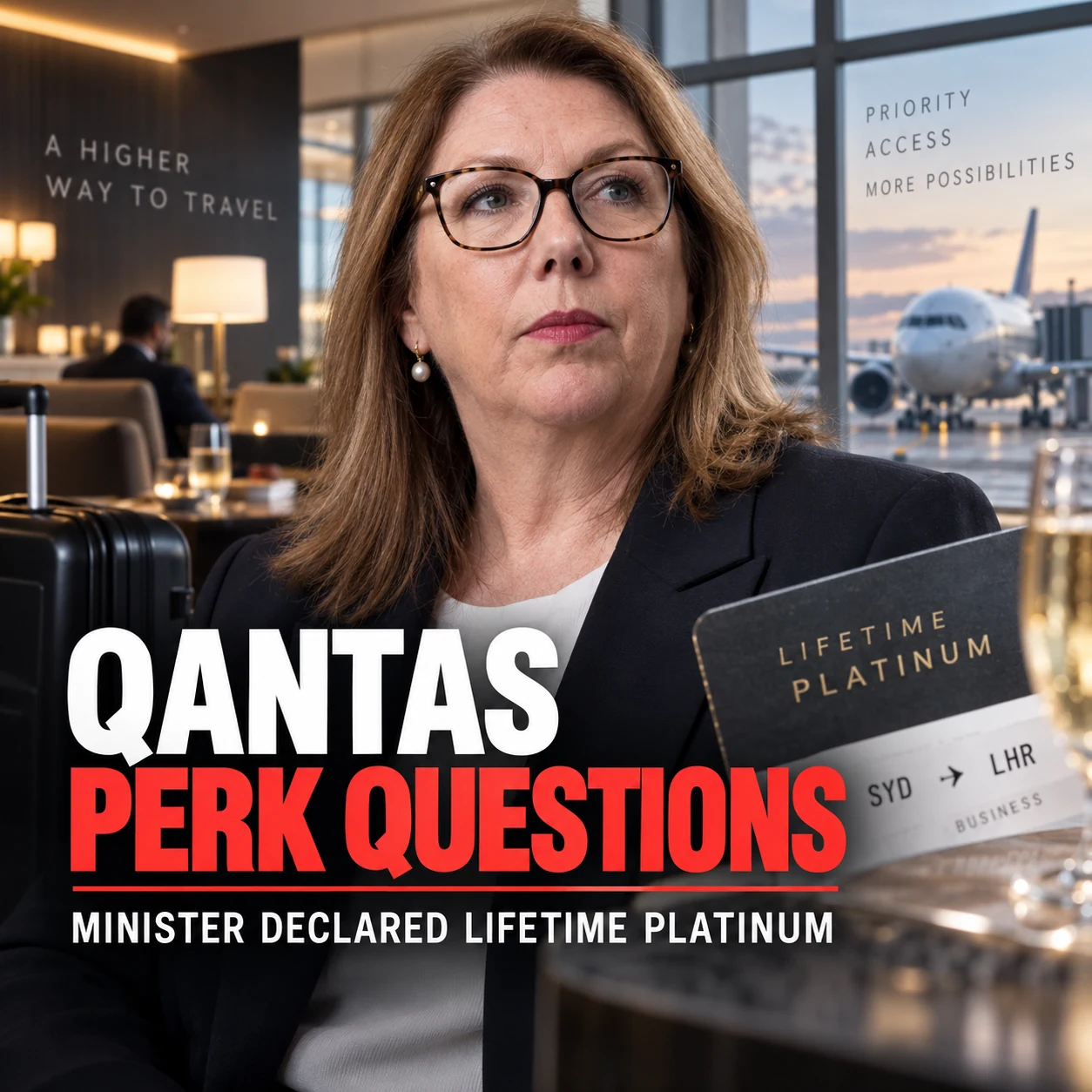
The disclosure has revived a familiar argument in Canberra: where should the line sit between travel benefits earned or provided through extensive official travel and perks that can create a perception of special access to a company overseen by the government?
Guardian Australia reported on Tuesday that King had added the lifetime status to her register of interests on Monday afternoon. Housing Minister Clare O’Neil defended her colleague, saying federal politicians travel an extraordinary amount and stressing that King had declared the benefit publicly. Deputy Prime Minister Richard Marles also argued that King’s long parliamentary career and extensive travel should be kept in context.
There is no suggestion in the available reporting that King breached a disclosure rule by holding the status. The current controversy is instead centred on transparency, value and perception, especially because King’s ministerial responsibilities include aviation policy.
Qantas describes Lifetime Platinum as one of the highest levels in its frequent flyer program. Under the airline’s published program rules, a member ordinarily needs 75,000 lifetime Status Credits to qualify. The benefits include access to Qantas International First lounges and domestic Business lounges, priority international upgrades, priority baggage, a 100 per cent Status Bonus on eligible Qantas, Jetstar and American Airlines flights, oneworld Emerald status and access to a dedicated Qantas VIP Service Team.
Those benefits can continue for life, which is why the disclosure has attracted more attention than an ordinary one-off upgrade or lounge visit. For a senior minister whose portfolio touches aviation, airport policy and airline competition, the optics are especially sensitive even when a benefit is declared.
King has been the federal member for Ballarat for more than two decades and has spent long periods travelling between Victoria, Canberra and other parts of the country. Her ministerial colleagues have pointed to that workload in defending the status, arguing that frequent travel is an unavoidable part of the job rather than evidence of special treatment.
The broader issue is not new. Airline lounge memberships and status benefits have appeared on parliamentary registers for years, and both Qantas and Virgin Australia have historically offered forms of lounge access or elite recognition to politicians. Public concern tends to rise when those benefits intersect with major policy decisions affecting airlines, airports or competition.
King herself has previously attracted political scrutiny over aviation decisions, including the government’s 2023 refusal to approve additional Qatar Airways services into Australia. That decision was widely debated because extra international capacity can affect competition and airfares, and critics argued the outcome benefited Qantas. The government rejected claims that the decision was made to protect the airline.
The latest Platinum disclosure does not establish any connection between the status and a past or future policy decision. But it gives opposition parties, crossbenchers and transparency advocates another reason to focus on how ministers manage perceived conflicts of interest.
That distinction matters. A conflict of interest can be actual, potential or perceived. A declared benefit may be fully permitted while still raising questions about how the public views the relationship between a regulator, minister or policymaker and a major commercial player.
O’Neil’s defence of King focused heavily on the disclosure itself. Her argument was that transparency is the key safeguard: if a benefit is properly recorded, voters and parliament can judge it in the open. Critics are likely to respond that disclosure is only one part of the equation and that senior office-holders should also consider whether some benefits are appropriate to accept at all.
The value of lifetime status is difficult to reduce to a simple dollar figure because it depends on how often a person flies and which benefits they use. Lounge access, baggage priority, upgrade priority and status bonuses can be worth far more to a frequent traveller than to someone who rarely boards a plane. The fact that the benefit lasts indefinitely adds to its significance.
Qantas’ own published rules underline how difficult Lifetime Platinum is for an ordinary customer to reach. The 75,000 Status Credit threshold is far above the annual amount needed to hold standard Platinum status. That makes lifetime recognition rare and helps explain why the disclosure quickly became a political talking point.
For King, the immediate test is likely to be whether the issue remains an optics controversy or grows into a wider debate about ministerial standards. So far, the available reporting points to a declared benefit and political criticism rather than an allegation of unlawful conduct.
The episode may nevertheless add momentum to calls for clearer, more consistent rules around airline benefits for federal politicians. One approach would be to rely on existing disclosure requirements. Another would be to restrict certain forms of corporate hospitality or lifetime status for ministers with direct responsibility for the relevant industry.
Any reform would need to distinguish between travel arrangements necessary for parliamentary work and private benefits that continue long after a politician leaves office. That is the harder policy question now sitting behind the headlines.
One distinction is important in assessing the latest controversy. Qantas Lifetime Platinum is not the same product as the airline’s invitation-only Chairman’s Lounge. Qantas says Lifetime Platinum is awarded automatically when a frequent flyer reaches 75,000 eligible lifetime Status Credits. Once that threshold is reached, the member keeps Platinum recognition for life under the program rules, even if their later flying falls away.
That makes the argument more complicated than a simple claim that an airline executive personally handed a minister a private club membership. The published Qantas rules describe a defined loyalty milestone based on eligible travel. The political question is why a benefit generated through years of travel — much of it inevitably associated with parliamentary and ministerial work for a long-serving MP — should still be treated carefully when the person receiving it is responsible for national aviation policy.
The benefits are substantial. Qantas says Lifetime Platinum members receive access to International First and Domestic Business lounges, priority international upgrades, priority baggage, a 100 per cent Status Bonus on eligible Qantas, Jetstar and American Airlines flights, oneworld Emerald status and access to a dedicated VIP Service Team. For a frequent traveller, those advantages can make a meaningful difference to both the cost and convenience of travel over many years.
At the same time, Qantas does not attach a straightforward retail price to Lifetime Platinum. Unlike a normal annual lounge membership, it is not something an ordinary customer can simply purchase for a published fee. The qualifying threshold is built around Status Credits accumulated through eligible travel, which means the value depends on an individual’s flying patterns and how heavily they use the privileges once the lifetime tier is achieved.
That distinction matters for public debate about the word “gift”. News reporting on King’s disclosure has used that language because the status appears on her interests register as a benefit from Qantas. Qantas, however, says the lifetime tier is automatically awarded once the threshold is reached. Both facts can be relevant at the same time: a politician can disclose a benefit for transparency purposes even where the airline says the benefit arose under ordinary program rules rather than through a discretionary invitation.
The episode also sits inside a much older argument about airline access to political decision-makers. In 2024, reporting on federal interests registers found that the overwhelming majority of federal politicians had declared Qantas Chairman’s Lounge memberships, while some crossbench MPs later returned or declined elite airline benefits amid public criticism. That debate was not limited to one party. Politicians across Labor, the Coalition and the crossbench have accepted airline lounge memberships, upgrades or status-related benefits over many years.
The reason the issue keeps returning is structural. Airlines operate in a sector heavily shaped by government decisions: international route access, airport regulation, consumer protections, competition policy, security requirements and infrastructure all involve public authorities. Ministers and senior officials also travel constantly, which means they naturally have much more contact with airlines and loyalty programs than the average Australian.
Those two realities pull in opposite directions. Frequent travel makes elite status unsurprising for senior politicians. But the more valuable and permanent the benefit becomes, the stronger the argument for clear disclosure and for rules that can distinguish normal loyalty rewards from discretionary corporate hospitality.
For King, the disclosure itself is an important fact. There is no reported finding that she concealed the status or breached the register rules. Her colleagues have relied on that transparency in defending her, arguing that the public can see the benefit and judge it for themselves.
Critics are likely to say the harder question begins after disclosure. A minister may comply with the register and still face a perceived-conflict problem if the benefit comes from a company affected by decisions within the minister’s portfolio. Perceived conflicts do not establish corruption or improper decision-making, but they can damage confidence if the public believes commercial access and government power are too closely connected.
That is particularly relevant in aviation because major policy decisions can shift large amounts of revenue between airlines. The previous debate over Qatar Airways’ request for additional Australian services showed how quickly aviation policy can become politically charged when one carrier is seen as benefiting from a government decision. The government rejected suggestions that its decision was made to favour Qantas, and the Lifetime Platinum disclosure does not provide evidence connecting the two matters.
Still, the recurrence of airline-perk controversies suggests parliament may eventually face a broader policy choice. It can continue relying primarily on disclosure registers, allowing voters and media to assess benefits after they are declared. Or it can impose tighter rules on some categories of airline hospitality and loyalty advantages for ministers with direct responsibility for the sector.
Any tighter rule would have to be drafted carefully. A blanket ban on frequent-flyer status could create practical problems where status is earned automatically through legitimate travel. A narrower rule focused on discretionary invitations, complimentary upgrades or benefits unavailable to ordinary customers might be easier to administer, but it would not remove every perceived conflict.
There is also a difference between an office-holder using a benefit while in government and retaining it after leaving politics. Lifetime status, by definition, continues beyond the period in which the person holds ministerial power. That makes the benefit unusual: its political sensitivity arises now, while its practical value can continue for decades.
For Australians watching the aviation sector, the practical issue is straightforward: the Transport Minister’s relationship with major airlines needs to withstand not only legal and disclosure tests, but public confidence tests as well. King has disclosed the Qantas status. Qantas says the tier is automatically earned at 75,000 lifetime Status Credits. The next phase of the debate will be about whether those two facts are enough to settle concerns over valuable airline benefits for the politicians who oversee the industry.