Anthony Albanese has declared himself a “proud houso” in an emotional defence of his late mother after Pauline Hanson criticised her decades in public housing, with the One Nation leader now offering a qualified apology after days of bipartisan condemnation.
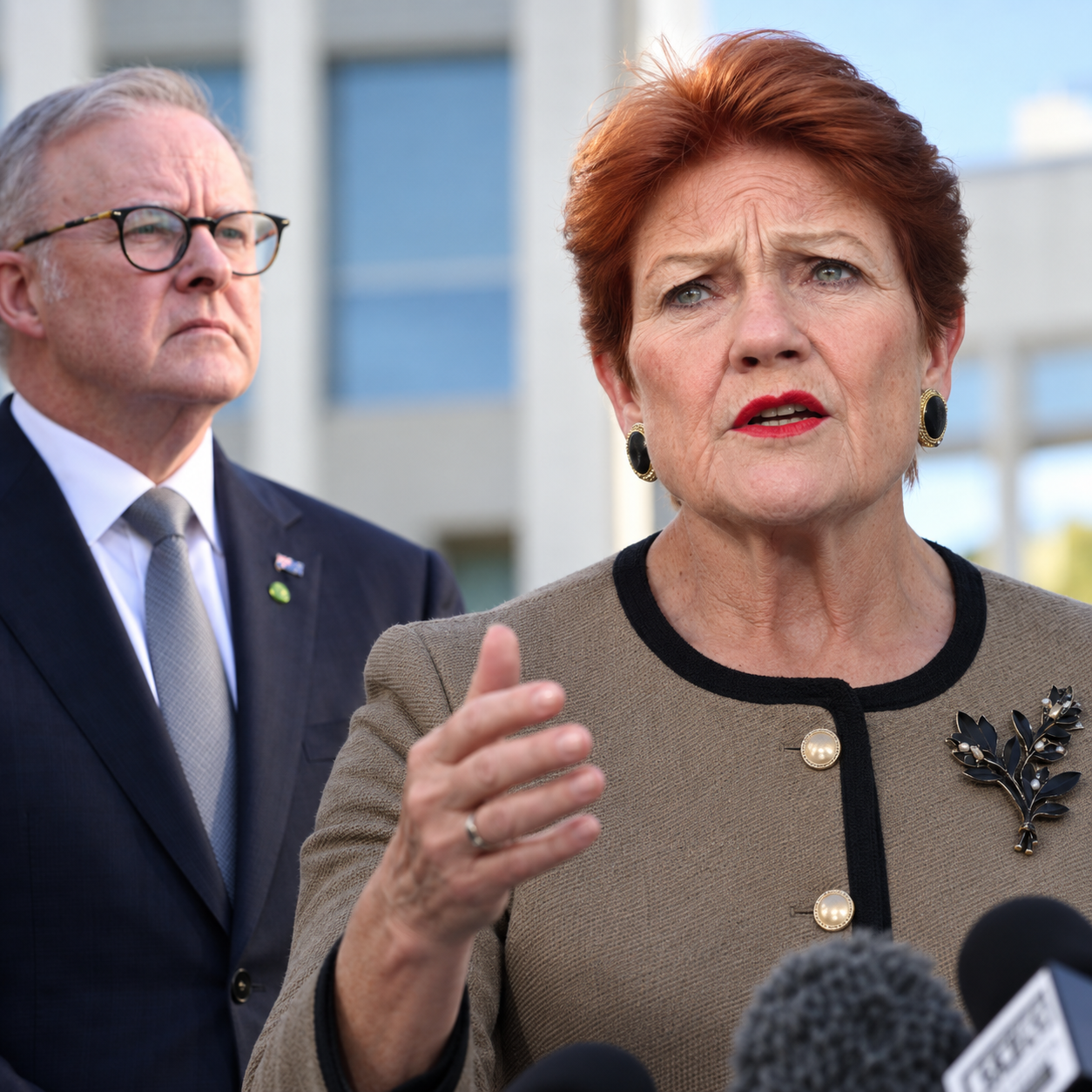
The Prime Minister said Hanson was entitled to criticise him and his government but had crossed a line by turning his mother, Maryanne, into a target in a political argument over social housing.
“If Pauline Hanson wants to criticise me then that’s fine,” Albanese told reporters.
“But my mother was way out of Pauline Hanson’s league. Way out of it.”
The confrontation began after comments Hanson made during a February podcast interview resurfaced over the weekend.
Hanson had criticised Albanese for repeatedly referring to his childhood in public housing and described that political narrative as “pathetic”.
She also questioned why his mother had remained in housing commission accommodation for decades.
Albanese has previously said Maryanne lived in the same public housing property in which she had been born for all 65 years of her life.
For Hanson, that was evidence of a system operating in the wrong way.
“Housing commission houses should not be there for people to live in them for 30, 40 years,” she said in the earlier interview.
“You have been given a hand up, move it on to the next ones coming through.”
It is a legitimate policy proposition to debate whether scarce social housing should be regularly reassessed and whether households able to support themselves privately should eventually make way for people in greater need.
But Albanese strongly rejected the implication that his mother’s lengthy tenancy showed she had taken advantage of the system.
He also rejected Hanson’s suggestion that he routinely complains about where he came from.
“Nothing could be further from the truth,” he said.
“I’m proud to be a houso and I’m proud of the community in which I grew up.”
Albanese was raised by Maryanne as a single child in council housing in Sydney’s inner west.
His official biography describes a household supported by a mother living on a disability pension and struggling with serious health problems.
Maryanne suffered severe rheumatoid arthritis, which progressively damaged her joints and limited her ability to work.
Albanese has recalled that she once cleaned offices overnight but eventually became so affected by the disease that everyday tasks became extremely difficult.
“She was someone who had a tough life,” he said.
He described periods when she could barely use a knife and fork or walk down stairs.
Yet his defence of her focused less on hardship than on character.
“She was compassionate, not uncaring. She was generous, not mean. And she was kind, not nasty,” Albanese said.
He recalled her belief that no matter how difficult her own circumstances became, “there’s always someone worse off than yourself”.
“She never complained. She never denigrated anyone. She respected everyone,” he said.
“And I grew up in a community that looked after each other.”
Maryanne died in 2002 at the age of 65.
For Albanese, attacking her more than two decades later turned an ordinary argument about housing policy into something personal.
He contrasted what he regarded as his mother’s generosity with the tone of Hanson’s comments.
“Tell you what’s weakness? Nastiness. Nastiness and spitefulness,” he said.
“I am stunned at these comments.”
The comments triggered criticism from politicians who rarely agree on much else.
Trade Minister Don Farrell described Hanson’s remarks as “appalling” and called on her to apologise.
Farrell said political figures must expect criticism directed at themselves but argued parents, particularly those who are dead and cannot defend themselves, should not be dragged into partisan attacks.
“Attacking somebody’s mother, I think, is appalling,” he said.
He also accused One Nation of bringing a “bitterness” into Australian politics and said Hanson’s demand for respect from other parliamentarians was difficult to reconcile with her own treatment of Albanese’s family.
Liberal frontbencher Andrew Hastie also condemned the remarks.
Hastie has spent the past week in a bitter confrontation of his own with Hanson over a One Nation cartoon that repeatedly labelled the former SAS captain a “traitor”.
But on the Albanese dispute he drew a straightforward boundary.
“I reckon mums you leave out of politics,” Hastie said.
He said the episode was another reason Australians should question whether Hanson was fit to become prime minister.
That criticism is significant because Hastie is no political ally of Albanese.
He routinely attacks Labor over immigration, economic policy, national security and energy.
His intervention therefore turned what might otherwise have been dismissed as a Labor grievance into a broader argument about the acceptable limits of political combat.
Hanson initially resisted demands for an apology.
On Tuesday, however, she softened her position.
Speaking to reporters, Hanson maintained she had been discussing housing policy rather than personally denigrating Maryanne.
“I don’t think my comments were derogatory towards his mother at all,” she said.
“I was referring to housing commission at that time.”
She then added: “So if he’s taken offence to it, well, I’m sorry for that.”
It was a qualified apology rather than a withdrawal of the argument.
Hanson continues to maintain that social housing should not automatically become a home for life while other families remain on waiting lists.
That underlying question deserves more scrutiny than the personal feud alone.
NSW does face an acute shortage of social housing.
As of July 31, there were 70,244 applicant households on the NSW Housing Register.
Of those, 13,776 were priority-approved and 56,468 were general applicants.
In many locations, waiting periods are measured in years.
Those numbers mean governments inevitably face difficult allocation decisions.
A home occupied by one household is a home unavailable to somebody else.
But that does not necessarily mean long-term tenancy is evidence of a policy failure.
Some people need public housing temporarily after losing work, escaping violence or experiencing a sudden financial crisis.
Others remain poor, disabled or medically vulnerable for much longer.
For those households, stable social housing can be a permanent protection against homelessness rather than a short-term bridge to the private market.
Maryanne’s circumstances are important in that context.
There has been no evidence presented in the political dispute that she became financially comfortable and remained in subsidised housing despite having the means to leave.
The established picture is of a single mother with severe rheumatoid arthritis who depended on a disability pension.
That makes Hanson’s use of the 65-year tenancy as a stand-alone statistic potentially misleading.
The length of a tenancy says little about whether the tenant continued to need the home.
NSW policy is also moving in a direction significantly different from the one Hanson advocates.
For years, many public housing tenants were placed on fixed-term leases of two, five or 10 years, with their circumstances reviewed before the tenancy was renewed.
Homes NSW is now phasing that system out.
Current government information says that when existing fixed-term public housing leases expire, they will transition to periodic, or continuous, leases.
Those leases have no predetermined end date.
The NSW government says the change is intended to give tenants more certainty and allow families to remain connected to schools, employment, medical care and their communities without repeatedly worrying about the expiry of a tenancy.
That does not mean social housing tenants are exempt from ordinary tenancy obligations.
Serious breaches, non-payment and other lawful grounds can still have consequences.
Nor does it mean governments should stop building new social housing or finding ways to help households capable of moving into other accommodation.
But it does demonstrate that long-term security itself is increasingly being treated as a policy objective rather than a flaw.
That principle lies at the heart of Albanese’s defence of his mother.
He has never portrayed the Camperdown council home simply as cheap accommodation.
He presents it as the source of stability that allowed a disabled single mother to raise a child without the constant threat of losing their home.
That child later became prime minister.
“My mum raised me in public housing as a single parent,” Albanese says in his official biography.
“Mum’s aspiration was that my life would turn out better than hers.”
It is a powerful political story, and opponents are entitled to scrutinise the policies Albanese attaches to it.
They are also entitled to argue that social housing shortages require tougher decisions about eligibility and allocation.
But those are policy arguments.
The controversy arose because Hanson moved from debating the system to using Maryanne’s personal history as evidence of what she believed was wrong with it.
That approach also creates a political tension for One Nation.
Hanson increasingly presents her party as the defender of Australians under economic pressure — people unable to afford homes, struggling with rent or dependent on public services.
Public housing tenants, disability pensioners and single parents are themselves among the Australians most exposed to those pressures.
Hanson’s broader point that people waiting for a home deserve fairness remains valid.
But fairness to those waiting does not require treating every long-term tenant as somebody who has overstayed their welcome.
Need can last a lifetime.
For Albanese, that is precisely what happened to his mother.
Hanson’s qualified apology may lower the political temperature, but it has not resolved that substantive disagreement.
Nor has it changed Albanese’s view of the original remarks.
He made clear that he regarded growing up in public housing not as an embarrassment to overcome but as part of who he is.
“I’m proud to be a houso,” he said.
He was equally unequivocal about the woman who raised him.
Hanson can criticise the Prime Minister as fiercely as she chooses.
On his mother, Albanese has made clear he believes she picked the wrong target.