Anthony Albanese has declared himself a “proud houso” in an emotional defence of his late mother after Pauline Hanson criticised her decades in public housing, with the One Nation leader now offering a qualified apology following days of bipartisan backlash.
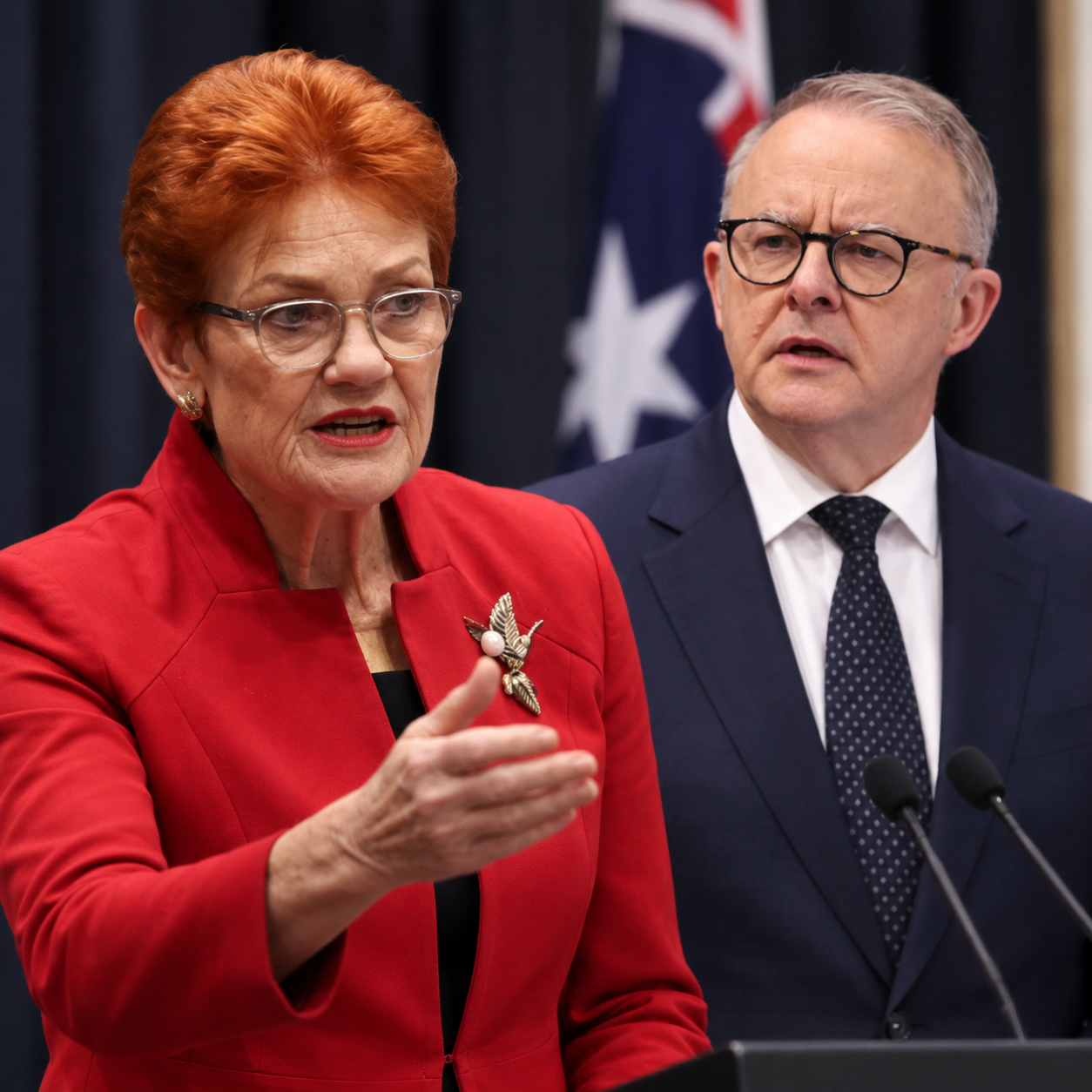
The Prime Minister said Hanson was free to attack him and his political record but had crossed a line by drawing his mother, Maryanne, into the fight.
“If Pauline Hanson wants to criticise me then that’s fine,” Albanese said.
“But my mother was way out of Pauline Hanson’s league. Way out of it.”
His comments followed the resurfacing of a February podcast interview in which Hanson criticised Albanese for regularly talking about his childhood in a public housing home in Sydney’s inner west.
Hanson described those references as “pathetic” and questioned why Maryanne had remained in housing commission accommodation for decades.
Albanese has previously said his mother lived in the same public housing property in which she was born for all 65 years of her life.
Hanson argued that was too long.
“Housing commission houses should not be there for people to live in them for 30, 40 years,” she said.
Her argument was that public housing should provide struggling households with a temporary “hand up” before the property is made available to another person in need.
Albanese rejected the suggestion that he had ever complained about the home that gave him and his mother stability.
“Nothing could be further from the truth,” he said.
“I’m proud to be a houso and I’m proud of the community in which I grew up.”
He said he was equally proud of his mother.
Maryanne raised Albanese alone in Camperdown after becoming pregnant in the early 1960s, at a time when having a child outside marriage carried substantial social stigma.
Albanese has described how his mother met his Italian father, Carlo, while travelling overseas but returned to Australia without him and devoted herself to raising their son.
She initially worked, including cleaning offices at night, before severe rheumatoid arthritis increasingly restricted her ability to earn an income.
The illness badly damaged her joints.
Albanese recalled that as her condition deteriorated she struggled to use a knife and fork and to walk down stairs.
The household relied heavily on her disability pension and the security of public housing.
“She had a tough life,” Albanese said.
But he said she did not respond to hardship by attacking other people.
“She was compassionate, not uncaring. She was generous, not mean. And she was kind, not nasty,” he said.
He said his mother’s outlook was that there was always somebody worse off than herself.
“She never complained. She never denigrated anyone. She respected everyone,” Albanese said.
For the Prime Minister, Hanson’s comments therefore struck at much more than an argument about government housing policy.
They challenged the character of the woman who had raised him and who died in 2002, more than two decades before the controversy erupted.
Albanese contrasted his mother’s values with what he described as the increasingly personal style of Hanson’s politics.
“Kindness isn’t weakness,” he said.
“Tell you what’s weakness — it’s nastiness. Nastiness. And spitefulness.”
The remarks drew condemnation from both sides of federal politics.
Trade Minister Don Farrell called Hanson’s comments “appalling” and urged her to withdraw them.
Farrell said politicians should expect attacks on themselves but their deceased parents should not become targets in partisan arguments.
He also accused One Nation of bringing a bitterness into Australian politics that he regarded as deeply unhealthy.
Liberal frontbencher Andrew Hastie, who has spent the past week in his own bitter confrontation with Hanson, took much the same position.
“I reckon mums you leave out of politics,” Hastie said.
He said the comments were another sign Hanson was not fit to become prime minister.
Hastie’s intervention was notable because he is hardly a political ally of Albanese.
He regularly attacks Labor on immigration, national security, energy and economic policy.
But he argued there should still be limits to political combat.
On Monday, Hastie went further and said Hanson should apologise, describing what he called the growing “MAGA-fication” of Australian politics as toxic and nasty.
Housing Minister Clare O’Neil also joined the calls, describing Hanson’s remarks as callous, cruel and personal.
Hanson initially stood by the substance of her argument.
On Tuesday, however, she offered a limited apology.
She maintained she had been talking about housing policy rather than denigrating Maryanne personally but said: “If he’s taken offence to it, well, I’m sorry for that.”
It was not an unqualified withdrawal of the original criticism.
Hanson continued to defend the proposition that governments should question whether public housing should remain with the same tenant for life.
That question is not inherently illegitimate.
Australia has a severe shortage of social housing and governments must decide how scarce properties are distributed.
As of July 31, 70,244 households were on the NSW Housing Register.
Almost 13,800 of those had been approved as priority applicants.
Waiting times in some areas are measured in years.
Against that backdrop, a political argument that public housing should be concentrated on people in greatest need has obvious appeal.
But the implication that a lengthy tenancy itself demonstrates abuse of the system is much harder to sustain.
Public housing was created partly for households whose need does not disappear after an arbitrary number of years.
Severe disability, old age, poverty and an inability to secure suitable private accommodation can persist for decades.
Maryanne’s circumstances, as consistently described by Albanese, fit squarely within that reality.
She was not a high-income tenant who acquired substantial wealth while refusing to give up a subsidised property.
She was a disabled single mother who relied on a pension and whose chronic illness severely restricted her capacity to work.
There is no evidence presented in the controversy that she had the financial capacity to secure equivalent accommodation privately and simply chose not to do so.
The argument has also arrived just as NSW is moving towards greater rather than lesser security for public housing tenants.
For years, many new Homes NSW tenants were placed on fixed-term leases of two, five or 10 years and could have their eligibility reviewed before renewal.
The state government has now begun phasing those fixed-term arrangements out.
Homes NSW told tenants this year that expiring fixed-term leases will transition to periodic, effectively continuous, leases without a predetermined end date.
The change is part of the Homes for NSW Strategy and is intended to provide greater stability to people living in social housing.
That policy shift does not mean tenants can ignore their tenancy obligations indefinitely or that governments cannot manage public housing stock.
But it reflects a view that housing security can itself improve social outcomes by allowing families to remain connected to schools, work, medical care and community networks.
That policy philosophy is close to the lesson Albanese says he drew from his own childhood.
He has repeatedly argued that public housing did not make him less ambitious.
It gave his family enough security for him to pursue opportunities his mother never had.
His political biography is built around that story.
His mother’s aspiration, he has often said, was simply that her son would have a better life.
“It was because of her that a working class boy from council housing would one day become our country’s Prime Minister,” Albanese says in his official biography.
That history is unquestionably useful to Labor politically.
Opponents are entitled to challenge the policies Albanese associates with it or argue that he invokes his upbringing too often.
They can also debate whether social housing rules should prioritise turnover, long-term stability or some balance between the two.
What made Hanson’s intervention politically dangerous was choosing Maryanne herself as the case study.
The attack allowed Albanese to move the argument away from abstract waiting lists and directly onto the circumstances of one disabled woman.
It also put Hanson in conflict with an important part of One Nation’s own political pitch.
The party increasingly presents itself as the voice of Australians who feel economically insecure, shut out of home ownership or abandoned by the political establishment.
Public housing tenants, disability pensioners and single parents are among the people most exposed to precisely that insecurity.
Hanson’s supporters can reasonably argue that families waiting years for a social home deserve consideration too.
But that argument does not require treating a long-term tenant as undeserving merely because she remained poor or disabled for a long time.
Barnaby Joyce has defended Hanson’s broader position by saying the real issue is whether public housing should be a permanent entitlement when other people are waiting.
Yet that formulation still depends on the circumstances of the tenant.
A person whose income rises substantially and who can comfortably enter the private market presents a different policy question from someone with permanent disability and minimal income.
That difference has been largely lost in the political fight.
For Albanese, the answer is personal as much as ideological.
He says the council home in Camperdown was not an example of dependency trapping his family.
It was the platform that allowed a mother with very little money to provide her child with stability.
That child eventually became prime minister.
Hanson’s qualified apology may take some heat out of the immediate confrontation, but it does not settle the underlying argument over public housing.
Nor does it reverse Albanese’s unusually forceful response.
He has spent decades recounting his mother’s story as an example of how public institutions can change a life.
On Sunday, confronted with the suggestion that she had stayed in public housing too long, he turned that story into a defence rather than an appeal for sympathy.
He was proud of where he came from, he said.
He was proud of the woman who raised him.
And whatever else Pauline Hanson chooses to say about the Prime Minister, Albanese made clear that he will not allow her to define the worth of his mother.