Pauline Hanson is facing renewed criticism from across federal politics after comments she made about Indigenous Australians in a 2025 podcast resurfaced, drawing condemnation from Labor, the Coalition and the crossbench.
The backlash remained active into Tuesday, with senior figures from across the political spectrum continuing to reject the remarks. Indigenous Australians Minister Malarndirri McCarthy called for an apology, while Nationals leader Matt Canavan described the comments as wrong and divisive.
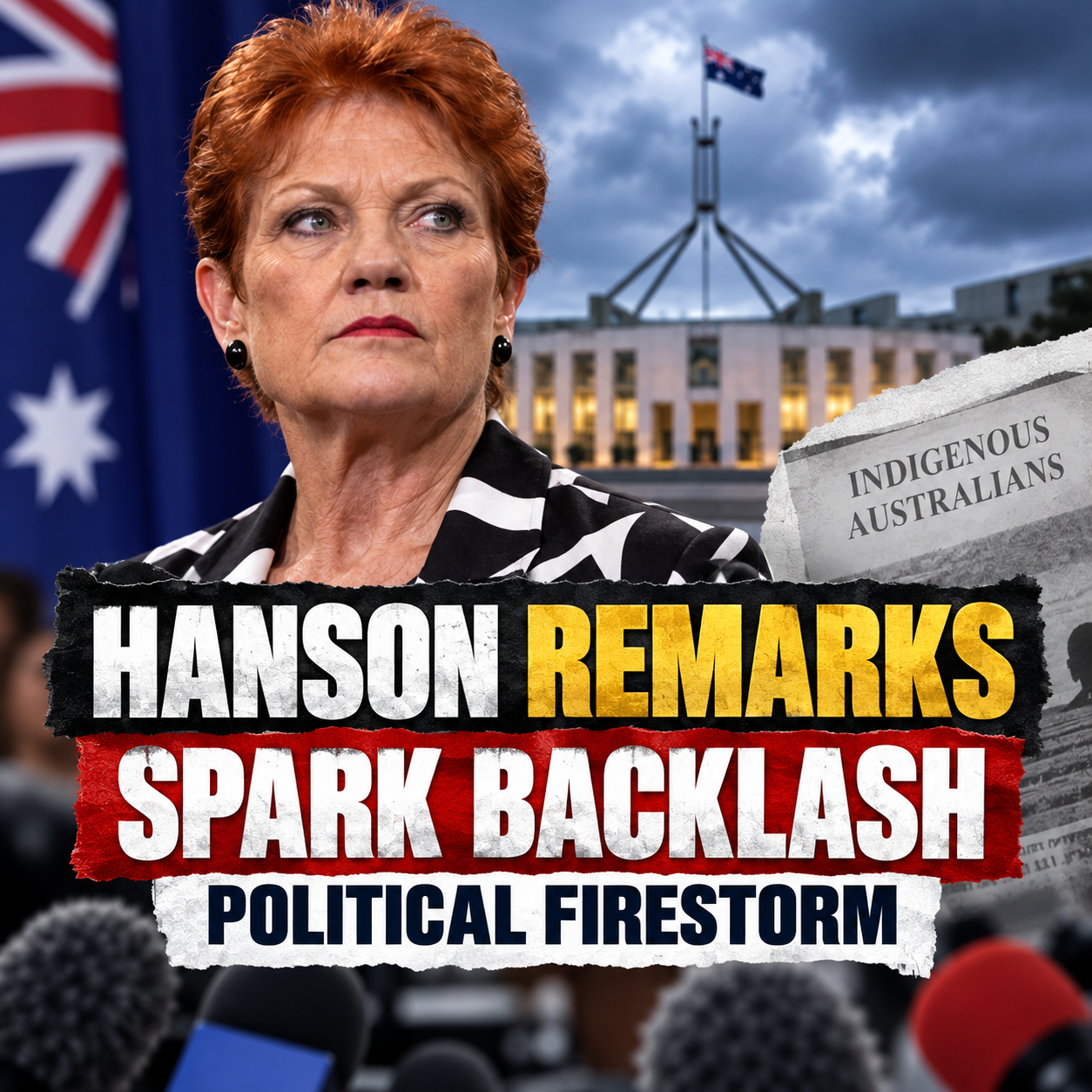
The One Nation leader’s year-old remarks returned to public attention this week after they were circulated again in the media and online. The comments included sweeping claims about Indigenous Australians and their history that senior politicians described as offensive, inaccurate and damaging.
Indigenous Australians Minister Malarndirri McCarthy condemned the remarks as “totally outrageous”, while opposition Indigenous affairs spokeswoman Jacinta Nampijinpa Price also criticised Hanson’s comments, describing them as appalling and reflecting wilful ignorance.
Independent senator Lidia Thorpe joined the backlash and called for stronger national action against racism, arguing that public figures have a responsibility not to spread ideas that demean Aboriginal and Torres Strait Islander people.
The criticism is notable because it crosses normal political divisions. McCarthy, Price and Thorpe frequently disagree sharply on Indigenous policy, constitutional recognition and the direction of federal programs. Their responses to Hanson, however, all rejected the broad characterisation of Indigenous Australians contained in the resurfaced interview.
Hanson has dismissed the renewed controversy as media overreaction to comments made about a year ago. Her response has focused in part on the timing of the coverage, suggesting opponents and journalists are reviving old material rather than responding to a new statement.
That defence does not resolve the central argument. Public comments by elected representatives can remain politically relevant long after they are made, especially when they concern race, national identity or groups that continue to face disadvantage. The renewed attention is therefore less about when the words were spoken than about what they reveal about Hanson’s current political message.
Guardian Australia reported that the podcast comments included a claim portraying Indigenous Australians as historically primitive and suggesting they had achieved little before European settlement. Critics say that framing ignores tens of thousands of years of continuous culture, sophisticated land management, law, trade, language and social systems across the continent.
Australia’s Indigenous history is not a single story or one uniform culture. Aboriginal and Torres Strait Islander peoples comprise hundreds of distinct nations and language groups with different traditions, political structures and relationships to Country. Archaeological and historical research has documented complex systems of agriculture, aquaculture, fire management, trade and settlement long before British colonisation.
That context matters because political arguments about Indigenous policy can easily become entangled with claims about history. There is legitimate debate over government spending, service delivery, constitutional arrangements and the effectiveness of programs. But those policy disputes are different from making sweeping judgments about the worth or achievements of an entire people.
Hanson has built much of her political career around direct language on immigration, national identity and what she describes as unequal treatment based on race. Her supporters often argue that she raises questions other politicians are unwilling to discuss. Critics say the same style repeatedly crosses from policy criticism into rhetoric that marginalises minority groups.
The latest controversy lands as One Nation is enjoying heightened political attention on other issues, including migration and cost-of-living pressures. That creates a strategic tension for the party. Hanson’s blunt style is central to her appeal, but remarks that generate cross-party condemnation can also shift attention away from policies the party wants voters to consider.
For the major parties, the response carries its own political calculation. Labor has long attacked Hanson over race and social cohesion, but the Coalition also has reason to draw a line when comments are seen as insulting to Indigenous Australians. Price’s criticism is particularly significant because she has been one of the country’s most prominent conservative Indigenous voices and has herself argued strongly against parts of the prevailing Indigenous policy consensus.
Her response demonstrates that disagreement over the Voice referendum, treaty processes or government programs does not require accepting broad racial claims. That distinction may become increasingly important as political debate becomes more polarised.
Thorpe’s intervention came from a very different position. She has called for structural change and stronger recognition of First Nations sovereignty and has often criticised both major parties for failing Indigenous communities. Her argument in this case is that Hanson’s comments are part of a wider pattern of racism that governments should address more directly.
The Albanese government has faced continuing pressure over how to improve outcomes after the defeat of the Indigenous Voice referendum. Closing the Gap targets continue to show serious disparities in areas including health, incarceration, housing and education. Those policy failures are frequently used by different sides to support very different conclusions about what should happen next.
Hanson’s critics say none of those failures justify language that reduces Indigenous Australians to a stereotype. They argue that poor outcomes in some areas should be treated as evidence of complex historical and policy problems, not as proof of cultural inferiority.
Supporters of Hanson are likely to frame the dispute differently, arguing that political correctness prevents frank discussion and that she is being attacked for challenging established narratives. That argument has been a recurring feature of One Nation’s appeal since the party’s rise in the 1990s.
The political risk is that debates framed as free speech can obscure the factual content of what was said. Elected representatives are free to make controversial arguments, but opponents, historians and voters are equally free to challenge those arguments as inaccurate or offensive.
There is also a difference between criticism of a government policy aimed at Indigenous Australians and criticism of Indigenous Australians as a group. The first is an ordinary part of democratic debate. The second can carry much broader social consequences because it can reinforce assumptions about people based on ancestry rather than individual conduct.
The renewed dispute is unlikely to produce a formal parliamentary consequence by itself, but it could shape the political environment around Hanson and One Nation. The party is attempting to broaden its appeal on migration, economic and institutional issues, and controversies over race can either energise its existing supporters or limit its ability to reach voters who agree with some policies but reject the rhetoric.
It also places other politicians under pressure to respond. Silence can be interpreted as acceptance, while condemnation can amplify the comments further. That is one reason resurfaced statements from public figures often generate a second news cycle long after the original interview has disappeared from attention.
Hanson has not indicated that she intends to apologise. Her public response so far has focused on rejecting the backlash and criticising the media attention surrounding the comments.
The debate will therefore continue on two levels. One is political: whether the controversy helps or harms One Nation at a time when the party is trying to capitalise on voter frustration. The other is social: how Australia distinguishes between robust debate over Indigenous policy and language that many Indigenous leaders and politicians regard as demeaning.
Those questions will not be settled by a single podcast clip. But the unusually broad criticism from politicians who disagree on almost everything else shows that Hanson’s comments have struck a line that many in federal politics are unwilling to leave unchallenged.