A rubbish removal operator has called for new migrants to be better educated about waste disposal after confronting shocking illegal dumping across Melbourne’s outer suburbs, but official evidence suggests the problem extends far beyond immigration and is being driven by everything from rogue waste businesses to construction activity and rising disposal costs.
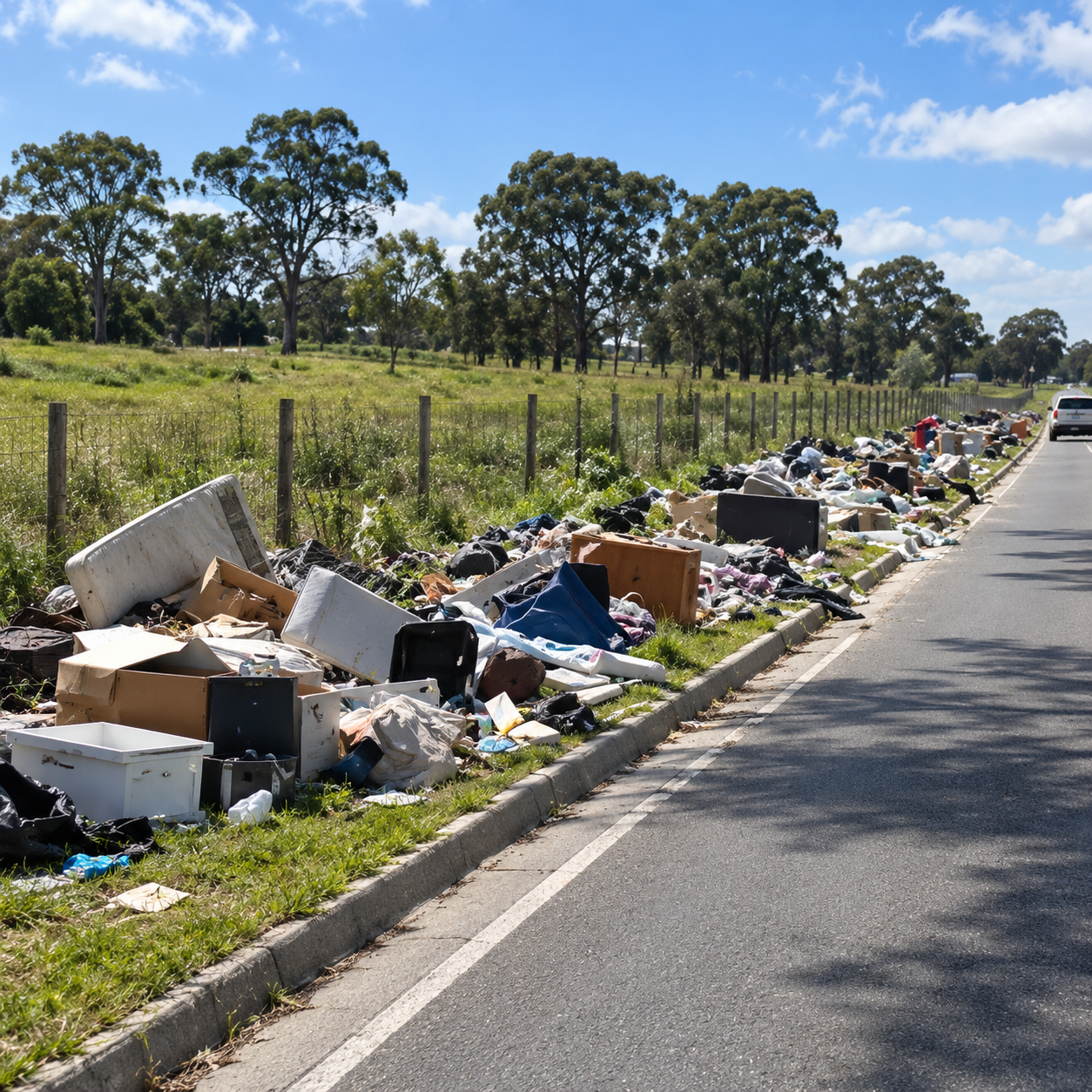
A viral video filmed on Equestria Boulevard at Wollert, in Melbourne’s north, shows household junk and other waste strewn along a lengthy stretch of roadside in one of the city’s rapidly developing growth corridors.
Kane Andrewartha, who runs Tip Top Rubbish Removals, recorded the footage after encountering what he described as one of the worst dumping sites he had seen.
“Look at this. This is insane,” he says while driving along the road.
“It’s literally been turned into a tip.”
Andrewartha has worked in rubbish removal for about 15 years and says the scale of illegal dumping has deteriorated markedly during the past five years, particularly around Melbourne’s expanding suburban fringe.
He singled out areas around Wollert, Melton, Wyndham, Tarneit and Truganina, where large residential developments sit alongside vacant land, building sites and quieter back roads.
“They’re literally just dumping fields,” he said.
His frustration is shared by Wollert residents.
Locals on Equestria Boulevard have complained repeatedly about mattresses, furniture, household waste and construction debris appearing by the roadside, sometimes soon after previous piles have been removed.
Residents have called for more surveillance, stronger penalties and better enforcement, arguing that repeated clean-ups alone are failing to stop the behaviour.
The City of Whittlesea says it uses dedicated litter enforcement officers, patrols, CCTV and information supplied by residents to identify offenders.
The council has successfully traced illegal dumps through vehicle registration details, CCTV and photographs, including cases involving businesses paid to remove waste legally before allegedly leaving it on vacant land instead.
It is against that backdrop that Andrewartha has added another, more contentious suggestion.
He believes governments should provide stronger education about rubbish disposal to people arriving in Australia.
“This country was built on immigration, people are welcome, but there needs to be some sort of education campaign,” he said.
Andrewartha recalled being taught as a child to pick up litter and said keeping public spaces clean had been ingrained in him as a civic responsibility.
He also described confronting a man he believed was illegally dumping soil in a paddock.
According to Andrewartha, the man did not speak English and passed his phone to an employer, who claimed permission had been given to dump at the site.
Andrewartha said another man later arrived and threatened him.
That encounter helps explain his view, but it does not establish that immigration is responsible for Melbourne’s illegal dumping problem.
There is no publicly available EPA, council or police dataset demonstrating that migrants are disproportionately responsible for illegal waste disposal.
Nor can the language ability, ethnicity or migration status of an individual seen dumping waste establish the cause of tens of thousands of incidents across a city of more than five million people.
What the evidence does show is that Melbourne’s outer suburbs have become major dumping hotspots.
Many of those areas are highly multicultural.
They are also among Australia’s fastest-growing communities, with extensive construction activity, large amounts of vacant or semi-rural land and roads where people can unload rubbish with a lower risk of being observed.
Those characteristics provide several plausible explanations for why dumping concentrates there.
Victoria’s own environmental regulator has identified construction and demolition waste as a particular priority.
In August, EPA Victoria launched a statewide compliance blitz targeting 50 skip-bin operators, saying rogue operators had become major contributors to illegal dumping.
The regulator alleges some businesses charge customers for lawful waste disposal but increase their profits by dumping the material on public land or at unauthorised private sites instead.
Construction waste can be especially lucrative to dump illegally because legitimate disposal may involve landfill charges, transport costs and environmental requirements for materials such as asbestos or contaminated soil.
Victorian government guidance says more than 30 per cent of dumped waste is estimated to originate from the construction sector.
In one heavily affected outer-metropolitan council area, construction material reportedly represented about 80 per cent of the total tonnage dumped in 2024–25.
Those figures make it difficult to explain the crisis simply as a question of household behaviour or cultural attitudes.
The scale of the problem is nevertheless enormous.
Victoria’s five most heavily affected councils have estimated that together they receive almost 38,000 reports of dumped rubbish each year.
They collectively incur more than $2.65 million in landfill levies for cleaning up that material and spend more than $12.9 million annually on education, investigations, enforcement and removal.
Hume City Council, which covers another fast-growing northern Melbourne corridor, has recorded an almost 70 per cent increase in illegal dumping reports over four years.
The council spent about $4.2 million responding to dumping in 2024–25 alone.
Melton City Council says it collects close to 3,500 tonnes of illegally dumped litter in an average year.
Victoria has responded with a $21.5 million statewide crackdown.
That package includes $13 million to strengthen the multi-agency Illegal Waste Dumping Taskforce and $8.5 million to help councils and public land managers cover clean-up costs when offenders cannot be identified or made to pay.
The taskforce combines EPA Victoria with other state agencies and local councils and is expanding surveillance, intelligence sharing and targeted enforcement at known dumping hotspots.
Its work this year has included operations with Wyndham City Council and a stronger focus on construction and demolition waste, tyres, asbestos and rogue skip-bin businesses.
That enforcement strategy reflects an important reality: illegal dumping is not one behaviour committed by one type of offender.
It ranges from a household leaving an unwanted mattress on a roadside to commercial operators disposing of truckloads of industrial material to avoid legitimate charges.
The environmental consequences can also range from an ugly streetscape to serious public-health risks.
Dumped waste can attract vermin, block drains, pollute waterways and leave residents exposed to asbestos, chemicals and other hazardous substances.
There is also a strong financial incentive to avoid legitimate disposal.
Victoria’s metropolitan landfill levy for municipal and industrial waste is now $177.19 per tonne for the 2026–27 financial year.
In 2020, the comparable levy was $66 per tonne.
The increase has been deliberate.
Waste levies are designed to make landfill less attractive and encourage recycling and resource recovery instead.
But critics argue that if legal waste disposal becomes too expensive without sufficiently accessible alternatives, some individuals and unscrupulous businesses will simply dump their loads illegally.
Andrewartha believes that tension is part of the worsening problem.
He blamed government policy as well as individual behaviour, saying disposal costs have increased dramatically while councils and regulators have struggled to keep dumping under control.
His criticism requires some qualification.
The $177.19 figure is the state landfill levy component, not necessarily the total price paid by every household or business to dispose of a tonne of waste.
Actual gate charges vary according to the facility, waste type, council arrangements and other costs.
Residents also have access to legitimate disposal services that reduce or remove the direct cost of getting rid of common household waste.
In Whittlesea, for example, households can book two free at-home hard rubbish collections each year.
The council also provides free or discounted vouchers for green waste, timber, bricks and rubble, general waste and other materials, alongside periodic recycling events.
That makes roadside dumping difficult to justify simply on the basis that lawful disposal is impossible or unaffordable.
For businesses carrying large volumes of waste, however, the economics are different.
A contractor handling tonnes of construction material can avoid significant charges by unlawfully unloading it on vacant land.
That is why EPA Victoria has increasingly focused on the commercial waste chain rather than relying only on campaigns telling residents not to litter.
The debate over who is responsible has also been fuelled by statistics circulated this year suggesting Victoria accounts for more than half of Australia’s illegal dumping complaints.
Those numbers require care.
They come from Snap Send Solve, a popular reporting platform used by residents to alert councils and other authorities about rubbish, potholes, abandoned trolleys and other local problems.
Data circulated from the platform showed an extraordinarily high number of dumped-rubbish reports in Victoria and has been repeatedly cited as proof that the state is Australia’s illegal dumping capital.
But reports made through one app are not the same thing as a comprehensive count of every illegal dumping incident in the country.
Different councils use reporting systems differently, awareness of the app varies and a higher reporting rate can partly reflect residents being more willing or able to lodge complaints.
EPA Victoria makes a similar caution about its own data.
The regulator says illegally dumped waste frequently goes unreported, making it difficult to determine with precision whether the true number of dumping events is increasing.
It can say with confidence that Victorians are reporting more environmental crime and that councils are facing substantial clean-up burdens.
It cannot identify the migration background of every offender from those figures.
That leaves Andrewartha’s call for migrant education in a particular category.
As a policy idea, governments could certainly provide waste-disposal information in multiple languages to new arrivals.
Councils already use translated information for many services, and explaining local rules, collection systems and penalties can benefit residents who are unfamiliar with them.
There is little downside to ensuring every new resident understands that unwanted furniture, building material and household rubbish cannot simply be abandoned on vacant land.
But an education campaign aimed at migrants should not become a substitute for addressing the parts of the problem already visible in official evidence.
That means prosecuting commercial operators who illegally dump construction waste.
It means making legitimate disposal convenient enough that households use it.
It means cameras and enforcement at repeat hotspots.
It means making businesses prove where the waste they collect actually ends up.
And it means imposing penalties large enough that dumping is no longer cheaper than following the law.
Whittlesea has shown that evidence-based enforcement can work.
In one Wollert case, a resident’s photograph, CCTV and vehicle information allowed investigators to connect rubbish dumped at three separate sites to an offender and issue fines.
Another case involved a truck allegedly hired to dispose of rubbish properly before the waste was found dumped on vacant land.
Those examples demonstrate why councils repeatedly ask residents to record registration numbers, vehicle descriptions, times and photographs when it is safe to do so.
The Wollert video has captured public anger because the result is so visible.
A newly developing suburb surrounded by piles of mattresses, broken furniture and discarded building material creates an impression that nobody is in control.
Residents understandably want that changed.
But identifying a solution requires more than deciding which demographic group to blame.
Illegal dumping in Melbourne is occurring at household, contractor and commercial levels, and the state’s own enforcement agencies have identified the waste industry and construction sector as significant parts of the problem.
Education may be one tool.
Stronger enforcement, affordable disposal, surveillance and accountability for waste contractors are others.
What the evidence supports is a city with a serious dumping problem.
What it does not yet support is the conclusion that immigration is the cause.
For residents staring at another pile of rubbish on their street, that distinction may not make the clean-up any easier — but it matters if governments want the policies used to stop the next load being dumped to actually work.