Former prime minister Kevin Rudd has launched a sweeping attack on One Nation leader Pauline Hanson, arguing that despite the party’s growing popularity in opinion polls, it continues to offer protest rather than practical solutions to Australia’s biggest policy challenges.
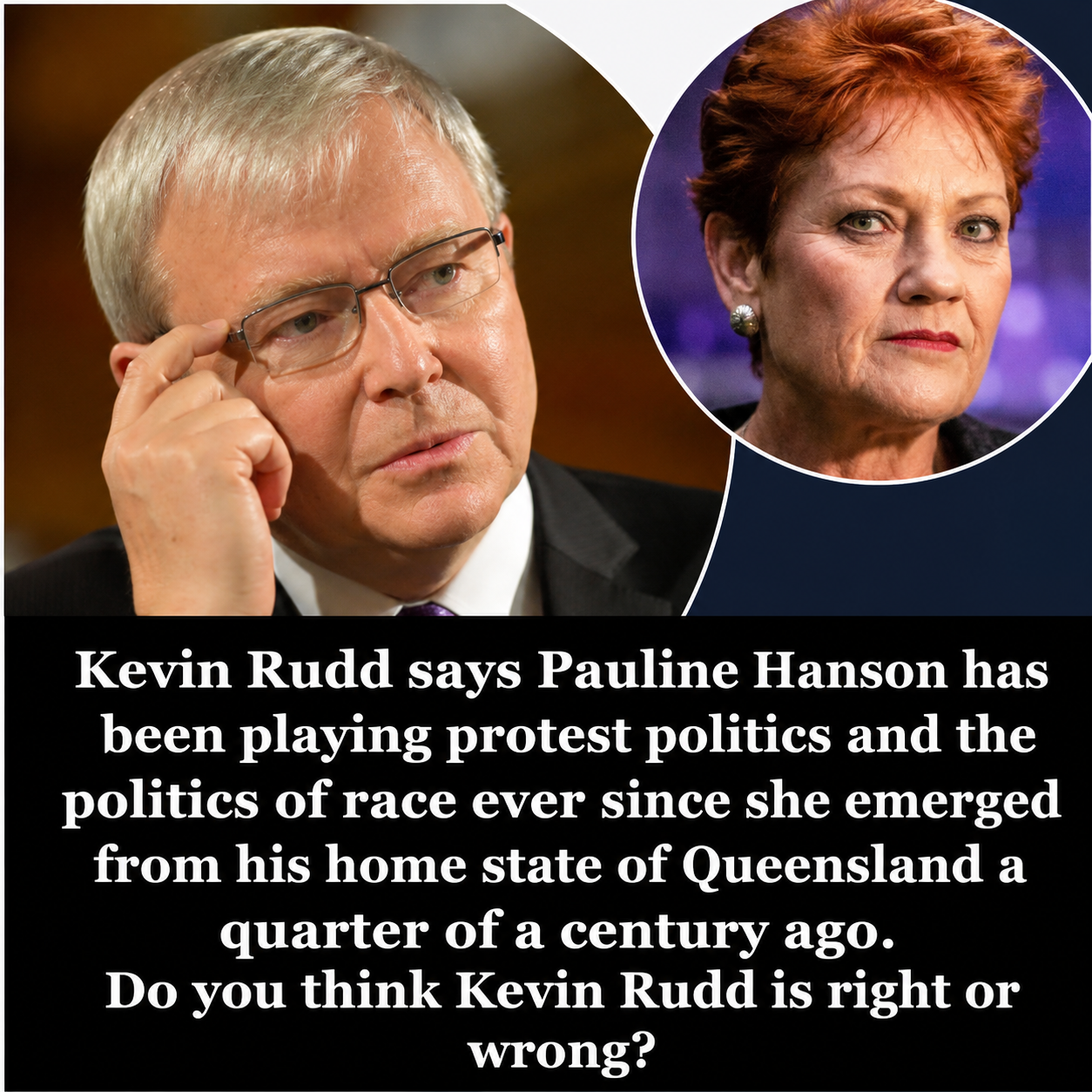
Speaking from London during an interview on ABC’s 7.30, Rudd questioned whether Hanson had developed any credible policy agenda during her three decades in Australian politics.
He argued that One Nation’s appeal has been built on political frustration rather than a detailed governing platform.
“She has no real answers,” Rudd said, challenging supporters to identify a single practical policy proposal Hanson has offered to address issues including national security, economic growth, housing affordability, environmental sustainability or public services.
According to Rudd, Hanson has relied on what he described as the “politics of race” since first entering federal politics in Queensland during the 1990s.
He argued that while Australia’s political and economic circumstances have changed dramatically over the past quarter-century, the core themes of Hanson’s political messaging have remained largely unchanged.
“Find me one answer,” Rudd said, before concluding the response was “zip”.
The remarks come at a significant moment in Australian politics.
Recent polling has shown One Nation enjoying some of its strongest support in years, reflecting growing voter dissatisfaction over issues including the cost of living, housing affordability, immigration and confidence in the major political parties.
A recent RedBridge poll placed One Nation ahead of Labor on the primary vote for the second time this year, an extraordinary development for a minor party that has traditionally relied on protest votes rather than broad electoral support. Despite that result, Anthony Albanese remained the preferred prime minister.
The polling has intensified debate over why One Nation continues to gain support despite criticism from political opponents across the ideological spectrum.
Hanson founded One Nation in 1997 after first entering federal parliament as the member for Oxley in 1996.
Since then, immigration, multiculturalism, national identity and government accountability have remained central themes of the party’s platform.
Over the years One Nation has expanded its policy agenda to include energy, taxation, regional development, housing, manufacturing and law-and-order issues, while continuing to campaign heavily on reducing immigration and challenging what it describes as political elites.
Rudd, however, argued that opposition rhetoric should not be confused with governing capability.
He suggested Australia’s major structural challenges require detailed policy design, long-term planning and practical administration rather than slogans or expressions of public frustration.
Among the issues he specifically referenced were Australia’s economic competitiveness, national security, housing shortages, environmental sustainability and the delivery of public services.
According to Rudd, Hanson has not demonstrated how a One Nation government would successfully manage those complex responsibilities.
The comments also arrive as One Nation seeks to convert its improving national polling into stronger electoral representation.
The party recently launched its Victorian election campaign, unveiling candidates across the state while positioning itself as an alternative to both Labor and the Coalition.
Pauline Hanson has argued that growing support reflects widespread frustration with the major parties rather than a temporary protest movement.
Recent surveys suggest voters are increasingly concerned about housing affordability, immigration, healthcare, crime and the broader cost-of-living crisis.
Those issues have provided fertile ground for minor parties promising significant policy change, particularly among voters who believe the traditional two-party system has failed to respond adequately to economic pressures.
Political analysts note that One Nation has successfully positioned itself as an anti-establishment alternative, attracting support from voters dissatisfied with both Labor and the Coalition.
Some commentators argue the party’s gains reflect broader frustration with living standards and economic management rather than support for every individual One Nation policy.
Rudd’s criticism reflects a different interpretation.
Rather than viewing One Nation’s rise as evidence of policy strength, he suggested the party continues to capitalise primarily on public discontent while failing to present comprehensive solutions capable of governing a modern economy.
His remarks also highlight a longstanding divide within Australian politics over the role of populist parties.
Supporters argue they give voice to communities that feel ignored by Canberra and force major parties to confront issues that might otherwise receive insufficient attention.
Critics counter that identifying problems is only one part of governing, and that sustainable public policy requires detailed implementation plans capable of balancing competing national priorities.
That debate has become increasingly significant as opinion polling points to growing fragmentation in Australia’s political landscape.
Although Labor continues to lead on a two-party-preferred basis in several national surveys, support for the major parties has steadily declined over recent decades while crossbench and minor parties have expanded their share of the vote.
The latest RedBridge polling illustrates that trend, showing One Nation competing directly with Labor on primary support while the Coalition also seeks to consolidate conservative voters ahead of the next federal election.
Neither Hanson nor One Nation immediately responded to Rudd’s latest criticism during the ABC interview.
The party has consistently argued that its policy platform addresses concerns frequently overlooked by the major parties, particularly on immigration, energy prices, regional Australia and government spending.
In recent months Hanson has repeatedly said that increasing support demonstrates Australians are seeking a stronger alternative to the established political parties.
Whether that momentum continues remains one of the key questions heading towards the next federal election.
For Labor, the Coalition and One Nation alike, the contest is increasingly centred not only on who can identify Australia’s biggest problems, but who can persuade voters they possess the most credible solutions.
Rudd’s intervention underscores that broader contest.
His argument is that political popularity alone is not evidence of governing capability, and that any party aspiring to shape Australia’s future must ultimately be judged not by its criticism of the existing system, but by the quality and practicality of the policies it proposes to replace it.






