Australia’s debate over tax reform has taken another significant turn, with economics editor John Kehoe arguing that the country should adopt a comprehensive dual-income tax system that caps tax on all capital income at a flat 30 per cent.
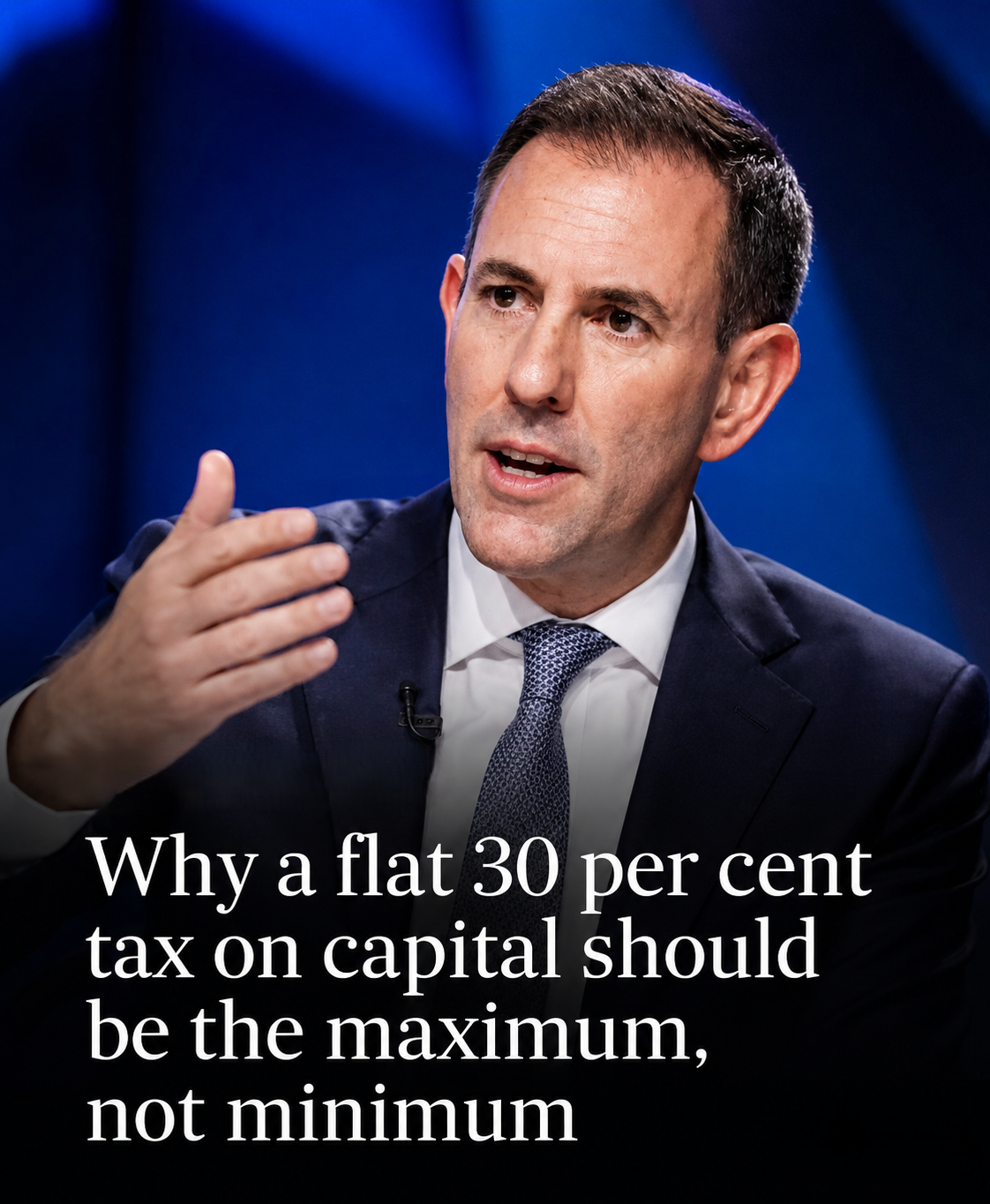
Writing amid renewed discussion over the Albanese government’s capital gains tax reforms, Kehoe contends that Australia should rethink how it taxes investment income altogether. Rather than layering increasingly complex rules onto an already complicated system, he argues a single maximum tax rate on capital income would simplify administration, reduce tax avoidance opportunities and improve economic efficiency.
The proposal centres on a dual-income tax system, a model used in several Nordic countries including Sweden, Norway and Finland. Under this approach, income earned from labour is taxed separately from income generated through capital such as investments, dividends, interest and capital gains.
Kehoe argues that Australia has already begun moving in this direction, albeit unintentionally.
He says the Albanese government’s introduction of a minimum 30 per cent tax applying to certain capital gains and discretionary trust arrangements effectively creates what he describes as a “bastardised” version of the Nordic model without fully embracing its broader simplicity and consistency.
Under Australia’s existing tax system, capital income is treated differently depending on its source. Long-term capital gains may receive discounts, dividends can attract franking credits, trust distributions follow separate rules, while interest income is generally taxed at an individual’s marginal income tax rate.
The result, according to supporters of reform, is a system filled with different rates, exemptions and planning opportunities that encourage taxpayers to restructure investments in pursuit of lower tax liabilities rather than making decisions based on genuine economic returns.
Kehoe argues that applying one flat maximum rate across all forms of capital income would significantly reduce these distortions.
Instead of requiring increasingly detailed anti-avoidance legislation, governments could rely on a simpler framework that provides fewer opportunities for tax arbitrage while remaining easier for taxpayers and the Australian Taxation Office to administer.
The proposal also reflects a long-running distinction in tax policy between income earned through work and income earned through accumulated savings or investment.
Supporters of dual-income taxation argue that capital is generally more mobile than labour. Investors can shift funds across jurisdictions more easily than workers can relocate, meaning excessively high taxes on investment income may discourage domestic investment or encourage capital to flow overseas.
A competitive but consistent flat tax rate, advocates argue, provides certainty for investors while still ensuring that capital contributes to government revenue.
The latest debate follows the federal government’s broader package of tax changes announced in the 2026 Budget.
Among the most closely watched measures is the introduction of a minimum 30 per cent tax rate on certain capital gains and discretionary trust arrangements from mid-2027, alongside changes affecting some assets that were previously outside the capital gains tax regime. The reforms have generated strong reactions from investors, tax professionals and business groups.
Business organisations have warned that increasingly complicated tax rules risk discouraging investment and reducing Australia’s international competitiveness.
Others argue that stronger taxation of capital is necessary to improve equity within the tax system and ensure wealthy individuals cannot substantially reduce their tax bills through sophisticated financial structures.
Kehoe’s proposal attempts to bridge those competing objectives by advocating a single transparent ceiling rather than multiple overlapping tax treatments.
He argues that if every form of capital income were taxed at no more than 30 per cent, taxpayers would have far less incentive to engage in complex tax planning designed solely to obtain preferential treatment.
The concept of dual-income taxation is not new.
Nordic countries introduced variations of the model during the late twentieth century as part of broader reforms intended to improve economic efficiency while maintaining progressive taxation of employment income.
Although each country applies different rates and detailed rules, the common principle is separating taxation of labour income from taxation of capital returns.
Supporters say this encourages investment, improves compliance and reduces opportunities for income shifting between different tax categories.
Critics, however, argue that taxing capital at lower rates than employment income can disproportionately benefit wealthier households, who typically derive a larger share of their earnings from investments rather than wages.
They contend that any move towards flatter capital taxation must be carefully balanced against fairness considerations and the government’s long-term revenue needs.
Australia’s tax system has long been the subject of periodic reviews examining capital gains tax, negative gearing, dividend imputation, superannuation concessions and trust taxation.
Each of these areas has generated substantial political debate because changes often affect property investors, retirees, family businesses and high-income earners in different ways.
Kehoe suggests that continuing to adjust individual parts of the system risks making the overall framework even more complex over time.
Instead, he argues that comprehensive structural reform would provide greater certainty for investors while making tax administration more straightforward for governments and taxpayers alike.
Whether such a proposal could gain political support remains uncertain.
Tax reform has traditionally been one of the most contentious areas of Australian public policy, particularly where changes affect housing, investment returns or retirement savings.
Any future conservative government considering a dual-income tax system would likely need to balance concerns about investment incentives with broader questions surrounding budget sustainability and income distribution.
The discussion nevertheless reflects a broader recognition among economists that Australia’s tax system has grown increasingly complicated after decades of incremental amendments.
Rather than introducing new concessions or targeted anti-avoidance measures each budget cycle, advocates of structural reform argue there may be greater long-term value in replacing complexity with consistency.
As debate continues over the Albanese government’s latest tax measures, Kehoe’s proposal adds another perspective to the conversation: if Australia is moving towards taxing capital differently from labour, then doing so through a single, transparent maximum rate may ultimately prove more coherent than relying on an expanding collection of overlapping rules and exceptions.