A Brisbane emergency nurse has gone viral after CCTV footage captured him using more than a decade of jiu-jitsu training to restrain an allegedly violent patient inside one of Queensland’s busiest hospitals, with the dramatic incident reigniting debate over the growing risks faced by frontline healthcare workers.
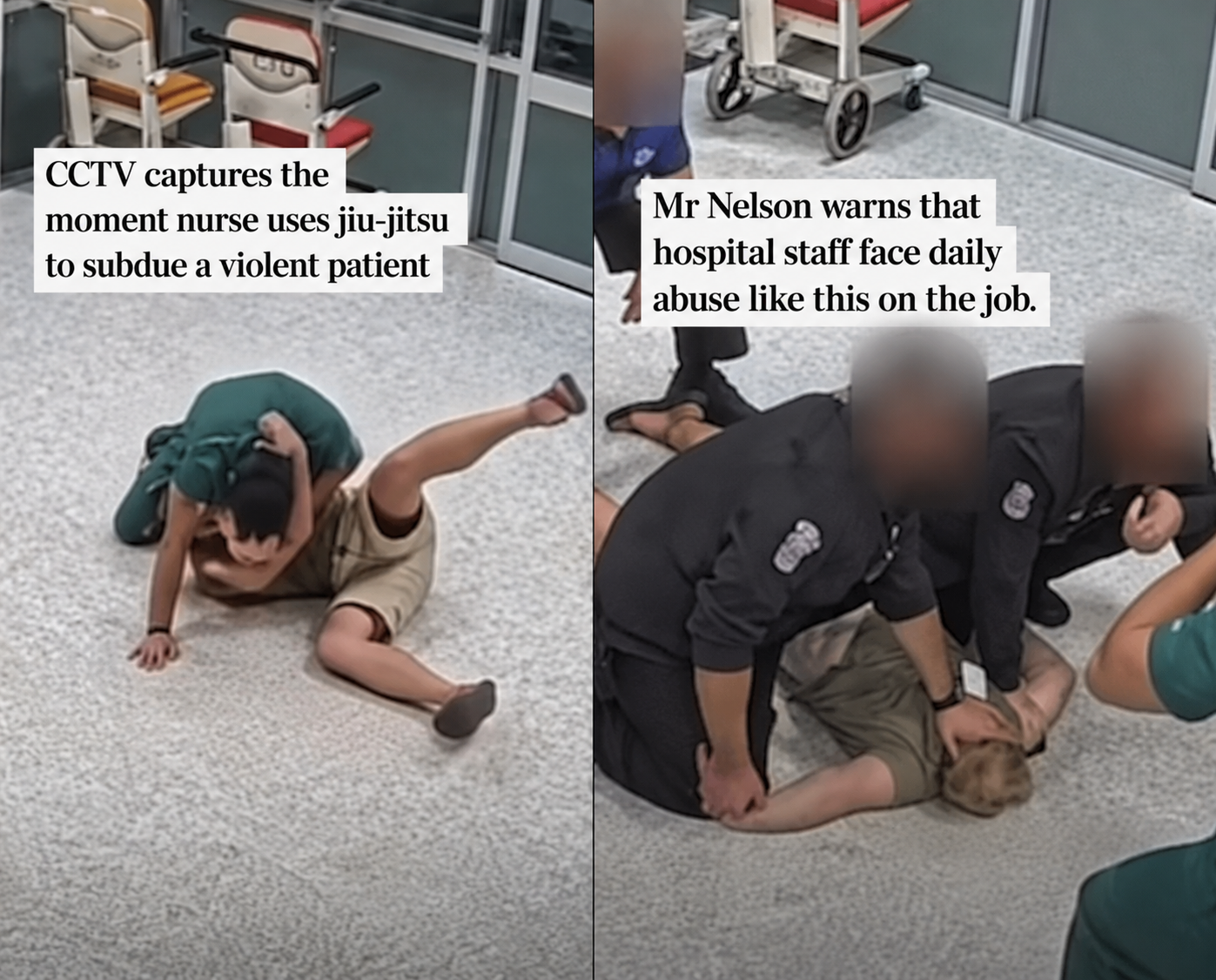
The footage, posted to social media by registered nurse Daniel Nelson, has attracted more than 1.3 million views after showing the moment an aggressive patient allegedly attacked him while being escorted from the emergency department of the Royal Brisbane and Women’s Hospital (RBWH).
Nelson said he released the CCTV vision not to draw attention to his martial arts background, but to expose the reality of workplace violence experienced by nurses, doctors, paramedics and other frontline health professionals.
The incident occurred at about 2am in October 2024 while Nelson was working in the emergency department.
According to Nelson, the patient had been intoxicated, had allegedly been verbally abusing hospital staff, spitting on the floor and behaving aggressively before being directed to leave the hospital.
He volunteered to escort the man outside, intending to stop by a nearby coffee van once the patient had left the building.
Security footage shows the man walking toward the exit before suddenly turning back, throwing an object at Nelson and charging through the emergency department doors.
The patient then appears to throw several punches at the nurse.
Within seconds, Nelson reacts instinctively, using jiu-jitsu techniques to take the man to the ground before restraining him until hospital security officers arrive to assist.
Although the takedown quickly attracted attention online, Nelson said the real issue was not his martial arts experience but what could have happened had another staff member been targeted instead.
“I laughed about it then and now because I was able to defend myself,” he wrote.
“But that’s not the point. What if he’d picked a nurse half my size? A new graduate? A student? Someone who simply couldn’t defend themselves?”
Nelson described himself as having an “obsession” with jiu-jitsu spanning more than ten years and suggested the attacker had no idea he was confronting someone with extensive grappling experience.
His martial arts background allowed him to neutralise the threat without appearing to strike the patient, instead relying on control and restraint until additional help arrived.
Despite widespread praise for his calm response, Nelson emphasised that healthcare workers should never be expected to physically defend themselves as part of their profession.
“Violence against healthcare workers isn’t ‘just part of the job’. It’s unacceptable,” he said, adding that alcohol should never be accepted as an excuse for assaulting medical staff.
He also paid tribute to colleagues who continue working despite regularly facing aggression, intimidation and abuse from patients and visitors.
The incident has renewed attention on occupational violence throughout Queensland’s public hospital system.
According to figures previously highlighted by the Nurses Professional Association Queensland, more than 16,000 violent incidents involving healthcare workers were recorded across Queensland hospitals in a single year—equivalent to around 45 assaults every day.
Those statistics have prompted repeated calls for stronger workplace protections, improved security and greater investment in staff safety.
The Queensland Nurses and Midwives’ Union (QNMU) said the footage demonstrates why stronger measures are needed to protect nurses from occupational violence.
Union secretary Sarah Beaman said no healthcare worker should have to rely on physical self-defence while performing their duties.
She acknowledged nurses receive occupational violence prevention training but argued employers must continue improving de-escalation procedures, staffing levels and on-site security so violent confrontations can be prevented before they escalate.
“No level of violence against nurses, midwives and all health workers is acceptable,” the union said.
Metro North Health, which operates the Royal Brisbane and Women’s Hospital, also condemned the assault.
A spokesperson said the health service recognises the serious impact workplace violence has on employees and maintains multiple strategies aimed at preventing assaults, including staff training, hospital security and initiatives encouraging the reporting of violent incidents.
The spokesperson added that the organisation remains committed to providing a safe and respectful environment for staff, patients and visitors alike.
The legal proceedings arising from the incident have already concluded.
The man involved, now aged 28, was charged over the assault. Court proceedings later resulted in him being fined $450 after the matter was finalised.
The incident reflects a broader international challenge confronting healthcare systems.
The World Health Organization estimates that between 8 and 38 per cent of healthcare workers experience physical violence at some point during their careers, while verbal abuse is even more common.
Emergency departments, ambulance services, mental health units and other frontline clinical settings are consistently identified as among the highest-risk workplaces because staff frequently treat intoxicated, distressed or psychologically unwell patients.
Australian Institute of Health and Welfare data has also shown assaults have become one of the leading causes of work-related hospitalisations among healthcare workers, underlining concerns raised by unions that occupational violence continues to increase despite ongoing prevention efforts.
For many viewers, Nelson’s composure and martial arts expertise made the CCTV footage remarkable.
For Nelson himself, however, the viral attention serves a different purpose.
He says the incident should not be remembered because a nurse happened to know jiu-jitsu, but because no healthcare worker should ever have to rely on combat training simply to return home safely after finishing a shift.
As Queensland hospitals continue searching for ways to better protect frontline staff, the footage has become a powerful reminder of the hidden dangers that many doctors, nurses and paramedics continue to face while caring for others every day.