Australia’s increasingly heated debate over multiculturalism has taken another unexpected turn, with a new opinion poll suggesting concerns about social cohesion extend well beyond Pauline Hanson’s traditional support base.
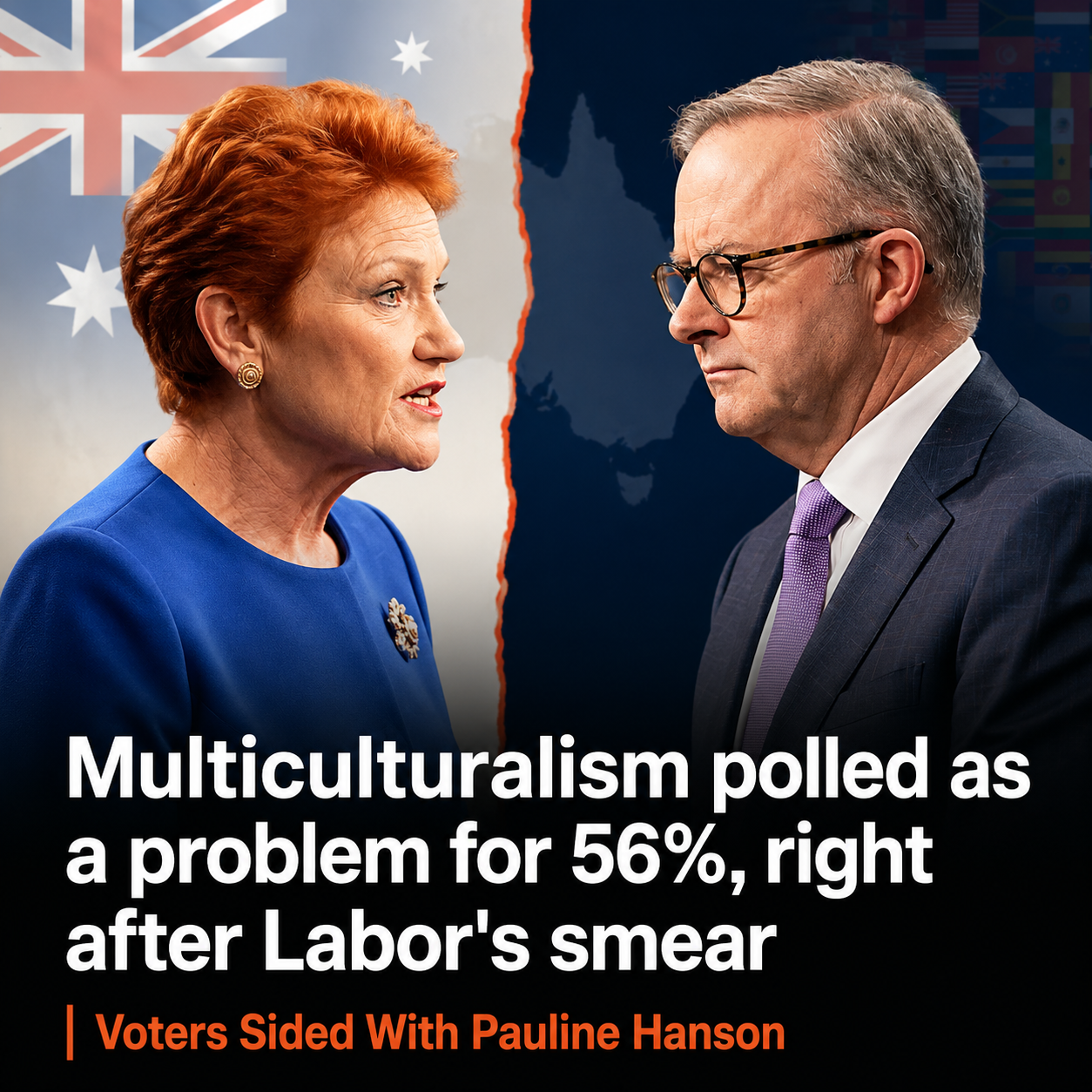
The findings emerged only days after Prime Minister Anthony Albanese and Home Affairs Minister Tony Burke sharply criticised the One Nation leader following her National Press Club address, in which Hanson argued Australia should move away from multiculturalism in favour of what she described as a stronger shared national culture.
Labor accused Hanson of reviving ideas reminiscent of the former White Australia policy, rejecting her arguments as inconsistent with modern Australia. Hanson denied those characterisations and maintained she was advocating for stronger national unity rather than discrimination.
The political argument was quickly followed by fresh polling that has intensified discussion over whether Australia’s major parties are accurately reading public sentiment.
According to a News24 Pulse survey conducted by YouGov involving 1,519 voters after Hanson’s speech, 46 per cent of respondents said multiculturalism had benefited Australia in the past but was now creating problems for social cohesion. A further 10 per cent believed multiculturalism had never served the country well.
Taken together, that meant 56 per cent of respondents expressed some level of concern about multiculturalism’s current impact, while 37 per cent believed it continues to work well for Australia.
The figures have become politically significant because concern was not confined to conservative or One Nation supporters.
Among respondents identifying as Labor voters, a sizeable minority reportedly agreed that Australia faces growing social cohesion challenges, highlighting an issue that cuts across traditional party loyalties.
The results also coincide with comments from South Australian Premier Peter Malinauskas, who has argued that automatically labelling every voter concerned about immigration as racist is both inaccurate and politically counterproductive.
Malinauskas has repeatedly said Australians can legitimately debate migration levels, infrastructure pressures and social integration without those concerns necessarily being motivated by racial prejudice. His comments have attracted attention because they come from one of Labor’s most successful state leaders.
The debate reflects a broader shift in Australian politics over the past two years, during which immigration has become one of the country’s defining political issues.
Rapid population growth following the pandemic has coincided with severe housing shortages, record rental prices, rising congestion and growing pressure on public infrastructure.
These economic pressures have increasingly intersected with discussions about migration policy, leading some voters to question whether current immigration settings remain sustainable.
Pauline Hanson has consistently argued that high migration levels are contributing to Australia’s housing crisis, placing additional strain on healthcare, schools and transport while weakening national cohesion.
Labor rejects that analysis, arguing skilled migration remains essential for economic growth and workforce shortages, while also defending multiculturalism as one of Australia’s greatest national strengths.
Anthony Albanese has previously described Australia’s multicultural success as one of the country’s defining achievements, warning against attempts to divide Australians by ethnicity or background.
Hanson, however, has continued to argue that Australia should prioritise stronger cultural integration, English language proficiency and a clearer national identity rather than celebrating multiple distinct cultural communities. Reuters reported in June that Hanson declared multiculturalism had failed and linked migration levels to Australia’s housing and cost-of-living pressures.
The disagreement illustrates how the political contest has evolved beyond traditional arguments over immigration numbers into broader questions about national identity and social cohesion.
Recent polling across multiple organisations has shown immigration climbing alongside housing affordability and cost-of-living pressures as one of voters’ major concerns.
At the same time, Labor continues to maintain an overall two-party preferred advantage nationally despite fluctuations in primary vote support and shifts involving One Nation and the Coalition.
The multiculturalism debate has also exposed differences within the broader conservative movement.
Former prime minister John Howard recently defended Australia’s post-war multicultural success while rejecting Hanson’s call for a monocultural model, arguing Australia has generally integrated migrants successfully without abandoning shared national values.
Meanwhile, senior Liberal figures have attempted to distance themselves from formal cooperation with One Nation even as some conservative commentators argue the major parties should take voters’ concerns about migration and social cohesion more seriously.
Political analysts say the issue is unlikely to disappear as Australia approaches the next federal election.
Housing affordability, infrastructure capacity, migration levels and community integration are increasingly overlapping in public debate, making multiculturalism part of a much broader conversation about Australia’s future.
Whether Labor’s criticism of Hanson ultimately strengthens or weakens her political position remains uncertain.
What appears increasingly clear is that concerns about immigration and social cohesion are no longer confined to One Nation’s traditional voter base.
As the latest polling suggests, Australians continue to express diverse views about how multiculturalism should evolve, ensuring the issue is likely to remain one of the country’s most closely watched political debates in the months ahead.