A private dinner attended by Prime Minister Anthony Albanese at the Sydney waterfront mansion of the son of a Chinese-born property billionaire has ignited fresh political debate over donations, influence and transparency, with the controversy unfolding as Labor continues criticising One Nation leader Pauline Hanson over her relationship with mining billionaire Gina Rinehart.
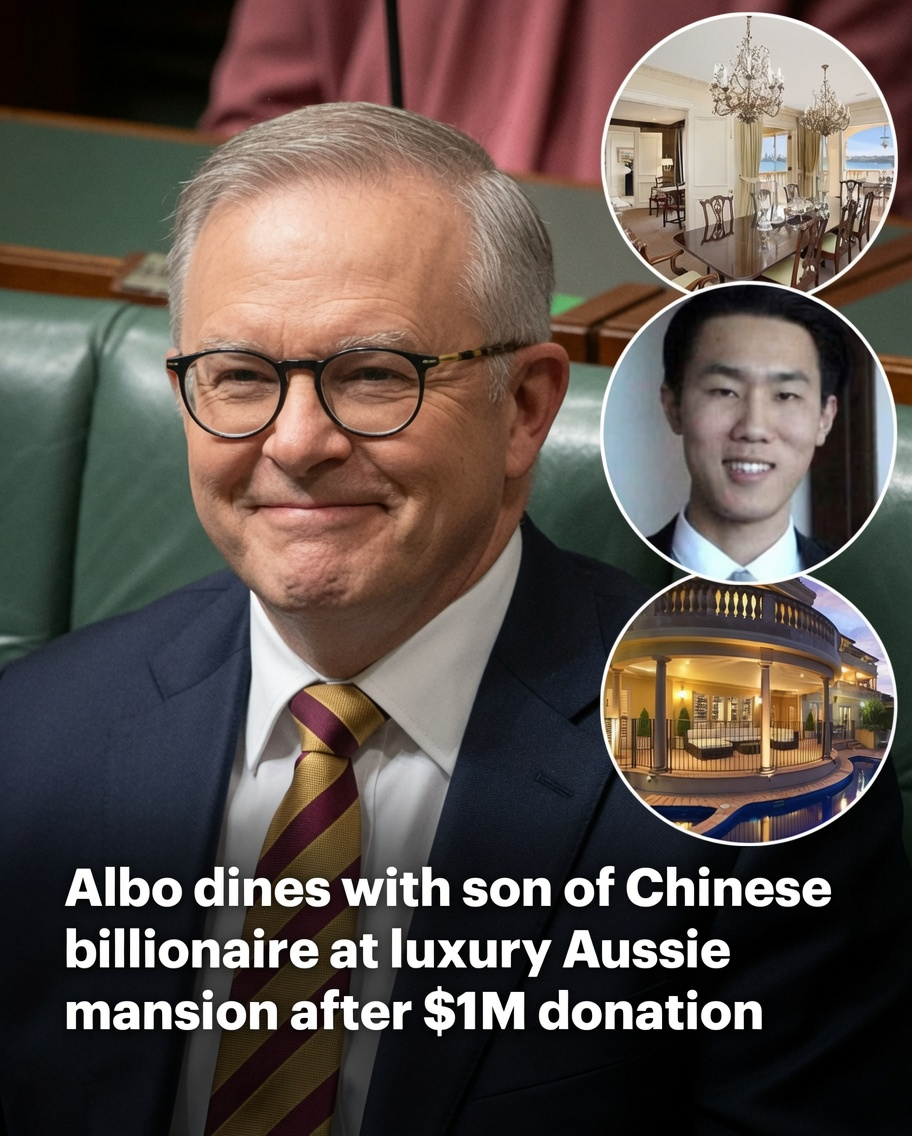
Mr Albanese attended an invitation-only dinner at Mandalay, the Point Piper waterfront estate owned by the family of property developer Phillip Dong Fang Lee. The gathering was reportedly hosted by the billionaire’s 25-year-old son, Felix Lee, and included a small group of prominent business and political figures.
According to reports, guests included Commonwealth Bank chief executive Matt Comyn, former Victorian premier Dan Andrews, former Australian Securities and Investments Commission chairman James Shipton and former Future Fund chairman David Murray.
The event attracted attention after reports suggested it followed a significant financial contribution connected to the Australian Labor Party.
Initial speculation claimed approximately $1 million had been pledged to Labor, with suggestions that the Prime Minister’s attendance was linked to the donation. However, Labor sources later disputed that figure, arguing the dinner was a fundraising event where individual guests paid between $5,000 and $10,000 each, resulting in a substantially smaller total contribution. The Prime Minister’s Office declined to comment on the private meeting but emphasised that political donations are disclosed in accordance with Australian electoral laws.
The dinner has reignited broader questions about political fundraising and access to senior government figures.
Australia’s federal political parties routinely hold fundraising dinners and private events attended by business leaders, industry representatives and major donors. While such events are lawful, they periodically attract scrutiny over whether wealthy supporters receive greater access to political decision-makers than ordinary voters.
The latest controversy has unfolded at the same time senior Labor figures have criticised Pauline Hanson over her close relationship with Gina Rinehart, Australia’s richest person.
Hanson was recently photographed holidaying with Ms Rinehart at the Grand Hotel San Pietro in Taormina, Sicily, after attending Dolce & Gabbana’s Alta Moda fashion event.
Images published in Australian media showed the pair spending time together at the luxury cliff-top resort, which gained international recognition after featuring in the second season of The White Lotus. Celebrity guests at the fashion event reportedly included Jennifer Lopez, Monica Bellucci, Theo James and footballer Erling Haaland.
The photographs prompted criticism from political opponents, including Opposition Leader Angus Taylor, who questioned Hanson’s overseas travel and relationship with the mining billionaire.
Hanson responded by accusing critics of applying a double standard.
She argued that other political leaders regularly associate with wealthy business figures without attracting the same level of public criticism.
“I wish they’d question Albanese’s friendships with Anthony Pratt and Twiggy Forrest,” Hanson said.
She also referred to the Prime Minister’s attendance at high-profile social events involving influential business and media personalities, arguing that her own relationships were being subjected to disproportionate scrutiny.
Hanson defended both her friendship with Ms Rinehart and the support she has received from Australia’s richest woman.
She confirmed she had travelled on an aircraft provided by Ms Rinehart and said the arrangement had been properly declared under parliamentary disclosure rules.
“Everything’s declared, and I’m very appreciative of it, and I’m not going to apologise for it either,” Hanson said.
She described Ms Rinehart as “a very proud, patriotic Australian” and rejected suggestions that their relationship involved anything improper.
The relationship between Hanson and Rinehart has attracted considerable public attention over the past two years.
Rinehart has publicly supported several of One Nation’s policy positions, particularly on energy, mining, taxation and opposition to government regulation.
Media reports have also documented occasions where Hanson has travelled using aircraft associated with Rinehart and attended events connected with the mining billionaire, all of which Hanson says have been disclosed in accordance with parliamentary requirements.
Political donations remain heavily regulated under Australian law.
Federal political parties must disclose donations above legislated thresholds to the Australian Electoral Commission, although disclosures generally occur after reporting periods rather than immediately following individual events.
Supporters of the current system argue transparency requirements allow voters to assess potential conflicts of interest.
Critics, however, contend that disclosure rules should be strengthened further by lowering reporting thresholds, shortening reporting timeframes and increasing public access to donation information.
The debate over political fundraising extends well beyond any individual party.
Both Labor and the Coalition have historically received substantial financial support from businesses, unions, industry groups and wealthy individuals.
Minor parties and independents have likewise relied on donations from supporters to finance election campaigns, advertising and organisational activities.
Because of that, allegations of inconsistency frequently arise when parties criticise opponents while maintaining relationships with influential donors of their own.
Political integrity experts generally distinguish between lawful political donations and evidence of improper influence.
While attendance at fundraising events and relationships with business leaders are not, in themselves, evidence of misconduct, transparency advocates argue that clear disclosure and public accountability are essential to maintaining confidence in Australia’s democratic institutions.
The latest dispute also reflects increasingly intense political competition ahead of future elections.
As Labor, the Coalition and One Nation seek to differentiate themselves on issues ranging from economic management to migration and cost-of-living pressures, personal relationships between politicians and prominent business figures have become part of the broader political contest.
For Hanson, criticism over Gina Rinehart has become another opportunity to argue that One Nation is judged by different standards than the major parties.
For Labor, questions surrounding donations have been met with repeated assurances that fundraising activities comply with electoral law and that required disclosures are made through the established regulatory framework.
The differing responses illustrate a broader challenge facing Australian politics.
Voters increasingly expect transparency regarding political donations and access to elected leaders, regardless of party affiliation.
Whether the discussion centres on a fundraising dinner at a Sydney harbour mansion or a friendship between a senator and Australia’s richest person, the underlying issue remains the same: ensuring the public can have confidence that political decisions are made in the national interest rather than influenced by private financial relationships.






