Claims by Treasurer Jim Chalmers that Australia is experiencing record levels of new business creation have ignited a heated national debate, with the Federal Government pointing to historic company registrations as evidence of a resilient economy while critics argue the figures paint a misleading picture of conditions facing small businesses.
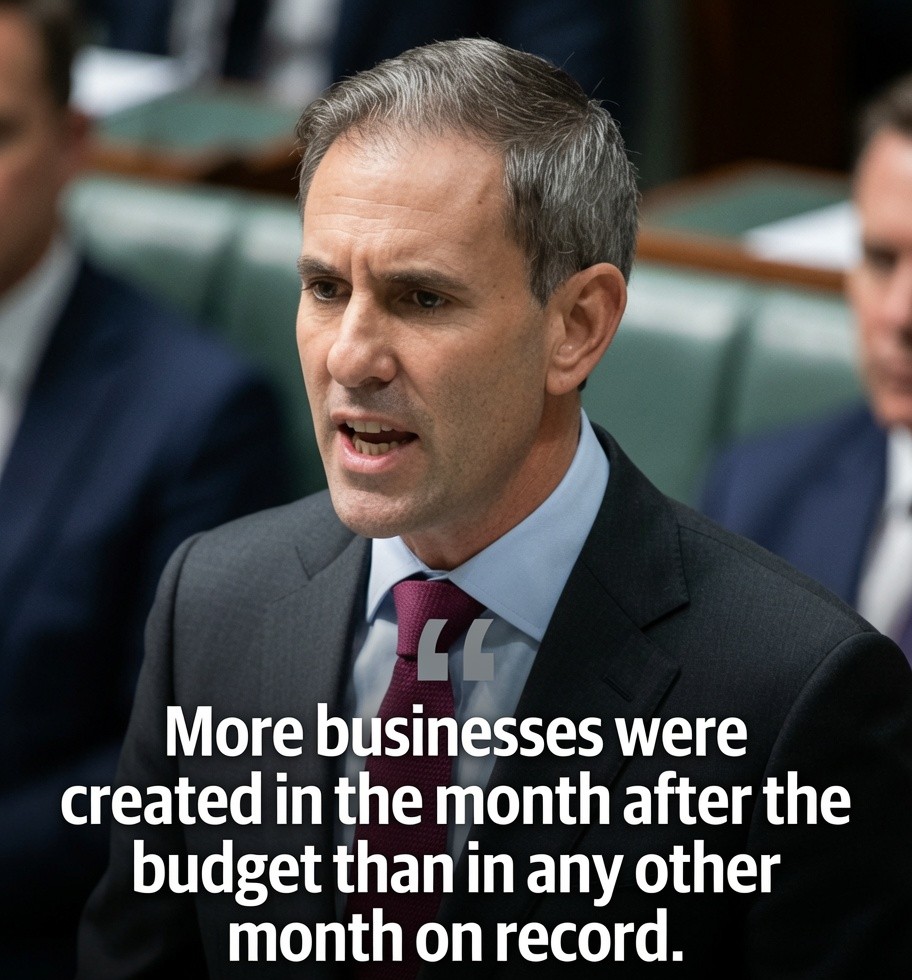
The controversy began after Mr Chalmers highlighted newly released Australian Securities and Investments Commission (ASIC) data showing more businesses were registered in June than in any month since records began in 1999.
Writing on social media, the Treasurer argued the figures demonstrated the strength of Australia’s economy following the Federal Budget.
“New numbers out this week show more new businesses were registered last month than in any other month since these records first began in 1999,” Mr Chalmers said.
Treasury subsequently expanded on that claim, stating Australia had not only experienced a record month for business registrations but also the strongest annual and four-year periods on record.
According to Treasury, more than 1.3 million new businesses have been created since Labor came to office, representing the highest number recorded during any four-year period.
The government argues those outcomes reflect policies designed to encourage investment and entrepreneurship.
Among the measures cited are $3.8 billion in business tax relief, making the instant asset write-off permanent, introducing a permanent two-year loss carry-back for eligible small companies, expanding venture capital tax incentives and providing a $250 tax offset for around 1.5 million sole traders.
Labor has consistently argued that these initiatives are helping strengthen business confidence while supporting investment despite ongoing global economic uncertainty.
Official National Accounts released earlier this year also showed business investment growing strongly, with Treasury describing private investment as one of the principal drivers of Australia’s recent economic growth.
Business investment increased 5.7 per cent during the March quarter and was 10.4 per cent higher than a year earlier, according to Treasury, marking its strongest quarterly growth in almost 15 years.
However, while few dispute the accuracy of the ASIC registration figures themselves, critics strongly contest what those numbers actually represent.
Several taxation specialists, accountants and investment professionals argue the surge in company registrations has been driven largely by restructuring following major tax reforms announced in the 2026 Federal Budget rather than by genuinely new commercial activity.
Under the government’s proposed changes, several long-standing tax concessions affecting investors—including reforms to negative gearing, capital gains taxation and aspects of discretionary trust taxation—have encouraged many investors and business owners to incorporate companies in order to access different tax treatment.
According to critics, this administrative restructuring inflates business registration statistics without necessarily creating additional economic output, employment or entrepreneurial activity.
CPA Australia tax lead Jenny Wong said the registration figures should not automatically be interpreted as evidence that Australia’s small business sector is booming.
She noted there had been a significant divergence between ASIC company registrations and the number of new GST registrations, suggesting many newly established companies may not actually be operating active businesses.
GST registration is generally regarded as a stronger indicator of trading activity because businesses exceeding the relevant turnover threshold are required to register for the Goods and Services Tax.
If company registrations rise much faster than GST registrations, some economists argue it may indicate structural or legal changes rather than widespread business expansion.
Investment manager Geoff Wilson was among those questioning the Treasurer’s interpretation of the data.
He argued that presenting company registration numbers without acknowledging the impact of recent tax changes risked creating an overly optimistic impression of the economy at a time when many small businesses continue to experience financial pressure.
Some commentators accused the government of “gaslighting” Australians by emphasising headline registration figures while many businesses face rising operating costs, weaker consumer spending and ongoing cost-of-living pressures.
The debate comes against a mixed economic backdrop.
Australia’s labour market has remained comparatively resilient, inflation has eased from its post-pandemic peak and business investment has strengthened in several sectors.
At the same time, many small businesses continue to report challenges including higher insurance premiums, elevated wages, increased energy costs, financing pressures and subdued household spending.
Business insolvencies have also remained significantly higher than during the years immediately following the COVID-19 pandemic, when extensive government support temporarily reduced business failures.
Economists note that these competing trends mean different indicators can legitimately present very different pictures of the economy depending on which data are emphasised.
Company registrations measure the creation of new legal entities, while business closures, insolvencies, GST registrations, employment growth and investment each capture different aspects of economic activity.
For that reason, many analysts caution against relying on any single statistic to judge the health of Australia’s business sector.
The disagreement also reflects broader political divisions over Labor’s economic agenda.
The government argues recent tax reforms are designed to improve productivity, encourage investment in new housing and innovative businesses, and create a fairer tax system.
Opponents contend those same reforms have encouraged investors to restructure existing assets rather than undertake genuinely new economic activity, making headline business registration figures a poor measure of business confidence.
The issue has become particularly significant because small businesses account for the overwhelming majority of Australian enterprises and employ millions of workers across the country.
According to the Australian Bureau of Statistics, small businesses make up more than 97 per cent of all Australian businesses, meaning changes affecting the sector have broad implications for employment, productivity and economic growth.
Whether recent registration records ultimately translate into stronger economic performance will likely become clearer over coming quarters as economists monitor employment, investment, productivity and business survival rates.
For now, both sides agree on one point: the registration data itself is genuine.
The disagreement lies in what those numbers actually signify.
The Federal Government views the figures as evidence that confidence in Australia’s economy remains strong and that recent policy settings are encouraging business formation.
Critics argue many of the newly registered companies simply reflect tax-driven restructuring and should not be interpreted as proof that thousands of genuinely new businesses are entering the marketplace.
As Australia continues to navigate cost-of-living pressures, tax reform and an uncertain global economy, the debate surrounding Mr Chalmers’ claim illustrates how the same economic statistics can produce sharply different political and economic interpretations depending on the context in which they are presented.






