Former deputy prime minister and One Nation MP Barnaby Joyce says the fierce public reaction to his now-viral television outburst at his farm dog has highlighted what he describes as Australia’s widening divide between city and regional communities.
The comments came a day after Joyce attracted international attention during a live interview on ABC’s 7.30, when he abruptly interrupted a political discussion to yell “Sit down!” at his barking dog, Stella, before returning to answer questions about One Nation leader Pauline Hanson’s recent overseas trip.
While the unexpected moment quickly spread across social media and international news outlets, Joyce insists the incident has been misunderstood by many Australians unfamiliar with rural life.
Speaking after the interview, Joyce said Stella is “only young”, describing her as a Staffy-Border Collie cross that works as a farm dog rather than a household pet.
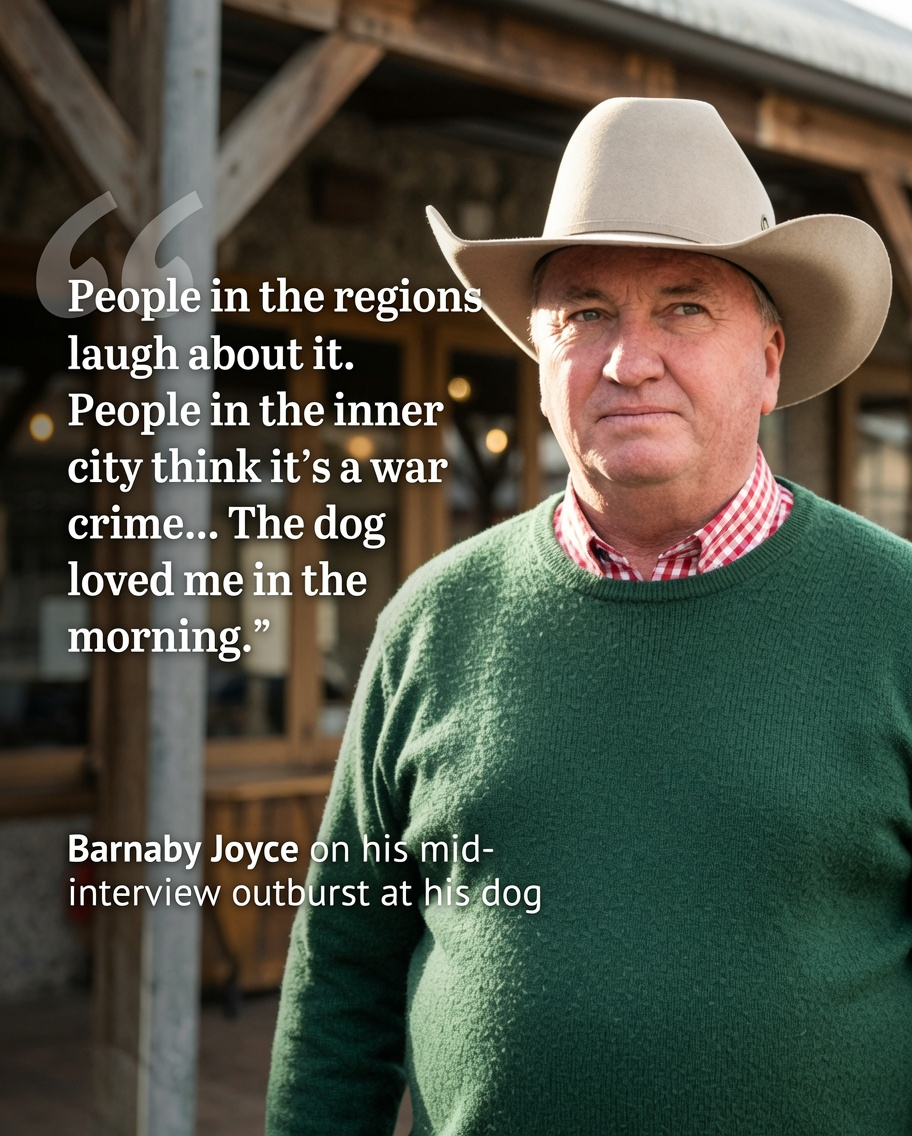
“People in the regions laugh about it. People in the inner city think it’s a war crime,” Joyce said, arguing the backlash demonstrates the different perspectives held by Australians living in metropolitan and rural communities.
A television interview that went viral
The incident unfolded during a live appearance on ABC’s 7.30, where Joyce was being questioned by host Sarah Ferguson about Pauline Hanson’s controversial European trip, including her meetings with British far-right activist Tommy Robinson.
Midway through answering a question, Joyce suddenly turned away from the camera and shouted “Sit down!” before apologising and explaining that the interruption came from Stella barking beneath the deck outside his home.
When Ferguson encouraged him to ignore the dog and continue answering the question, Joyce responded, “Don’t be rude. Otherwise, this interview will come to a grinding halt,” creating another widely shared television moment.
The exchange quickly eclipsed the political discussion itself, becoming one of Australia’s most talked-about television clips of the week and attracting coverage from international media.
Joyce defends his relationship with Stella
Despite criticism from some viewers and animal welfare advocates, Joyce has repeatedly insisted there is nothing unusual about the way he spoke to Stella.
He said the young dog had been barking continuously directly beneath his feet, making it difficult to hear questions during the interview.
“It’s a farm dog,” Joyce explained, adding that working dogs are commonly given loud verbal commands by farmers.
He also dismissed suggestions the incident reflected poor treatment of animals, joking that Stella still loved him afterwards and that their relationship remained unchanged.
“I loved the dog before, I love the dog after, the dog loves me,” Joyce said, adding that the media attention surrounding Stella had become excessive.
Later apology
Although Joyce defended his actions, he later softened his tone during a television interview, acknowledging that frustration had contributed to the outburst.
He said the dog had been barking incessantly while he was simultaneously trying to answer difficult political questions.
“I verbally assaulted the dog, which I’m incredibly sorry for,” Joyce said, while reiterating that Stella had not been harmed and that he had simply reacted in the heat of the moment.
Criticism from animal welfare advocates
The incident prompted criticism from Victorian Animal Justice Party MP Georgie Purcell, who argued that yelling aggressively at a dog should not be normalised.
Purcell wrote on social media that anyone who believes such behaviour is acceptable should reconsider how animals are treated, with her comments generating significant online discussion among supporters and critics alike.
Animal rights organisation PETA also criticised the exchange, saying dogs communicate through barking and that shouting at them can be intimidating rather than effective.
Supporters of Joyce, however, argued the criticism ignored the realities of working farms, where dogs are routinely trained using firm verbal commands while assisting with livestock.
The regional versus city argument
Joyce’s defence has centred less on the dog itself than on what he believes the public reaction says about Australia’s cultural divide.
Representing a rural electorate for many years, Joyce has frequently argued that urban Australians often misunderstand everyday life in farming communities.
He contends that behaviours considered ordinary when managing livestock or working dogs are sometimes viewed very differently by people who have little exposure to agricultural life.
For Joyce, the reaction to Stella became another example of what he sees as a growing disconnect between regional Australia and inner-city voters.
Political attention shifts away from policy
Ironically, the viral dog moment overshadowed the political issues Joyce had intended to discuss during the interview.
He had appeared on the program primarily to defend Pauline Hanson following criticism of her recent overseas visit, which included appearances alongside controversial figures and comments that generated widespread political debate.
Instead, headlines around Australia and overseas focused almost entirely on Stella, with footage of Joyce shouting at the dog circulating widely across television broadcasts and social media platforms.
Joyce later joked that his dog had received more political attention than many elected representatives, suggesting the intense media focus reflected a shortage of more significant issues to discuss.
Pauline Hanson backs her deputy
One Nation leader Pauline Hanson brushed aside the controversy, laughing when asked about the incident after returning from overseas.
She described the moment as an example of live television capturing genuine human behaviour and said it reflected why she appreciated having authentic people around her.
Hanson said she did not know what else had been happening around Joyce at the time but regarded the incident as more amusing than controversial.
A debate extending beyond one television moment
Although the incident itself lasted only a few seconds, the discussion that followed has evolved into a broader debate about cultural expectations, animal welfare and the differences between urban and rural Australia.
For some Australians, Joyce’s reaction represented an ordinary interaction with a working farm dog during a stressful interview. Others viewed it as an unnecessarily aggressive response that public figures should avoid.
The differing interpretations illustrate how the same event can be understood through very different cultural experiences, particularly in a country where farming communities and major cities often hold contrasting views on issues ranging from agriculture to animal management.
Whether remembered as an amusing television mishap or as another example of Australia’s increasingly polarised public debate, the brief exchange has become one of the week’s most talked-about political moments—one that Barnaby Joyce believes says as much about the country itself as it does about his young farm dog, Stella.






