Barnaby Joyce’s barking TV moment overshadows One Nation’s political message

What was intended to be a serious television appearance defending One Nation leader Pauline Hanson instead became one of Australia’s most widely shared political moments, after Barnaby Joyce abruptly interrupted a live interview to shout at his barking farm dog.

The unscripted exchange unfolded during ABC’s 7.30 program, where host Sarah Ferguson questioned Joyce about a series of controversies surrounding One Nation and Pauline Hanson’s recent overseas trip.

Instead of the discussion focusing solely on immigration, political alliances and the party’s direction, viewers watched as Joyce suddenly shouted “Sit down!” toward his off-camera dog, Stella, before apologising and attempting to continue the interview. The interruption immediately became the defining moment of the broadcast and quickly spread across television bulletins, online news sites and social media.
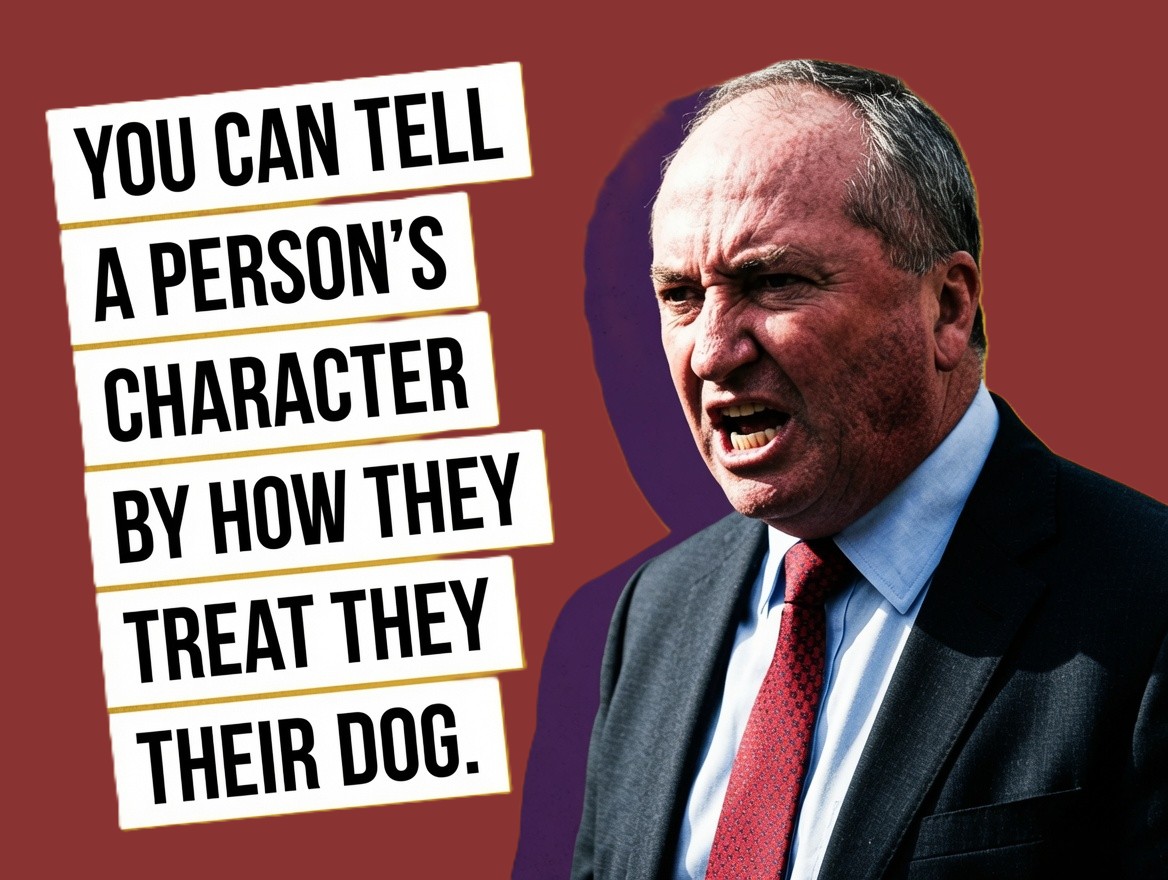
Barnaby Joyce during his ABC 7.30 interview that went viral after an interruption from his dog

The interview itself was already politically challenging.

Ferguson questioned Joyce about Hanson’s controversial European itinerary, which included an appearance with British far-right activist Tommy Robinson, and asked whether joining One Nation had drawn him toward a more hardline political movement.

Joyce defended his party while rejecting suggestions that One Nation promoted intolerance, arguing instead that the party was attracting growing public support because many Australians felt ignored by the major parties.

Yet the viral dog interruption rapidly eclipsed those political arguments.

Within hours, clips of the exchange had circulated widely online, prompting jokes, memes and commentary that shifted attention away from policy and toward Joyce’s reaction to Stella’s persistent barking.

The episode illustrates how modern political communication can be transformed by a single unscripted moment.

Media analysts have long observed that viewers often remember spontaneous incidents more vividly than carefully prepared political messages. In Joyce’s case, a few seconds involving his dog generated significantly greater public attention than the party positions he had appeared to explain.

The supplied commentary accompanying the incident adopts an openly satirical tone.

Rather than presenting a straightforward news account, the article portrays Joyce as attempting to accomplish several impossible political tasks simultaneously: defending Pauline Hanson while distancing himself from controversy, responding to aggressive questioning from Sarah Ferguson and maintaining composure while dealing with a barking dog.

Using irony throughout, the commentary argues that the interview reflected broader difficulties confronting One Nation.

It jokes that Joyce appeared trapped between political controversies involving immigration policy, Hanson’s overseas engagements and ongoing media scrutiny, before concluding that even the family dog seemed to have joined the interrogation.

Those observations represent the opinion of the article’s author rather than established fact, but they illustrate how political satire frequently uses humour to critique public figures and party strategy.

Political satire has become an increasingly influential feature of Australian media, particularly during election periods and moments of heightened political controversy.

Rather than simply reporting events, satirical commentary often exaggerates personalities and circumstances to draw attention to perceived inconsistencies or political vulnerabilities.

Joyce’s interview provided particularly fertile material because it combined serious political debate with an unexpected comic interruption.

After the interview, Joyce sought to reassure viewers that there had been no lasting consequences for Stella.

Speaking the following day, he explained that the dog had been barking continuously beneath the deck where the interview was taking place, making it difficult to hear questions and maintain concentration.

He also stressed that Stella remained a valued working farm dog and joked that “the dog still loves me”, dismissing suggestions the exchange reflected anything more than ordinary life on a rural property.

Pauline Hanson also treated the incident lightly, suggesting the moment simply demonstrated Joyce’s authenticity and the unpredictable nature of live television.

Supporters argued the interruption made Joyce appear more relatable, while critics contended it symbolised a broader sense of disorder surrounding One Nation’s recent public appearances.

The interview occurred against a backdrop of heightened attention on One Nation.

Hanson’s overseas visit, comments on immigration, meetings with controversial political figures and the party’s growing polling support have all generated significant public debate during recent weeks.

Joyce, a former Deputy Prime Minister who joined One Nation after leaving the National Party, has consequently become one of the party’s most visible defenders in national media interviews.

That visibility has also increased scrutiny.

Throughout the ABC interview, Ferguson repeatedly pressed Joyce on whether he was comfortable with the direction in which Hanson was taking the party, asking whether his move to One Nation aligned him with more divisive political positions.

Joyce rejected that characterisation and instead highlighted what he described as growing electoral support for the party.

For many observers, however, the substance of that exchange quickly faded behind the viral image of a senior politician suddenly shouting at an unseen dog.

The incident has since become another memorable chapter in Joyce’s long history of headline-grabbing public moments, adding to a political career already marked by colourful interviews, outspoken remarks and episodes that frequently attract attention well beyond the policy debates themselves.

Whether viewed as harmless comic relief or an unfortunate distraction, the episode demonstrates the reality of modern political media.

Carefully prepared messages can disappear within seconds when an unscripted moment captures the public imagination.

For Barnaby Joyce, the barking dog may have interrupted only a few moments of a television interview, but it ultimately became the story that far more Australians remembered than the political arguments he had set out to make.


Related Posts

Editorial illustration of Steven Miles and David Crisafulli in Queensland politics

Steven Miles Challenges Crisafulli Over Child Safety After Amanda Camm Quits

Queensland Opposition Leader Steven Miles has challenged Premier David Crisafulli to appoint an experienced replacement for Amanda Camm after she announced her decision to step down from the child safety and domestic and family violence portfolios. Miles says the choice will reveal how seriously the government takes services for vulnerable children and families. Crisafulli has praised Camm’s record and defended the reforms initiated during her term. Camm says her decision was personal and followed major surgery and an incomplete recovery. She has also referred to the stress of her ministerial workload and the impact of public harassment. Her resignation should not be portrayed as an admission that the criticism of her administration was correct. The policy dispute and the reasons she has given for leaving office are separate facts.

Editorial illustration of Sharon Freund and Michael Allen with courthouse imagery, not a photograph of proceedings

Judge Sharon Freund Challenges Watchdog Referral Amid Dispute With Michael Allen

NSW Deputy Chief Judge Sharon Freund has taken her challenge to a watchdog referral before the Court of Appeal amid a prolonged dispute involving Local Court Chief Judge Michael Allen. The latest proceedings concern whether decisions and observations arising from a Judicial Commission process were reached and handled lawfully. The legal contest remains unresolved, and the allegations at its centre must not be treated as disciplinary findings against either judge. Published accounts of the Court of Appeal proceedings say Freund’s lawyers have challenged the Attorney-General’s referral of her conduct to the NSW Judicial Commission. The dispute has been linked to questions about the handling of a criminal case involving a judicial colleague’s adult child and to competing allegations about procedural propriety. Those accounts remain contested, and the Court of Appeal’s task is not identical to a final disciplinary inquiry.

Editorial illustration of Angie Bell and Anne Aly, Australian parliamentary debate

Angie Bell Calls Stoning Remarks ‘Regrettable’ After Anne Aly Criticism

Liberal frontbencher Angie Bell has described her earlier parliamentary remarks about Small Business Minister Anne Aly and Prime Minister Anthony Albanese as regrettable, calling them a poor choice of words after a furious public dispute over violent imagery in political debate. Bell says the comment was neither helpful nor planned, and that she withdrew it and tried to rectify the matter with Aly. The new statement follows criticism from Aly, who described the original language as racist and misogynistic. The exchange is significant not because the words have just been spoken, but because Bell has now publicly addressed them. Her expression of regret should be reported accurately without claiming that she accepted every criticism Aly made or that the parties have resolved their disagreement.

Editorial illustration of Nina Taylor and Fishermans Bend urban development

Nina Taylor Defends Fishermans Bend Plans as Rivals Demand Faster Transport

Labor MP Nina Taylor has defended the Victorian government’s approach to Fishermans Bend as rival candidates in the Albert Park electorate demanded faster public transport and better infrastructure for the growing inner-Melbourne precinct. The debate at a local election forum highlighted the gap between plans for a major urban renewal area and the transport connections residents and businesses can already use. Candidates questioned why promised tram and rail links remain distant prospects despite long-running plans to accommodate substantially more homes and jobs. Taylor pointed to recent planning steps, the Metro Tunnel and expanded bus services, while opponents pressed the government to deliver infrastructure earlier. The disagreement concerns priorities, funding and sequencing; a planning announcement should not be confused with a completed railway or tram service.

Editorial illustration of Angus Taylor and Chris Bowen with the Snowy 2.0 hydroelectric project

Angus Taylor Demands Chris Bowen Resign Over Snowy 2.0 Cost Blowout

Opposition Leader Angus Taylor has called for Energy Minister Chris Bowen to resign after Snowy Hydro revised the cost and completion forecast for Snowy 2.0, reviving a political argument over who is responsible for one of Australia’s most expensive energy projects. The company’s updated target is $22.2 billion, with an allowance for a cost of up to $25 billion, while commissioning is now expected in late 2029. The latest assessment is a major test for the Commonwealth-owned company and for governments of both political persuasions. Taylor was energy minister when the project was approved under the Coalition. Bowen, who oversees the project as a shareholder minister under Labor, says the early design and engineering assumptions left a lasting problem. Neither side’s political account changes the figures Australians now need to assess.

Editorial illustration of David Pocock and Anthony Albanese with parliamentary funding documents

David Pocock Challenges Albanese Over Helen Haines Funding Dossier

Independent senator David Pocock has challenged Prime Minister Anthony Albanese’s explanation of a document circulated from his office about fellow independent Helen Haines, drawing a sharp distinction between routine political briefing and material that can cast doubt on an MP’s integrity. Albanese says the file concerned Haines’s requests for funding for her electorate and was not intended as a personal attack. The row has taken on particular sensitivity after the alleged vehicle attack that left Haines critically injured. That incident is the subject of a separate criminal investigation. No established evidence links the circulation of the political document to the alleged attack or identifies political briefing as a motive. Treating the two events as causally connected would go beyond the facts.




