One Nation leader Pauline Hanson has once again found herself at the centre of a national debate after a televised conversation with a 15-year-old Muslim student touched on religion, women’s rights, immigration and Australia’s multicultural identity.
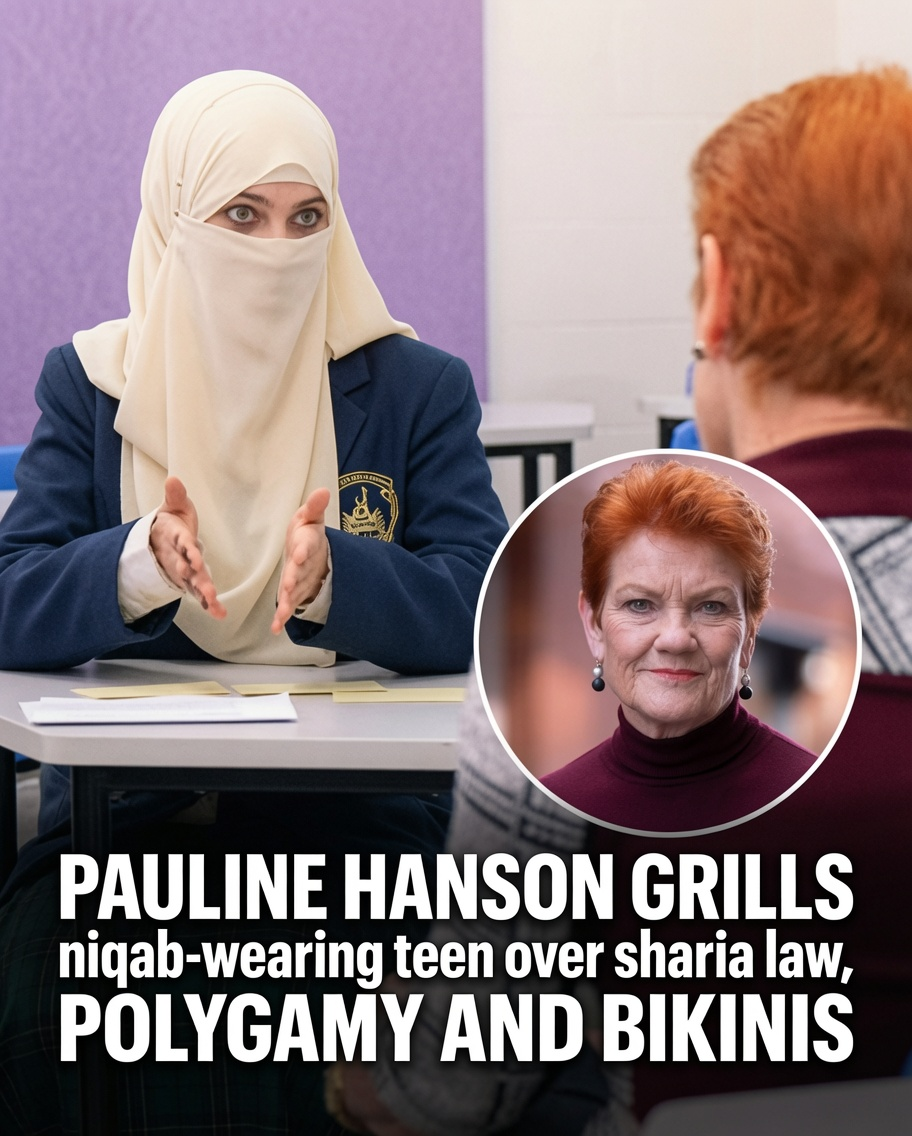
The discussion formed part of Seven’s Spotlight documentary, which followed Hanson during a series of meetings in Australia and the United Kingdom exploring immigration, social cohesion and national security. One of the documentary’s most widely discussed moments came when Hanson visited the Islamic College of Brisbane and spoke at length with Year 10 student Nabiha, who wears a niqab covering all but her eyes.
During the exchange, Hanson stressed that her concerns were directed at what she described as increasing radicalisation rather than Muslims generally.
“We are seeing so much radicalisation happening in this country,” Hanson said.
“People are in fear now of attacks. Most of those attacks come from radical Islam in this country. That’s where my concern is.”
Her comments reflected long-held positions on immigration and national security that have defined much of her political career and remain central to One Nation’s platform.
The conversation then turned to Nabiha’s decision to wear the niqab.
Hanson asked whether the face covering had been chosen freely or whether it was influenced by family expectations.
Nabiha replied that although her mother also wears a niqab, the decision had been entirely her own.
“As I grew older, my urge to wear it grew stronger. It was my own choice,” she explained.
She said wearing the niqab strengthened her relationship with God and allowed people to focus on her character rather than her appearance.
“It also makes me feel liberated from social beauty standards,” Nabiha said.
“People can’t judge me based on my appearance. They focus more on how I speak and how I interact with others.”
Hanson acknowledged the student’s explanation while expressing concern that some women around the world are pressured into wearing religious coverings.
“It’s your choice. I acknowledge that and I accept that,” Hanson responded.
“But a lot of women are forced to wear it when they don’t want to.”
The discussion broadened into questions about Islamic law.
When asked whether she believed in Sharia law, Nabiha answered yes, but clarified that it should not override Australian law.
Asked whether arranged marriages should be permitted, she said she saw no issue provided there was mutual consent and the child agreed to the arrangement.
Those responses prompted renewed discussion across Australia about the distinction between religious beliefs, cultural traditions and the country’s secular legal system.
The interview is particularly significant given Hanson’s history of campaigning against Islamic face coverings.
She famously wore a burqa into the Senate chamber in 2017 to promote a ban on full-face coverings, an action that attracted widespread criticism from across the political spectrum.
In 2025 she repeated a similar protest and was formally censured by the Senate after again wearing Islamic dress inside Parliament.
For supporters, Hanson has consistently argued that full-face coverings present security concerns because they conceal identity in public spaces.
Critics, however, have accused her of unfairly targeting Muslim Australians and contributing to social division.
The Islamic College of Brisbane has itself previously been at the centre of public attention over debates surrounding anti-Muslim sentiment and community relations, making Hanson’s visit especially closely watched.
Despite their obvious differences, the exchange between Hanson and Nabiha remained respectful throughout.
Rather than ending in confrontation, the conversation allowed each participant to explain their perspective directly.
Following the broadcast, Nabiha published an opinion piece reflecting on the experience, saying she hoped Hanson had been able to see beyond stereotypes.
“I hope that, for a brief moment, she stopped seeing a niqab and started seeing a young Australian who loves robotics, dreams of reaching space and believes that her faith and her country are not competing identities,” Nabiha wrote.
School representatives later said they agreed to participate because meaningful dialogue was preferable to allowing misconceptions to persist.
They argued that face-to-face conversations provide opportunities for understanding that rarely emerge through political debate alone.
The interview comes at a time when immigration, multiculturalism and national identity have returned to the forefront of Australian politics.
Record migration following the COVID-19 pandemic, concerns over housing affordability, and international security tensions have intensified public discussion about integration and Australia’s immigration settings.
Questions surrounding religious freedom have also become more prominent, particularly regarding the balance between individual rights and broader public interests.
Australia’s legal framework protects freedom of religion under federal anti-discrimination laws while maintaining that Australian law takes precedence over religious rules or customs.
Successive governments have emphasised that all Australians, regardless of faith, are subject to the same legal system.
National security agencies have likewise consistently distinguished between Islam as a religion and the small number of individuals influenced by violent extremist ideologies.
Australian Security Intelligence Organisation (ASIO) has repeatedly stated that violent extremism can emerge from multiple ideological backgrounds, including both religiously motivated and ideologically motivated movements, and has urged Australians to avoid conflating entire communities with the actions of extremists.
Hanson’s comments nevertheless reflect concerns held by a segment of the Australian electorate that stronger measures are required to combat extremist violence and ensure successful integration of new migrants.
Others argue Australia’s multicultural model has delivered significant economic and social benefits and caution against rhetoric that risks stigmatising entire communities.
The timing of the interview has also attracted attention because it coincides with renewed political momentum for One Nation.
Recent opinion polling has shown the party improving its primary vote after earlier declines, while Labor’s support softened over the same period.
Although individual polls vary and political support can shift quickly, immigration and national identity are increasingly prominent issues heading towards Australia’s next federal election.
For Hanson, the televised discussion reinforced her longstanding message that difficult conversations about immigration, security and cultural integration should not be avoided.
For Nabiha, it became an opportunity to present a personal perspective rarely heard in Australia’s often polarised political debate.
The exchange ultimately illustrated how two Australians with sharply different worldviews could engage directly, respectfully and publicly on issues that continue to shape national conversations about identity, faith and the future of multicultural Australia.






