One Nation MP Barnaby Joyce has warned Australia risks importing the social tensions and political polarisation seen in parts of the United Kingdom unless governments take stronger action to reduce immigration and better manage social integration.
Joyce made the remarks following One Nation leader Pauline Hanson’s controversial fact-finding visit to Britain, where she met British activist Tommy Robinson and toured Luton as part of Seven’s Spotlight documentary.
The visit has generated widespread debate in Australia, with critics focusing on Hanson’s decision to spend time with Robinson, a far-right activist with multiple criminal convictions, while supporters argue the more important issue is the immigration debate that prompted the trip in the first place.
Speaking after the program aired, Joyce said the central lesson from Britain was not Robinson himself but the social conditions that allowed highly polarised political movements to emerge.
“The big message” from Britain, he argued, was the growing “friction and division” visible in parts of the country.
Joyce suggested Australia should avoid repeating what he believes are Britain’s policy mistakes by addressing migration pressures before social resentment becomes entrenched.
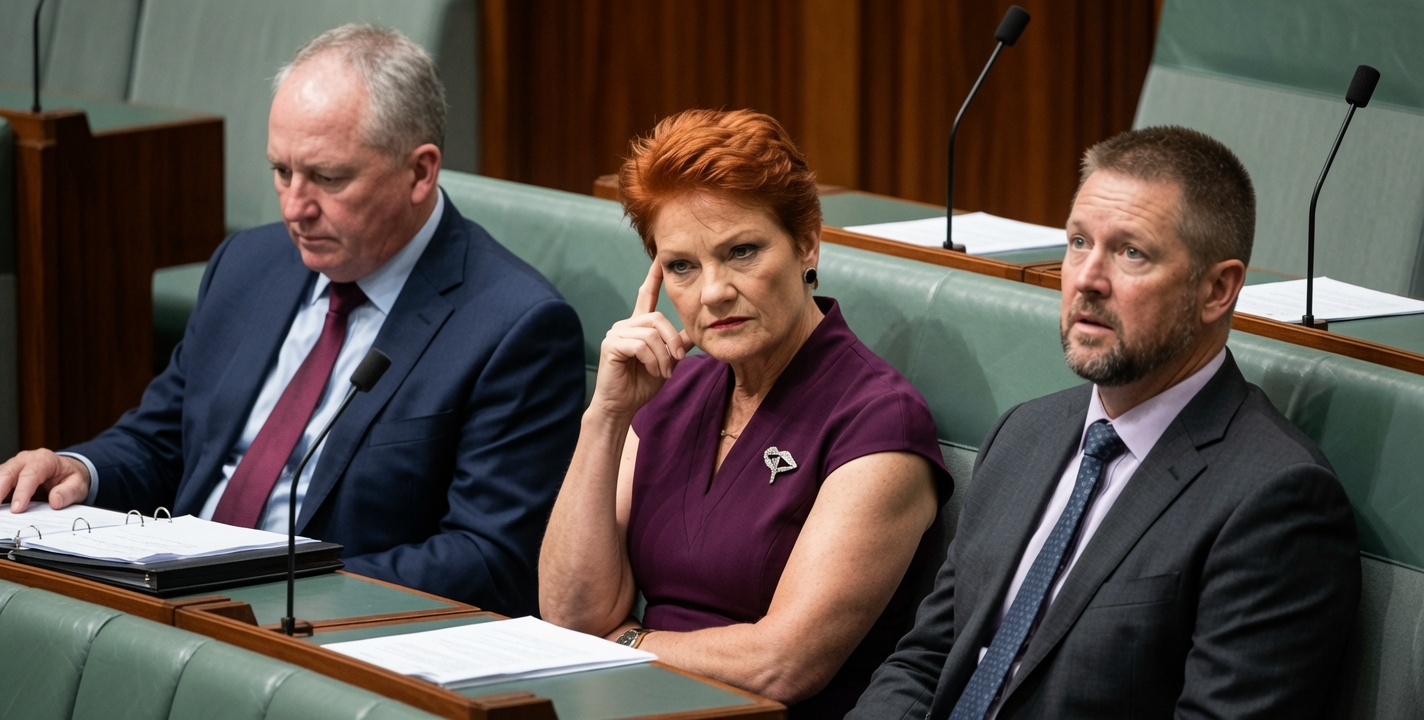
“There quite obviously are sections of England that no longer look like England and are starting to look a lot like Bangladesh or Pakistan,” Joyce said.
“That’s what a lot of English people are saying. And because there’s this resentment building up, you’re getting the Tommy Robinsons.”
He added that Australia could eventually produce similar political figures if comparable conditions developed.
“You’re going to get the Tommy Robinsons in Australia if you end up in the same situation as England. And I don’t want that. I really don’t.”
Immigration moves to the centre of political debate
Joyce’s comments reflect the increasingly prominent role immigration has assumed in Australian politics during 2026.
Following record post-pandemic migration levels, housing affordability, rental shortages, infrastructure capacity and population growth have become major political issues.
The Albanese government has already announced measures designed to reduce migration from its post-pandemic peak while maintaining skilled migration needed to support the labour market.
One Nation argues those measures remain insufficient.
The party has consistently advocated substantially lower migration, tighter border controls and stronger expectations that migrants integrate into Australian civic life and institutions.
Joyce has framed the issue less as opposition to immigration itself than as opposition to migration levels that outpace infrastructure, housing and community capacity.
His comments also echo longstanding One Nation policy that argues rapid demographic change can undermine social cohesion if governments fail to plan appropriately.
Britain has become a political case study
Pauline Hanson described her UK visit as a fact-finding mission examining migration, national identity and multiculturalism.
During the trip she met Robinson, appeared on his podcast and visited Luton, a town that has become symbolic in Britain’s long-running debates over immigration and community integration.
Luton is one of England’s most ethnically and religiously diverse urban centres.
Supporters of Hanson argue the town illustrates how rapid demographic change can create social and political challenges if integration fails.
Critics respond that Luton also demonstrates the success of multicultural Britain, with diverse communities contributing to business, education and public life despite periodic tensions.
The reality is considerably more complex than either narrative alone.
Like many large urban centres, Luton has experienced demographic change over several decades through migration from South Asia, Eastern Europe, Africa and elsewhere.
It has also faced economic restructuring, housing pressures and episodes of social unrest that cannot be attributed solely to immigration.
These overlapping factors have made the town a recurring reference point in debates over multiculturalism and national identity.
Why Tommy Robinson became part of the argument
Joyce attempted to shift attention away from Robinson’s personality towards what he sees as the conditions that produced him.
Robinson, whose real name is Stephen Yaxley-Lennon, first gained prominence as co-founder of the English Defence League and has remained one of Britain’s most controversial anti-Islam activists.
His criminal record includes convictions for assault, mortgage fraud, using false travel documents and contempt of court.
Critics argue those convictions make him an unsuitable figure for any Australian parliamentarian to promote.
Joyce’s counterargument is that Robinson should be understood as a symptom rather than the cause of wider public dissatisfaction over immigration and integration.
That distinction is politically important.
If Robinson’s popularity is interpreted as a consequence of broader policy failures, then governments seeking to avoid similar political movements may conclude they should address underlying concerns about migration and social cohesion.
If, however, Robinson is viewed primarily as an extremist exploiting social anxiety, critics argue governments should focus on countering divisive rhetoric while continuing evidence-based immigration policy.
Is Britain becoming more divided?
The United Kingdom has experienced an intense national debate over immigration for more than a decade.
Brexit itself was driven partly by concerns over migration, border control and sovereignty.
Since then, immigration has remained one of the country’s most politically sensitive issues.
Recent years have seen continuing disputes over asylum seekers crossing the English Channel, integration, housing pressures and public services.
Anti-immigration demonstrations and counter-protests have occurred in several English communities, reflecting broader political polarisation rather than a single cause.
At the same time, Britain continues to operate as a diverse democracy where millions of people from different ethnic and religious backgrounds live peacefully alongside one another.
Official statistics do not support the conclusion that multicultural communities are inherently unstable.
Social outcomes vary significantly depending on local economic conditions, education, employment opportunities, housing availability and community engagement.
This broader context is important because Joyce’s remarks reflect a political interpretation of Britain’s experience rather than a settled factual conclusion accepted across the political spectrum.
Australia faces different circumstances
Although comparisons between Australia and Britain are common in political debate, the two countries differ in important ways.
Australia’s migration program remains heavily skills-based, with many permanent migrants selected through employment, education and family categories.
Britain’s migration profile has been shaped by different historical, legal and geographic factors, including proximity to continental Europe and irregular migration across the English Channel.
Australia also maintains much stricter border controls for unauthorised maritime arrivals than Britain currently exercises over Channel crossings.
However, Australia faces its own challenges.
Rapid population growth following the pandemic has coincided with severe housing shortages, rental inflation and infrastructure pressures across major cities.
Those conditions have increased public concern about whether migration settings remain aligned with housing supply, transport capacity and essential public services.
That is the context in which One Nation has sought to expand its electoral appeal.
Labor rejects One Nation’s framing
The Albanese government argues migration remains essential for addressing labour shortages, supporting economic growth and meeting workforce demand in sectors including health care, construction and aged care.
Labor also points to recent policy changes designed to reduce net overseas migration from the exceptional levels recorded immediately after Australia’s borders reopened.
Ministers have repeatedly argued that responsible migration policy requires balancing economic needs with housing and infrastructure capacity rather than pursuing dramatic reductions.
Government figures have also criticised Hanson and Joyce for presenting immigration primarily through the lens of social conflict.
Prime Minister Anthony Albanese recently criticised Hanson’s overseas tour, suggesting Australia should not define itself through the rhetoric of fringe political movements overseas.
The broader question of integration
Joyce’s warning raises a broader issue that extends beyond migration numbers alone.
Countries experiencing significant migration also face questions about language, education, employment, housing, civic participation and integration.
Many policy experts argue successful immigration depends not only on selecting migrants but also on ensuring governments invest sufficiently in infrastructure, schools, health services and community programs.
Poor planning can generate pressure regardless of where migrants come from.
Conversely, well-managed migration accompanied by adequate investment can contribute to economic growth while maintaining social cohesion.
That is why the debate cannot be reduced simply to annual migration targets.
It also involves long-term planning, housing construction, labour markets and the capacity of governments to respond to rapid population change.
One Nation seeks to broaden its appeal
Joyce’s intervention also illustrates how One Nation is attempting to broaden its political message.
Rather than focusing exclusively on immigration, the party increasingly links migration with housing affordability, infrastructure congestion, health services, public finances and national identity.
This integrated narrative has become central to the party’s campaign as opinion polling suggests growing voter dissatisfaction with both major parties.
Joyce, who joined One Nation after leaving the National Party, has brought additional attention to that strategy because of his long experience in federal politics and his appeal among regional voters.
Whether that approach translates into sustained electoral support remains uncertain.
Polling has fluctuated significantly during 2026, but One Nation has consistently recorded stronger support than in previous federal election cycles.
A debate likely to continue
Joyce’s comments are unlikely to settle Australia’s immigration debate.
Instead, they reinforce two sharply different political interpretations.
One Nation believes Britain demonstrates the long-term consequences of maintaining migration levels that outstrip integration and infrastructure.
Labor and many migration experts argue the answer lies in better planning, targeted reforms and continued investment rather than fundamentally reshaping Australia’s immigration model.
The discussion is also becoming increasingly intertwined with housing affordability, cost-of-living pressures, workforce shortages and national identity.
Those issues are unlikely to disappear before Australia’s next federal election.
Whether Australians ultimately accept Joyce’s warning will depend less on events in Britain than on their own experience at home.
If housing remains difficult to afford, infrastructure struggles to keep pace with population growth and community confidence weakens, arguments for tighter migration settings may continue to gain political traction.
If governments demonstrate they can balance economic growth with adequate housing, public services and social cohesion, support for more moderate migration policies may prove more resilient.
For now, Joyce has made clear that he views Britain’s experience not as a distant political story but as a warning Australia should heed before similar divisions take hold.






