Australia’s prolonged squeeze on household living standards has become a new political battleground, with One Nation seizing on international economic data to argue Australians are working harder while having less money left to spend.
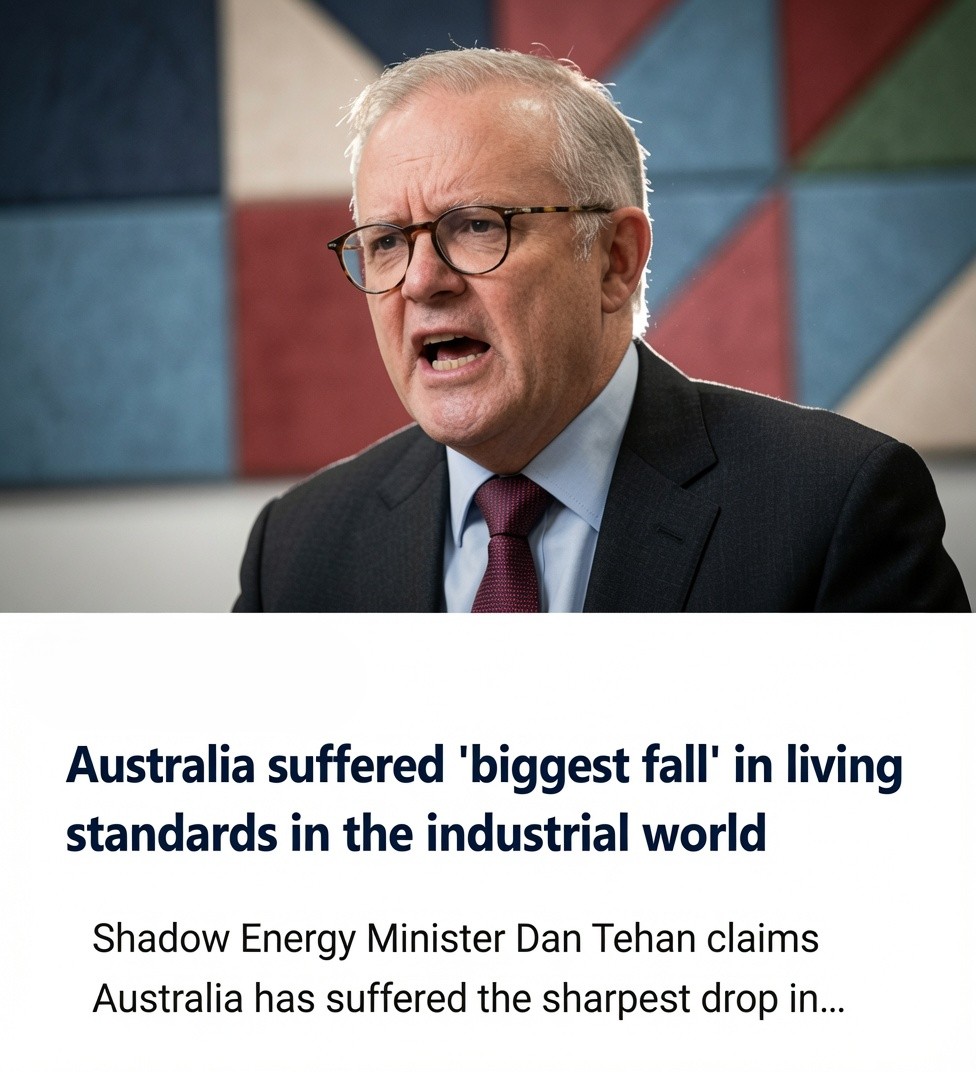
The party has pointed to Australia’s weak performance on household incomes compared with other developed economies, declaring that people who feel they are “going backwards” are experiencing a genuine deterioration in their financial position.
Its message is uncompromising: Australians are earning less in real terms, paying more for essential expenses and suffering because of government policy.
But while the political attribution is contested, the underlying economic problem is real.
Australia has endured an unusually severe decline in real household disposable income in recent years, with inflation, higher mortgage costs, rising tax payments and weak productivity growth combining to squeeze household finances.
The OECD’s 2026 Economic Survey of Australia said real disposable incomes had “declined markedly” following the pandemic as high inflation eroded real wages, bracket creep increased tax burdens and rising mortgage payments hit indebted households.
That assessment gives substantial weight to concerns about declining living standards, although it does not support the much broader claim that every individual Australian is worse off or that a single government policy explains the entire decline.
What happened to Australian living standards?
Living standards can be measured in several ways, but one of the most useful indicators is real household disposable income per person.
Unlike headline GDP, which measures the overall size of the economy, this measure looks more closely at the income households have available after accounting for factors such as taxes and transfers, while adjusting for inflation and population.
On that measure, Australia experienced an exceptionally difficult period after the pandemic.
OECD comparisons showed Australia recording some of the sharpest falls in real household disposable income per capita among advanced economies during parts of the post-pandemic period.
In 2023, Australia recorded a particularly steep annual decline, driven in significant part by higher interest payments and increased taxation. Subsequent data showed some improvement, but the cumulative pressure on households remained substantial.
The Reserve Bank of Australia has also identified a clear decline in real household incomes beginning in late 2021.
That timing matters politically.
The deterioration began before the Albanese government took office in May 2022, but much of the financial pain experienced by households occurred during Labor’s period in government as inflation remained elevated and interest rates rose sharply.
This creates an important distinction between economic conditions occurring under a government and conditions caused entirely by that government.
Governments influence taxation, spending, regulation, energy policy, housing programs and migration settings, all of which can affect household living standards. But inflation, global commodity markets, international supply disruptions and monetary policy decisions by the independent Reserve Bank also play major roles.
Inflation changed what wages could actually buy
For many households, the most visible problem has been the gap between rising wages and rising prices.
A worker can receive a pay rise in dollar terms and still become poorer in practical terms if the cost of goods and services increases faster than their income.
That is what happened to many Australians during the inflation surge.
Food, electricity, insurance, rents, construction costs and a range of everyday services became significantly more expensive. Even as nominal wages increased, purchasing power was eroded.
The effect was especially painful because households do not experience inflation as an abstract national statistic.
They experience it through weekly grocery bills, rent increases, mortgage repayments, insurance renewals, electricity accounts and the cost of filling a car.
For families whose budgets were already tight, relatively modest increases across multiple essential expenses could absorb hundreds or thousands of dollars in additional annual income.
Inflation has since moderated significantly from its peak, but lower inflation does not mean prices return to where they were before.
It means prices are generally rising more slowly.
That distinction helps explain why households can continue to feel under severe financial pressure even when official inflation figures improve.
Interest rates delivered another major blow
The inflation surge triggered one of the fastest monetary tightening cycles Australia had experienced in decades.
The Reserve Bank began lifting the cash rate in May 2022, taking it rapidly from the emergency settings introduced during the pandemic.
For households with large variable-rate mortgages, the consequences were dramatic.
Monthly repayments increased by hundreds or, in some cases, thousands of dollars depending on the size of the loan.
Australia is particularly exposed to interest-rate changes because of high household debt and the prevalence of mortgages that reprice relatively quickly compared with long-term fixed-rate lending systems in some other countries.
That meant higher rates flowed rapidly into household budgets.
The pressure was unevenly distributed.
People who owned their homes outright were largely insulated from higher mortgage repayments and some savers benefited from higher deposit rates.
Renters faced a different crisis as rental shortages and rising housing costs pushed rents higher across much of the country.
Mortgage holders, particularly younger families who bought near the peak of the housing market with large debts, often experienced the sharpest direct financial shock.
This is another reason broad political claims that “every Australian” has become worse off require caution. The economic squeeze has been widespread, but its severity has varied enormously between households.
Tax and bracket creep added to the pressure
The OECD has specifically identified bracket creep as another factor weighing on Australian disposable incomes.
Bracket creep occurs when nominal wages rise with inflation and workers move into higher effective tax burdens even when their real purchasing power has not increased by the same amount.
Before tax thresholds or rates are adjusted, governments can collect more personal income tax as wages rise nominally.
This can create a situation in which a worker receives a pay increase but finds that inflation and additional taxation consume much of the benefit.
Tax cuts have subsequently provided relief for many households, but the earlier combination of inflation, bracket creep and higher mortgage costs contributed to the unusually sharp decline in real disposable income.
Australia remains wealthy — but growth has been weak
The living-standards debate requires another important distinction.
Australia has not suddenly become a poor country.
The OECD continues to describe Australia as having high living standards by international standards, supported by strong institutions, a highly educated workforce and substantial economic resources.
International comparisons of household disposable income also continue to place Australia above the OECD average on several measures.
The concern is the direction and pace of change.
Australians became accustomed over many decades to rising real incomes and improving material living standards.
When real disposable income per person falls sharply — particularly while housing, energy and essential services become more expensive — households experience a reversal of that expectation.
The OECD’s 2026 assessment described Australia as having experienced weak economic growth in recent years and highlighted slow productivity growth, housing affordability and fiscal pressures as major long-term challenges.
Those structural issues extend beyond any single electoral term.
Productivity may be the biggest long-term problem
While inflation and interest rates dominate household conversations, productivity is fundamental to sustainable improvements in living standards.
Productivity measures how efficiently an economy turns labour, capital and technology into goods and services.
When productivity rises, businesses can generally afford stronger real wages without simply passing higher costs on through prices.
When productivity stagnates, improving living standards becomes much harder.
Australia’s productivity performance has been weak for years, prompting repeated warnings from economists, the Productivity Commission, Treasury and international institutions.
The challenge spans multiple areas, including business investment, competition, infrastructure, regulation, skills, technology adoption and the efficiency of government services.
There is no single policy capable of reversing the problem quickly.
But without stronger productivity growth, governments face increasingly difficult choices between higher taxes, reduced spending, greater debt or slower improvements in public services and household incomes.
Housing has become central to the living-standards crisis
Any discussion of Australian living standards is incomplete without housing.
For homeowners who purchased property decades ago, rising house prices created enormous wealth.
For younger Australians trying to enter the market, the same price increases created a formidable barrier.
Australia now faces a severe housing affordability problem involving high purchase prices, expensive rents, construction constraints and shortages in many high-demand areas.
Rapid population growth has added to housing demand at a time when new supply has struggled to keep pace.
Governments at federal, state and local levels share responsibility for different parts of the system, from migration and taxation to planning, infrastructure and development approvals.
The Albanese government has committed to ambitious housing supply targets and introduced measures intended to increase construction and improve affordability.
However, building enough homes has proved difficult as the construction industry deals with high costs, labour shortages, business failures and planning constraints.
For renters and aspiring first-home buyers, housing can therefore overwhelm improvements elsewhere in the household budget.
One Nation turns economic pain into a political argument
One Nation is attempting to convert this widespread economic frustration into support for a broader change in government policy.
Its argument is that Australia’s decline in household living standards is not inevitable and that different decisions on taxation, migration, energy, housing and government spending could improve the financial position of ordinary Australians.
The party’s message taps into a powerful political sentiment: the belief that Australia is a wealthy country whose citizens should not feel as though they are becoming poorer.
That argument has become increasingly potent as One Nation’s support has risen in national polling.
But evaluating proposed solutions requires more than identifying the problem.
Policies that reduce taxes, for example, may increase household disposable income but can also reduce government revenue unless spending is cut or other taxes rise.
Reducing migration can ease some demand pressures on housing and infrastructure, but it can also affect labour supply, economic growth, universities and industries dependent on migrant workers.
Energy policy involves similarly complex trade-offs between reliability, investment costs, household prices and long-term infrastructure.
The economic consequences therefore depend on the detail, timing and implementation of individual policies rather than political slogans alone.
Can living standards recover?
There are reasons to believe the worst phase of the household income squeeze can ease.
Inflation has fallen substantially from its peak, real wage conditions have improved compared with the worst of the inflation shock, and tax changes have provided additional disposable income to many workers.
But Australia’s longer-term challenge remains much larger than simply waiting for inflation to fall.
The country must improve productivity, build more housing, manage population growth and infrastructure more effectively, encourage investment and ensure real wages can grow sustainably.
The OECD has warned that addressing slow productivity growth and strained housing affordability will be critical if Australia wants to preserve the high living standards it has historically enjoyed.
That is the deeper significance behind the current political argument.
One Nation’s claim that Australians feel they are going backwards reflects a genuine economic experience shared by many households. Official international analysis confirms that Australia suffered an unusually severe decline in real disposable incomes during the post-pandemic period.
But responsibility is more complicated than attributing every part of that decline to one government.
The squeeze emerged from a combination of global inflation, domestic economic pressures, rising interest rates, taxation, housing costs and longstanding structural weaknesses, some of which predate the Albanese government.
For voters, however, political responsibility is often judged more simply.
People tend to assess governments according to whether their own lives are becoming easier or harder.
If Australians continue to feel that wages do not stretch as far, housing is becoming less attainable and essential bills consume an increasing share of income, improvements in headline economic statistics may provide limited political comfort.
The central test for Labor — and for every party offering an alternative — will be whether it can move beyond explaining why living standards fell and demonstrate a credible path towards making Australian households materially better off again.






