Australia’s political landscape is becoming increasingly fractured, with a new Newspoll showing Labor’s primary support falling to 30 per cent while Pauline Hanson’s One Nation draws level with the governing party.
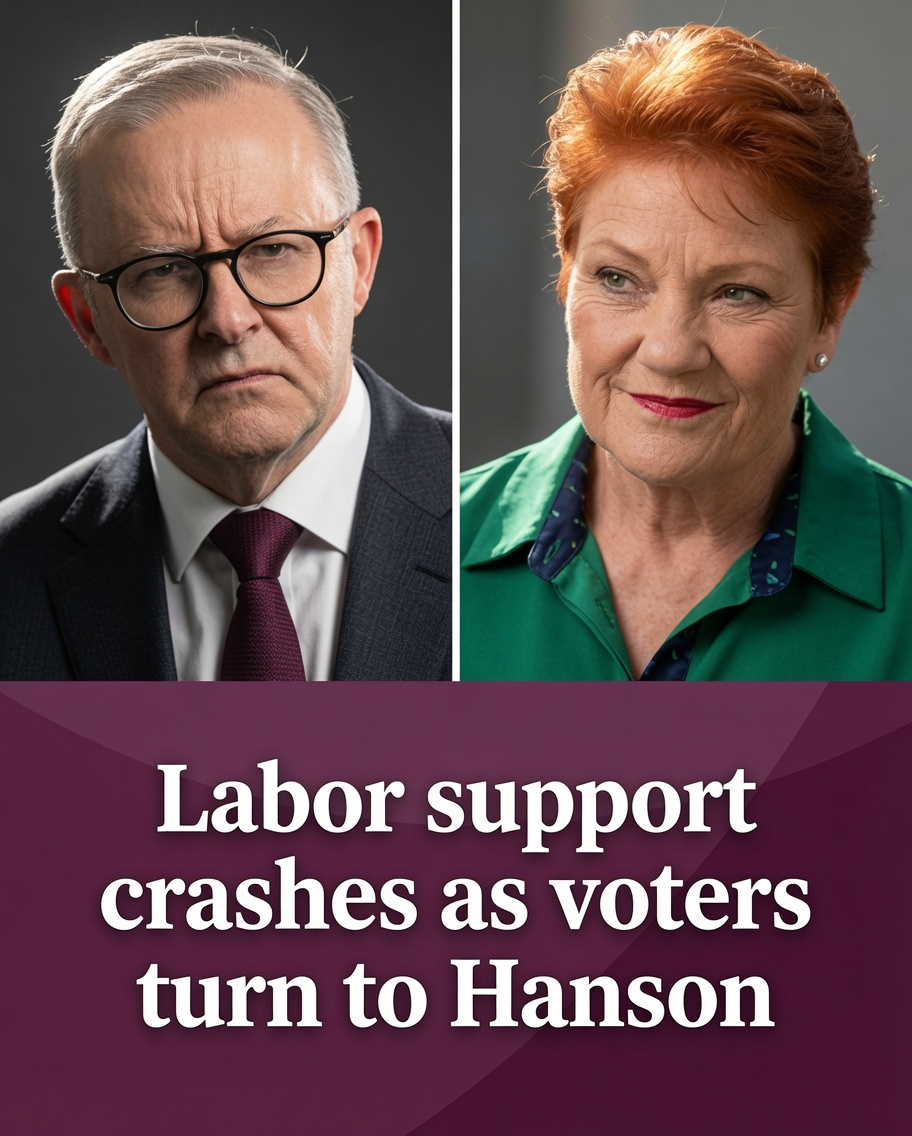
The result represents another warning for Prime Minister Anthony Albanese as support continues to move away from the major parties and towards One Nation, which has emerged as a much more significant force in federal politics than it was at the last election.
Labor’s primary vote has fallen to one of its weakest levels since Albanese came to power in 2022, according to the latest polling, while the Coalition also remains around historically depressed territory.
The most striking feature of the result is the position of One Nation. A party that for much of its history operated on the margins of the federal political contest is now polling at levels comparable with, and in some surveys above, Australia’s traditional parties of government.
That does not mean One Nation would necessarily win the most seats if an election were held immediately. Australia’s preferential voting system, the geographic distribution of support and the strength of individual candidates all play major roles in converting a national primary vote into seats in the House of Representatives.
But the polling trend points to something politically significant: a growing share of voters is no longer automatically choosing between Labor and the Coalition.
A major-party system under pressure
For decades, Australian federal politics has largely revolved around a contest between Labor and the Liberal-National Coalition, even as minor parties and independents gained influence in the Senate and, more recently, in lower-house electorates.
The latest polling suggests that structure is under unusually intense pressure.
Labor and the Coalition are both dealing with historically weak levels of primary support, while One Nation has expanded far beyond the modest national vote shares traditionally associated with the party.
The shift has not appeared in a single isolated survey.
Several polls during 2026 have recorded extraordinary volatility in voter intention. A RedBridge Group and Accent Research survey reported earlier this year put One Nation at 31 per cent nationally, ahead of Labor on 28 per cent and the Coalition on 20 per cent.
Other polling has produced different numbers but pointed in the same broad direction: the combined dominance of Labor and the Coalition has weakened, while One Nation has become a serious competitor for voters who are dissatisfied with established political choices.
Roy Morgan polling has demonstrated how quickly that support can move. One Nation reached 31.5 per cent in one of its June surveys before falling sharply in subsequent weeks. In polling conducted from June 29 to July 5, Roy Morgan put Labor at 28 per cent, One Nation at 22.5 per cent and the Coalition at 21.5 per cent.
The differences between pollsters are important. Different methodologies, survey periods and preference assumptions can produce substantially different results, particularly in a volatile multi-party environment.
What is more difficult to dismiss is the broader pattern across multiple surveys: One Nation is competing at a level that would once have been considered extraordinary.
Why voters are moving
The rise of One Nation has coincided with intense public concern over the cost of living, housing affordability, immigration, interest rates, government spending and dissatisfaction with the direction of the country.
Those issues do not affect every voter in the same way, and polling cannot establish a single reason why people change their political allegiance.
However, recent research has shown that One Nation’s support is no longer confined to a narrow demographic or to former Coalition voters.
Polling published after the federal budget indicated significant anti-establishment sentiment across several age groups. In one RedBridge and Accent Research survey, One Nation was ahead of Labor among millennials, while Pauline Hanson performed particularly strongly among Generation X voters in preferred prime minister measurements.
That presents a more complicated challenge for Labor than the assumption that One Nation’s growth simply divides the conservative vote.
If Hanson were attracting support almost exclusively from former Liberal and National voters, Labor could potentially benefit from fragmentation on the political right.
But evidence of voters shifting away from Labor as well changes that calculation.
Labor strategists must now defend support on multiple fronts: against the Coalition in traditional marginal seats, against the Greens and independents in some metropolitan electorates, and increasingly against One Nation in communities where economic or cultural dissatisfaction is producing a stronger protest vote.
Labor faces a difficult political equation
For Albanese, the challenge is not simply to improve Labor’s headline primary vote.
The government must work out why voters who supported it previously are now considering alternatives and whether those voters can be persuaded to return before the next federal election.
Cost-of-living pressures remain central to that task.
Australians have endured years of elevated household expenses, housing stress and interest-rate pressure. Even where governments introduce tax relief, health measures or other financial assistance, voters may judge economic conditions according to what they experience at the supermarket, through rent or mortgage payments, utility bills and other everyday costs.
The Albanese government has sought to emphasise measures including tax cuts, Medicare investment, hospital funding, paid parental leave and housing reforms.
It has also argued that controversial tax and housing changes are designed to improve fairness and help younger Australians enter the property market.
Yet polling during 2026 has repeatedly shown that policy announcements do not automatically translate into stronger political support.
That gap between policy delivery and voter sentiment may be one of Labor’s biggest strategic problems.
If voters believe the country is moving in the wrong direction, a government can struggle to gain political credit even when individual measures are popular.
The Coalition has an equally serious problem
The polling is hardly comfortable for the opposition.
One Nation’s rise has transformed what would normally be a straightforward contest between a Labor government and the Coalition seeking to replace it.
Instead, the Coalition has found itself fighting to retain voters who might once have regarded the Liberals or Nationals as the natural alternative to Labor.
That creates both an electoral and strategic dilemma.
Moving towards One Nation on issues such as immigration or cultural debates could potentially help the Coalition appeal to some defecting conservative voters, but it also risks alienating moderates and metropolitan voters.
Moving towards the political centre, meanwhile, may leave more space for Hanson to argue that the major parties are indistinguishable on issues important to her supporters.
The problem is especially acute because Australia’s electoral system means the consequences of a fragmented vote can vary dramatically from electorate to electorate.
In some seats, One Nation could take votes primarily from the Coalition. In others, it could attract meaningful support from Labor. In three-cornered contests, preference flows could become decisive.
The next federal election could therefore involve a far more complicated electoral map than the traditional national two-party-preferred figure suggests.
Why 30 per cent does not automatically mean government
A national primary vote figure can be politically powerful without translating directly into parliamentary representation.
Australia elects members of the House of Representatives in individual electorates using preferential voting.
A party can accumulate a large national vote but win relatively few seats if that support is spread thinly across the country. Conversely, concentrated support in carefully targeted electorates can produce a much larger parliamentary return.
This is one reason One Nation’s polling numbers should be interpreted cautiously.
The party would need credible candidates, effective local campaigns and sufficient organisational infrastructure across a large number of electorates to convert national momentum into lower-house seats.
Preference flows would also matter enormously.
Roy Morgan has attempted to model hypothetical contests between Labor and One Nation and has found Labor could retain a substantial advantage after preferences even when One Nation records a very strong primary vote.
That illustrates the difference between becoming a major force in the national vote and being in a position to form government.
Still, One Nation would not need to win government for its rise to reshape Australian politics.
A significant bloc of lower-house MPs, greater Senate representation or the ability to determine which major party reaches the final two-candidate contest in marginal electorates could give the party considerably more influence.
Hanson’s support has also proved volatile
One Nation’s rapid rise has not followed a straight line.
Roy Morgan recorded the party reaching 31.5 per cent after Hanson’s National Press Club appearance in June before its support subsequently fell by nine percentage points over two weeks.
The pollster linked part of that decline to intense scrutiny of Hanson’s comments about “monoculturalism”.
That volatility is important because it demonstrates both the opportunity and the risk facing One Nation.
The party is clearly capable of attracting large numbers of dissatisfied voters, but maintaining that coalition of support may prove more difficult as its policies, candidates and leadership receive the level of scrutiny normally applied to parties competing seriously for government.
Recent controversies surrounding Hanson’s comments on immigration, multiculturalism and her interactions with political figures overseas have kept her at the centre of national debate.
Such controversies can strengthen her appeal among voters who believe mainstream political and media institutions are hostile to her views, while simultaneously pushing other voters away.
That makes One Nation’s future polling trajectory particularly difficult to predict.
A more fragmented era of Australian politics
The larger story emerging from the latest polling is not simply whether Labor, One Nation or the Coalition is ahead in any individual survey.
It is the weakening of the political structure Australians have been accustomed to for generations.
Voters now have a wider range of viable alternatives, including One Nation, the Greens, community independents, teal independents and smaller parties with strong regional or issue-based support.
That fragmentation makes national politics less predictable.
Primary votes that once would have been considered disastrous for a major party may still produce government if preferences and seat distribution work in its favour. At the same time, a minor party can become enormously influential without coming close to winning a national majority.
For the Coalition, the numbers raise an equally fundamental question about whether it can re-establish itself as the dominant alternative government rather than competing with One Nation for a shrinking conservative vote.
And for Hanson, the polling provides evidence that One Nation has entered territory it has never occupied consistently before: not merely as a protest party, but as a national political force capable of challenging the major parties on primary support.
Polling remains a snapshot rather than a prediction. Voter intentions can change quickly, particularly between elections, and recent surveys have demonstrated just how volatile the electorate has become.
But when different polls repeatedly show unusually weak support for the traditional major parties and unusually strong support for an insurgent competitor, the underlying shift becomes harder to ignore.
Australia’s next federal contest may no longer be defined simply by whether voters prefer Labor or the Coalition.
The increasingly important question is how many Australians still believe either of those two traditional choices represents them at all.






