A 15-year-old Muslim student from Brisbane has shared an emotional first-hand account of meeting One Nation leader Pauline Hanson, saying she never expected to change the senator’s political beliefs but hoped to achieve something much simpler — to be seen as a person before being judged by her appearance.
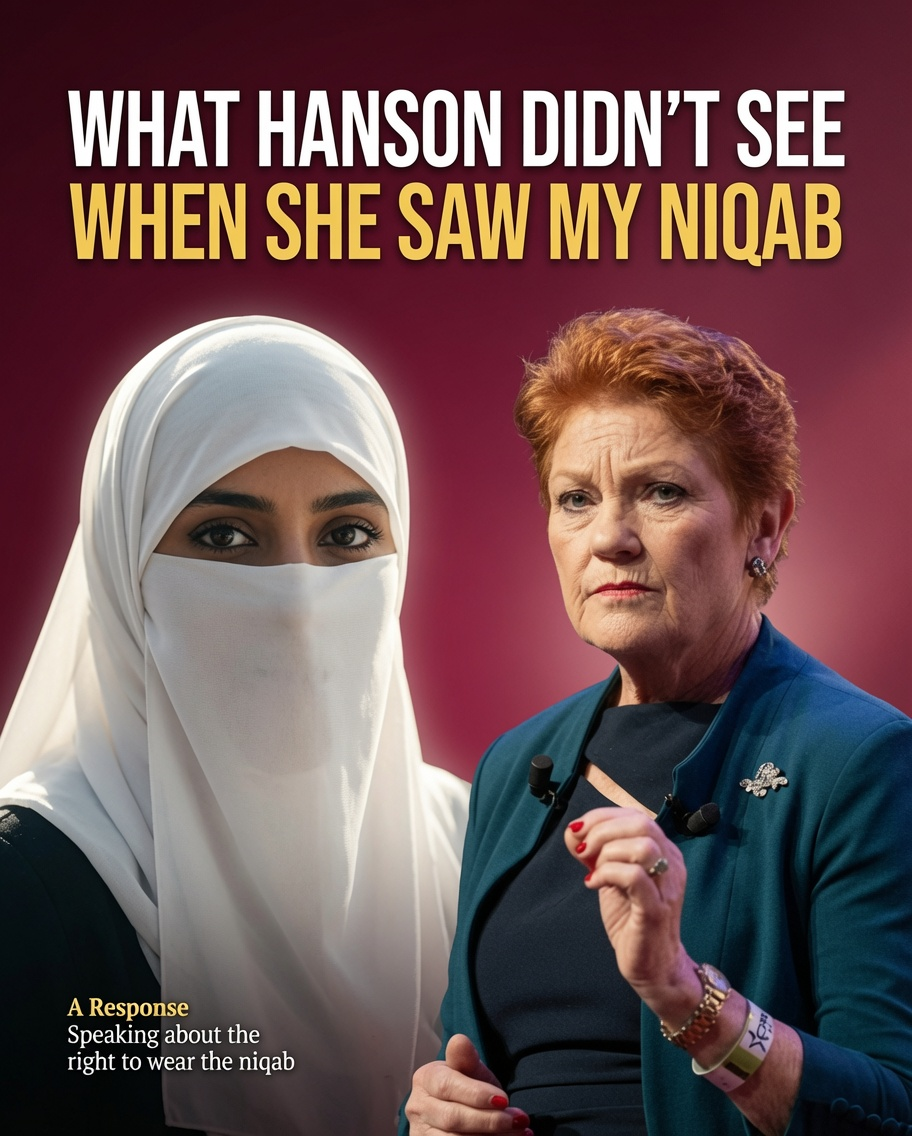
The opinion piece, written by Year 10 student Nabiha and published by 7NEWS Spotlight, offers a rare perspective from one of the students who sat down with Hanson during her visit to the Islamic College of Brisbane for a television program examining the veteran politician’s views on Islam and multiculturalism.
Nabiha recalls the atmosphere changing the moment Hanson entered the school, describing the encounter as both unusual and significant.
“Most Australians know Pauline Hanson. Very few young Muslims have the opportunity to sit across from her and have an honest conversation,” she wrote.
Rather than focusing on political disagreements, Nabiha said the meeting became an opportunity to challenge assumptions that can arise from outward appearances.
When discussion turned to the niqab she wears, she realised the garment represented only one small part of her identity.
“She saw the first thing people usually notice about me. I saw an opportunity for her to notice everything else,” Nabiha wrote.
According to the student, persuading Hanson to embrace her beliefs was never the objective.
“I wanted her to meet me before judging me,” she explained.
Nabiha describes herself as much more than a Muslim teenager who wears a niqab. She says she spends her days studying, preparing for exams and pursuing a passion for robotics and engineering.
She has competed in robotics competitions across Queensland and says she was recently selected to participate in ShakthiSAT, an international initiative involving around 1,200 girls working together on the design and launch of a satellite.
Those experiences, she argues, have reinforced a lesson that extends well beyond science.
“Innovation doesn’t care what you’re wearing. Science doesn’t ask what religion you follow.”
She says engineering projects judge participants on preparation, technical ability and collaboration rather than faith or clothing, and believes Australian society should strive for the same standard.
“A robot doesn’t become less functional because the person programming it wears a niqab,” she wrote.
The essay also reflects on broader public debates surrounding Muslim women in Australia.
Nabiha argues that Muslim women are frequently discussed in political debates without being given opportunities to speak for themselves.
She says assumptions are often made about their freedoms, ambitions and beliefs based solely on what they wear.
“People discuss our clothing as though it explains everything about us. They assume our aspirations, our values and even our freedoms without taking the time to ask.”
Instead, she says people are invariably more complex than the labels attached to them.
Nabiha describes herself as someone who hopes to contribute to Australia’s future through science and technology while remaining proud of both her Islamic faith and her Australian identity.
“Those identities don’t compete with one another. They strengthen one another,” she wrote.
The student said she could not know whether Hanson left the meeting with different views from those she held before arriving.
Only the senator herself, Nabiha wrote, could answer that question.
However, she hopes that for at least a brief moment Hanson saw beyond the niqab and recognised a young Australian with ambitions in science, engineering and space technology.
The article concludes with a broader message about dialogue and understanding.
“It’s easy to fear people we’ve never met. It’s much harder to reduce someone to a stereotype once you’ve sat across from them, looked them in the eye and heard their story.”
“Because behind every label is a person. And sometimes the most powerful thing we can do is allow ourselves to be seen.”
The meeting formed part of a wider 7NEWS Spotlight program examining Pauline Hanson’s recent political activities and comments, including her controversial visit to the United Kingdom where she met far-right activist Tommy Robinson and defended a range of views on immigration, multiculturalism and Islam. Those actions have attracted criticism from political opponents across the spectrum as well as renewed scrutiny of One Nation’s policies on migration and cultural integration.
Hanson has long been one of Australia’s most polarising political figures on issues involving immigration and multiculturalism. In recent months she has argued Australia should become a “monocultural” nation, while maintaining that migrants from diverse backgrounds are welcome provided they adopt a shared commitment to Australian laws and values. Critics argue that such rhetoric risks increasing division and marginalising minority communities.
The Islamic College of Brisbane has previously said it welcomed the opportunity for respectful discussion despite significant disagreements with Hanson. School leaders indicated they hoped direct engagement could encourage better understanding, even where consensus proved impossible. Reports following the meeting suggested both staff and students viewed the conversation as robust but respectful, and expressed interest in continuing dialogue in the future.
For Nabiha, however, the lasting memory was not the political debate itself but the opportunity to present a fuller picture of who she is.
Her story suggests that, regardless of political differences, face-to-face conversations can sometimes challenge assumptions more effectively than public arguments conducted from afar.






