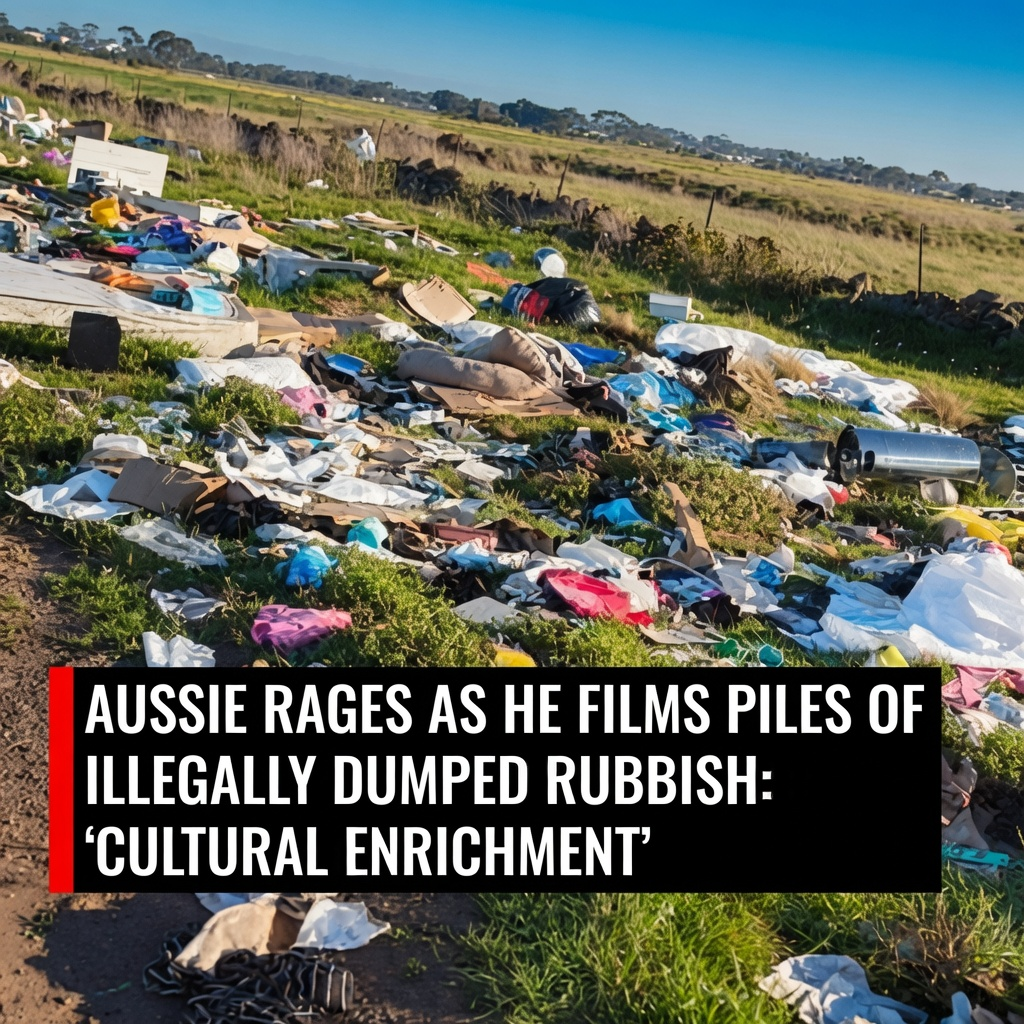
A viral social media video showing piles of illegally dumped rubbish along roads near farmland on Melbourne’s western fringe has reignited a heated national debate over illegal waste disposal, population growth and community responsibility.
The nearly four-minute video, filmed by a local resident using the Facebook name Bent Axle, shows multiple roadside dumping sites scattered across what he says was once predominantly farming land. The footage attracted widespread attention after being shared online with the caption, “welcome to my country”, generating thousands of comments from Australians expressing frustration about the condition of parts of Melbourne’s expanding outer suburbs.
Throughout the video, the man says he grew up in the area and is devastated by how dramatically it has changed.
He repeatedly criticises what he describes as “cultural enrichment” and “diversity”, arguing that the rubbish represents a broader decline in respect for the local environment. He also makes inflammatory remarks linking the dumping to particular ethnic communities and recent immigration.
Those comments have proven highly divisive online. While many viewers agreed that illegal dumping has become an increasingly visible problem across Melbourne’s growth corridors, there is no publicly available evidence confirming the identity or background of the individuals responsible for the rubbish shown in the footage. Authorities have not attributed the waste to any particular community.
The video nevertheless reflects growing public frustration about environmental neglect in rapidly developing suburbs where large residential estates continue to replace former agricultural land.
Illegal dumping—sometimes referred to as fly-tipping—has become one of Victoria’s most persistent environmental enforcement challenges. Waste ranging from household furniture and construction debris to tyres, mattresses and hazardous materials is regularly abandoned on roadsides, vacant blocks, parks and bushland.
Victoria has acknowledged the scale of the issue.
The Allan Government announced a $21.5 million package aimed at tackling illegal dumping, including an $8.5 million clean-up rebate program to help councils and public land managers remove abandoned waste, alongside approximately $13 million to strengthen the state’s Illegal Waste Dumping Taskforce through increased surveillance, intelligence gathering and enforcement activities.
The rebate scheme assists councils, Parks Victoria and other eligible public land managers with part of the often substantial costs involved in removing illegally dumped waste where offenders cannot be identified. Authorities say the funding is designed to reduce the financial burden on local communities while ensuring dangerous waste can be removed more quickly.
The taskforce itself is led by Victoria’s Environment Protection Authority (EPA) in partnership with other agencies. Its work includes identifying dumping hotspots, increasing inspections, improving intelligence capabilities and targeting industries considered at higher risk of illegal waste disposal.
Illegal dumping carries significant penalties under Victorian law. Individuals and businesses found responsible can face substantial fines, and in the most serious cases involving environmental harm, criminal prosecution.
Despite stronger enforcement, illegal dumping remains difficult to police.
Many incidents occur on isolated roads, industrial estates, rural properties or undeveloped land during the night, making it challenging to identify offenders without surveillance footage or eyewitness evidence. Councils also report that cleaning up abandoned waste places considerable pressure on already stretched local budgets.
The viral video has also become part of Australia’s broader political debate surrounding immigration and population growth.
Some social media users argued that Melbourne’s rapid expansion has outpaced infrastructure, public services and environmental management. Others blamed recent migration levels for placing additional pressure on outer suburban communities.
However, experts generally caution against attributing environmental offences to particular ethnic or migrant groups without evidence. Illegal dumping has existed in Australian cities for decades and has been linked to a wide range of factors including illegal commercial waste disposal, high landfill costs, illegal building activity, inadequate waste collection services and opportunistic dumping by individuals seeking to avoid disposal fees.
Construction and demolition waste has been identified by Victorian authorities as one priority area for enforcement because of the financial incentives that can exist for illegally avoiding lawful disposal costs.
Environmental agencies also note that illegal dumping affects communities across metropolitan Melbourne as well as regional Victoria, although population growth corridors often experience greater visibility because of ongoing development and large areas of vacant land.
For long-term residents, the issue is often intertwined with broader concerns about how quickly Melbourne’s outer suburbs have transformed.
Over recent decades, extensive farming districts west, north and south-east of Melbourne have been progressively converted into residential developments to accommodate one of Australia’s fastest-growing urban populations. Roads that once bordered paddocks now sit alongside industrial estates, warehouses and expanding housing developments.
Many locals say this rapid change has altered not only the physical landscape but also the character of their communities.
At the same time, others argue that blaming population growth alone overlooks the responsibility of individuals who deliberately break environmental laws.
Illegal dumping remains a criminal act regardless of who commits it, and authorities continue to encourage residents to report suspicious activity, vehicle registrations and illegal waste sites to assist investigations.
The EPA says stronger enforcement, better surveillance technology and improved cooperation with councils are central to reducing the problem over time. Public education campaigns also encourage residents to dispose of waste legally and make use of council hard-rubbish collections and authorised transfer stations wherever possible.
Meanwhile, the online debate sparked by the viral video shows little sign of fading.
Supporters argue the footage highlights a genuine deterioration in parts of Melbourne that deserves greater political attention. Critics, however, say the environmental issue should not be used to make unsupported assumptions about particular communities or recent migrants.
Regardless of those competing interpretations, the images captured in the video have once again drawn attention to an issue that Victorian authorities themselves acknowledge is growing in both cost and complexity.
As Melbourne continues to expand, balancing population growth, environmental protection, effective waste management and community confidence is likely to remain an ongoing challenge for governments, councils and residents alike.






