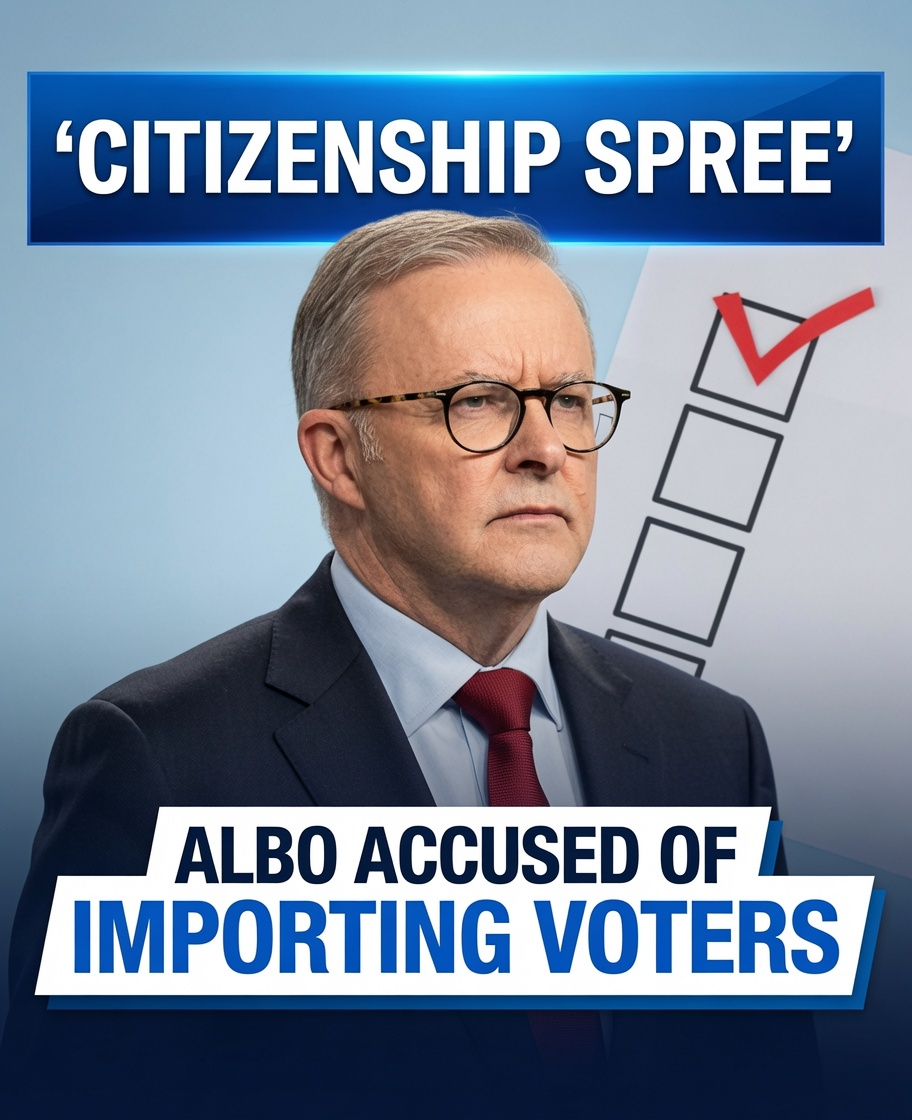
The Albanese Government has found itself at the centre of a fresh political dispute after allegations emerged that local councils were being encouraged to hold more Australian citizenship ceremonies, prompting critics to question whether the push was driven by administrative priorities or electoral considerations.
The latest controversy was sparked by a social media post from One Nation, which claimed Prime Minister Anthony Albanese had been pressuring councils to conduct more citizenship ceremonies and argued that only One Nation was willing to question the government’s motives.
The post did not provide evidence that the Prime Minister personally directed councils. However, recent reporting has confirmed that the Department of Home Affairs has been working with local governments to increase the number of citizenship ceremonies in an effort to reduce waiting times for approved applicants.
According to the Department of Home Affairs, officials regularly engage with councils, exchange monthly reports on waiting lists and forecast approvals, and encourage additional ceremonies where practical to address a growing backlog of people who have already been approved for Australian citizenship.
The issue has become politically contentious because Australia is currently experiencing historically high demand for citizenship ceremonies following several years of elevated migration and population growth.
Media reports indicate that around 300,000 approved applicants are waiting to attend ceremonies before they can formally become Australian citizens. Several large metropolitan councils have reported substantial waiting lists despite increasing the frequency and size of ceremonies.
Liverpool Mayor Ned Mannoun said the Department of Home Affairs had recently asked councils to increase the number of ceremonies but argued that additional federal funding would be needed if councils were expected to expand their programs further.
“If the federal government is asking us to perform more citizenship ceremonies they need to give us more money to pay for them,” he said.
Former Cumberland mayor Steve Christou also said citizenship events had grown significantly compared with previous years, noting that councils were now conducting multiple sessions where only one had previously been held. He argued that ceremonies had become increasingly politicised because elected representatives regularly attend the events.
Those developments have prompted criticism from some conservative politicians and commentators.
Independent NSW upper house MP Rod Roberts suggested the accelerated citizenship program could benefit Labor politically by creating large numbers of new voters ahead of future elections. He claimed governments often seek to reduce citizenship backlogs before elections, although he did not present evidence demonstrating that newly naturalised citizens vote disproportionately for any particular party.
Immigration Minister Tony Burke rejected suggestions that increasing ceremony numbers was motivated by electoral strategy.
Burke has consistently argued that approved applicants should not face unnecessary delays once they have satisfied every legal requirement for Australian citizenship. He has previously said he would prefer citizenship ceremonies to be held every day if that were administratively possible, emphasising that becoming an Australian citizen should not be delayed simply because of ceremony scheduling.
The current debate differs significantly from an earlier controversy under the Morrison Government.
In 2019, the Coalition introduced rules requiring councils to hold citizenship ceremonies on Australia Day, 26 January, as well as on Australian Citizenship Day each September. Councils that refused risked losing the authority to conduct ceremonies altogether.
After coming to office in 2022, the Albanese Government repealed that requirement, restoring flexibility for councils to schedule ceremonies throughout the year rather than compelling them to hold events specifically on Australia Day.
Supporters of the current government’s approach argue that the priority should be reducing waiting times for eligible migrants who have already completed the citizenship process, including residency requirements, language expectations and character checks.
They contend that timely ceremonies allow new citizens to vote, obtain Australian passports and fully participate in civic life without unnecessary administrative delays.
Critics, however, argue that rapidly expanding citizenship ceremonies at a time of historically high migration inevitably creates political questions, particularly when many ceremonies occur in metropolitan electorates with large migrant populations.
One Nation has sought to place those concerns within its broader critique of Australia’s migration policy.
The party has repeatedly argued that high migration is contributing to housing shortages, pressure on infrastructure and rising living costs. It has also criticised what it describes as major parties’ reluctance to debate immigration levels openly.
In its latest statement, One Nation claimed that members of the Liberal Party occasionally raise concerns about citizenship ceremonies but are discouraged from pursuing the issue by the party’s moderate faction. The party presented itself as the only political movement consistently challenging the government’s approach.
Neither the Liberal Party nor the Albanese Government has endorsed that characterisation.
Political analysts note that citizenship ceremonies have long attracted political attention because they represent one of the final stages in Australia’s migration system. However, the ceremonies themselves occur only after applicants have successfully completed a lengthy legal process administered under the Australian Citizenship Act.
Applicants must first satisfy residency requirements, pass the citizenship test where applicable, meet character standards and receive formal approval before being invited to attend a ceremony. The ceremony is therefore an administrative conclusion to a process that may have taken several years.
The latest dispute illustrates how immigration remains one of Australia’s most politically sensitive issues.
With migration levels, housing affordability and population growth expected to feature prominently in future political debate, administrative decisions surrounding citizenship are increasingly being viewed through a political lens.
Whether the government’s expanded engagement with councils is ultimately seen as efficient public administration or as politically advantageous is likely to remain contested. What is clear is that the backlog of approved applicants awaiting ceremonies has become another focal point in Australia’s broader debate over immigration, citizenship and electoral politics.






