One Nation has intensified speculation about Australia’s political landscape after the next federal election, with senior party figure Hollie Hughes declaring that the party — rather than the Liberal Party — could ultimately determine whether a conservative government is formed.
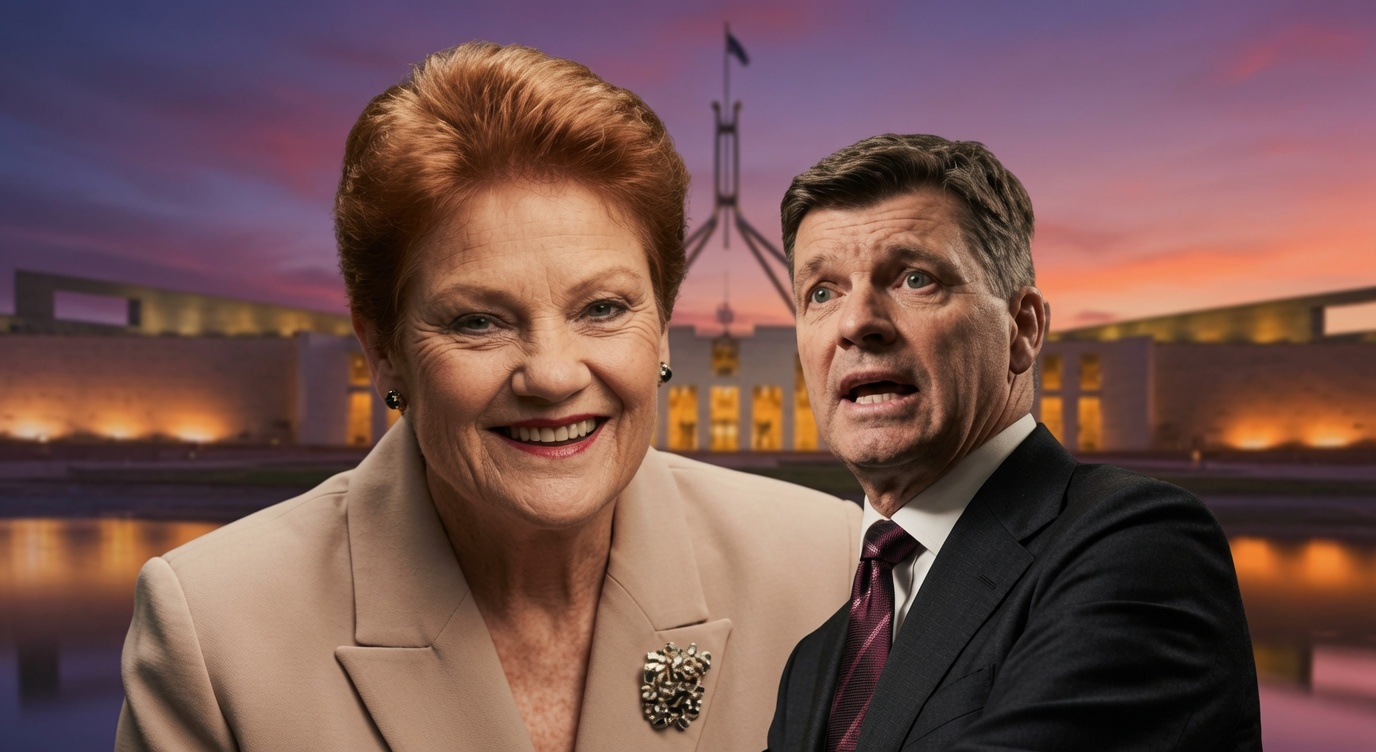
The comments come at a time when opinion polling continues to reshape expectations about the balance of power in federal politics, with One Nation maintaining support well above the Coalition in several recent surveys despite experiencing its first polling setback in months.
Speaking to Sky News host Rowan Dean, Hughes argued that if current polling trends continue, the Coalition may eventually have little choice but to negotiate with Pauline Hanson’s party.
“If you look at the way the polling is, it’ll be One Nation that decides whether or not it forms a coalition with the Coalition,” Hughes said.
Her remarks came only days after Opposition Leader Angus Taylor categorically ruled out any formal governing arrangement with One Nation during an appearance on the ABC’s 7.30.
“I’m ruling it out,” Mr Taylor said.
“There is no plan to form any kind of coalition with One Nation.”
Taylor went further, warning that One Nation’s economic policies would be damaging if ever implemented in government, describing them as a recipe for higher inflation, higher interest rates and long-term economic instability.
Despite that public rejection, Hughes suggested political reality after the next election could prove very different.
“Never stand in the way between ambition and the blue carpet, so of course they’ll do a deal,” she said.
Her assessment reflects growing confidence inside One Nation following an unprecedented rise in national polling throughout 2026, during which the party overtook the Coalition in several major surveys and established itself as Australia’s second-largest political force by primary vote.
However, the latest Sky News Pulse/YouGov polling indicates that momentum has slowed. One Nation’s primary vote slipped four percentage points to 26 per cent following a series of controversies surrounding party leader Pauline Hanson and senior figures, although the party still remained comfortably ahead of the Coalition’s reported 20 per cent primary vote.
The decline followed several weeks of intense media attention surrounding Hanson’s interview with British political activist Tommy Robinson, along with renewed scrutiny of controversial comments made by One Nation senator Malcolm Roberts praising conspiracy theorist Alex Jones.
Even with that setback, Hughes argued that the Coalition’s political problems extend beyond polling numbers.
She questioned whether Angus Taylor would still be Liberal leader by the time Australians next vote.
“At the end of the day, for Angus, this could be all academic, because will he be the leader by the next election?” Hughes said.
“There’s plenty of talk that that won’t be the case.”
She also referred to recent RedBridge polling that she claimed suggested both Taylor and Shadow Industry Minister Andrew Hastie could lose their seats to One Nation candidates if current trends continue.
Those claims highlight the increasingly direct electoral competition developing between the Coalition and One Nation across outer suburban and regional electorates where conservative voters have become increasingly dissatisfied with the major parties.
Political analysts have noted that One Nation’s growth has largely come at the Coalition’s expense rather than Labor’s, creating pressure on Liberal strategists to retain conservative voters without alienating more moderate supporters.
While Hughes portrayed a future Coalition-One Nation agreement as almost inevitable, not everyone shares that assessment.
Former Labor MP Michael Danby argued Australia’s preferential voting system means the situation is considerably more complicated than simple primary vote figures suggest.
“Unfortunately, the preferential system is going to be a big problem for Angus Taylor and for One Nation,” Danby said.
He questioned whether each side could reliably direct enough preferences to the other in closely contested seats.
“Can One Nation deliver preferences to the Liberals, or can the Liberals deliver preferences to One Nation?” he asked.
Danby suggested that failure to cooperate effectively on preferences could ultimately benefit Labor and the Greens instead.
Australia’s preferential voting system differs significantly from electoral systems used in many other democracies. Voters rank candidates in order of preference rather than selecting only one candidate, meaning lower-ranked candidates can still influence the final outcome through the redistribution of preferences after exclusions.
As a result, political parties do not necessarily need formal coalition agreements before elections to influence government formation. Preference recommendations, post-election negotiations and the distribution of parliamentary seats can all play significant roles depending on the final electoral arithmetic.
That uncertainty has become more significant because of One Nation’s recent surge in support.
Several analysts have argued that the party’s rise has pushed Australia’s electoral landscape into largely uncharted territory, with polling suggesting One Nation could reach the final two-candidate contest in far more electorates than at previous elections. Whether that translates into parliamentary seats, however, remains uncertain because preference flows can vary considerably between electorates.
For Angus Taylor, the political challenge is increasingly twofold.
He must convince voters that the Coalition offers a credible alternative to the Albanese Government while simultaneously preventing further conservative support drifting toward One Nation.
Taylor has consistently argued that although Labor should be defeated at the next election, replacing it with a government dominated by One Nation would create serious economic risks.
His repeated rejection of any formal coalition arrangement is intended to reinforce that distinction, even as political opponents continue questioning whether such a stance could survive the realities of a hung parliament.
For One Nation, meanwhile, Hughes’ comments reflect a growing belief that the party has moved beyond being simply a protest movement and is now positioning itself as a potential power broker in federal politics.
Whether that confidence proves justified will ultimately depend not only on national polling but also on how support converts into seats under Australia’s preferential electoral system.
With the next federal election still some time away, both major conservative parties are already fighting for many of the same voters. If current polling remains broadly consistent, the relationship between the Coalition and One Nation could become one of the defining political stories of the campaign, regardless of whether any formal agreement is ever reached.






