Artificial intelligence is rapidly becoming one of the defining political, economic and technological issues of the decade, and Prime Minister Anthony Albanese is signalling that Australia intends to shape the transition rather than simply react to it.
Rather than waiting until public concern over automation, misinformation and copyright reaches boiling point, the Albanese Government is attempting to establish a national framework that provides certainty for businesses while reassuring Australians that AI will remain subject to clear rules.
The approach represents a notable shift in federal policy. After previously regulating AI through separate initiatives across different portfolios, the government is now proposing a single national strategy coordinated from inside the Department of the Prime Minister and Cabinet through a newly created Office of AI.
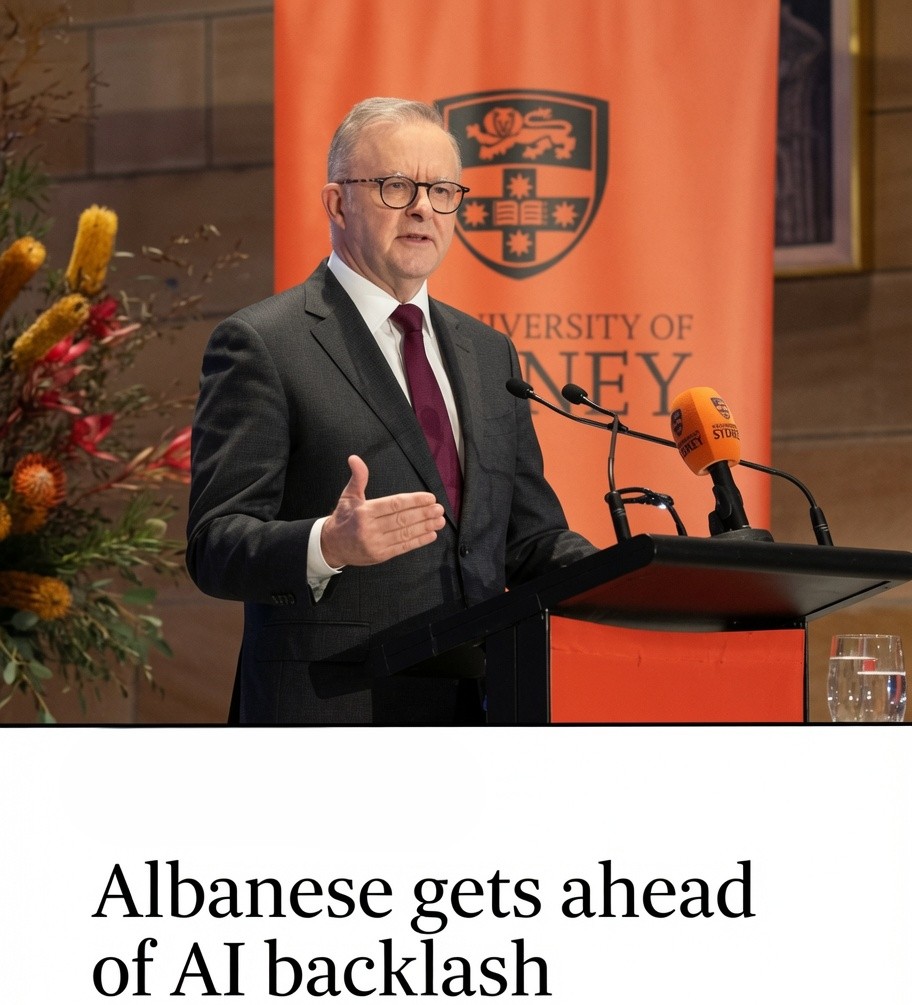
Supporters argue the move reflects political foresight. Technology investor Rohan Silva described the government’s approach as an “impeccably smart political move”, arguing that creating predictable rules before controversy intensifies could encourage investment while reducing the likelihood of a broader political backlash.
The timing is significant. Around the world, governments are wrestling with concerns ranging from AI-generated misinformation and cyber threats to workplace disruption, copyright disputes and the enormous energy demands created by modern data centres.
Australia has watched those debates unfold overseas while simultaneously attempting to attract billions of dollars in AI investment.
Albanese argues those objectives are not incompatible.
In announcing the framework, the Prime Minister said Australia should embrace AI as an opportunity for stronger productivity, improved economic resilience and greater sovereign capability, while ensuring the technology develops in ways consistent with Australian values.
Central to the proposal is the creation of Australian Standards for AI covering areas including data centres, copyright, environmental impacts and infrastructure approvals. The government also wants national consistency across states and territories, replacing what it describes as a fragmented collection of separate approval processes.
One major focus is Australia’s rapidly expanding data-centre industry.
Modern AI systems require enormous computing capacity, creating demand for new facilities that consume significant amounts of electricity and water. While these projects promise investment and employment, they have also triggered community concerns about local infrastructure, energy reliability and environmental impacts.
Under the proposed standards, large AI data centres would be expected to underwrite or provide their own additional electricity supply, contribute fully towards connection costs, minimise water consumption and reduce electricity use during periods of peak demand to help protect the broader energy grid.
The government believes those requirements could provide greater certainty both for investors and for communities hosting major developments.
Another contentious issue is copyright.
Australian artists, journalists, musicians and publishers have become increasingly concerned that AI companies may use their work to train large language models without permission or compensation.
The Albanese Government has indicated Australia’s framework will seek stronger protections for creative industries, with the Prime Minister arguing that Australian books, music, art and journalism should not become free training material without creators retaining meaningful control over their work.
That position has been welcomed by many within Australia’s creative sector, although technology companies continue to argue internationally that broad access to training material is important for AI development.
Employment remains another politically sensitive area.
Public discussion around artificial intelligence often centres on fears of widespread job losses. Headlines warning of an imminent “jobs apocalypse” have become increasingly common as AI systems improve their ability to perform administrative, analytical and creative tasks.
The government acknowledges those concerns but rejects the suggestion that automation will simply eliminate employment across the economy.
Instead, ministers argue AI will reshape work, requiring new skills while creating entirely new industries and occupations that do not yet exist.
The challenge for policymakers is ensuring workers can adapt while maintaining confidence that technological change benefits the broader economy rather than only a small number of technology firms.
The political calculation behind the government’s approach may prove just as important as the policy details themselves.
Political scientists Christopher Achen and Larry Bartels famously argued in their book Democracy for Realists that voters frequently respond to highly visible events even when governments exercise little direct control over them. Their discussion of the deadly shark attacks along New Jersey’s coast in 1916 illustrates how unexpected events can quickly reshape public opinion and political fortunes.
For governments confronting artificial intelligence, the lesson is clear.
If AI becomes associated primarily with misinformation, unemployment, copyright disputes or environmental controversy, political support for the technology could deteriorate rapidly regardless of its longer-term economic benefits.
By introducing national rules before those conflicts escalate further, Labor appears to be attempting to reduce uncertainty while demonstrating that government remains actively in control of the transition.
Business groups have generally welcomed efforts to create clearer regulatory settings, arguing that predictable approval processes make Australia more attractive for international investment.
Companies considering major AI infrastructure projects often cite regulatory uncertainty as one of the biggest barriers to committing billions of dollars in long-term capital.
A nationally coordinated framework may therefore improve Australia’s competitiveness compared with jurisdictions where approval processes remain inconsistent or politically unpredictable.
However, not everyone is convinced the government’s approach strikes the right balance.
Some critics argue additional regulation risks slowing innovation, particularly if compliance becomes too expensive or overly complex for smaller Australian technology companies.
Others question whether creating another government office will meaningfully improve AI governance or simply add another administrative layer.
Opposition figures have also suggested that productivity gains will depend less on bureaucracy than on broader economic reforms capable of supporting innovation, investment and competition.
Environmental organisations have likewise called for careful scrutiny of AI infrastructure.
Large data centres can consume enormous quantities of electricity and water, making renewable energy planning increasingly important as Australia’s AI sector expands.
Balancing economic development with environmental sustainability is therefore likely to remain a central challenge as more projects seek approval across the country.
National security considerations also feature prominently within the government’s thinking.
Artificial intelligence is increasingly viewed as both an economic opportunity and a strategic capability. Advanced AI systems are expected to influence cyber security, defence technologies, intelligence analysis and critical infrastructure, while also creating new opportunities for hostile foreign actors to spread disinformation or manipulate democratic debate.
For that reason, the proposed Office of AI is expected to coordinate policy across multiple government portfolios rather than leaving individual departments to develop separate approaches.
The framework will ultimately require cooperation from Australia’s states and territories, particularly regarding planning approvals, energy infrastructure and environmental regulation.
Achieving national consistency could prove politically challenging, but the government argues that a unified approach is preferable to a patchwork of competing state policies.
Whether Albanese’s strategy succeeds will become clearer over coming months as legislation is developed and negotiations continue with industry, state governments and community stakeholders.
What is already evident, however, is that artificial intelligence has moved beyond being simply a technology issue.
It is now becoming a central question of economic policy, national security, environmental planning, copyright law and political leadership.
Rather than waiting for those debates to be driven by crisis, the Albanese Government is attempting to establish the rules before the public backlash fully arrives. Whether that proactive approach ultimately delivers both investment and public confidence may shape Australia’s AI future for years to come.






