A controversial billboard truck that carried the slogan “Ditch the Witch” alongside an image of Victorian Premier Jacinta Allan has been removed from Melbourne’s roads after police issued a vehicle defect notice, ending weeks of political controversy surrounding one of the state’s most divisive advertising campaigns.
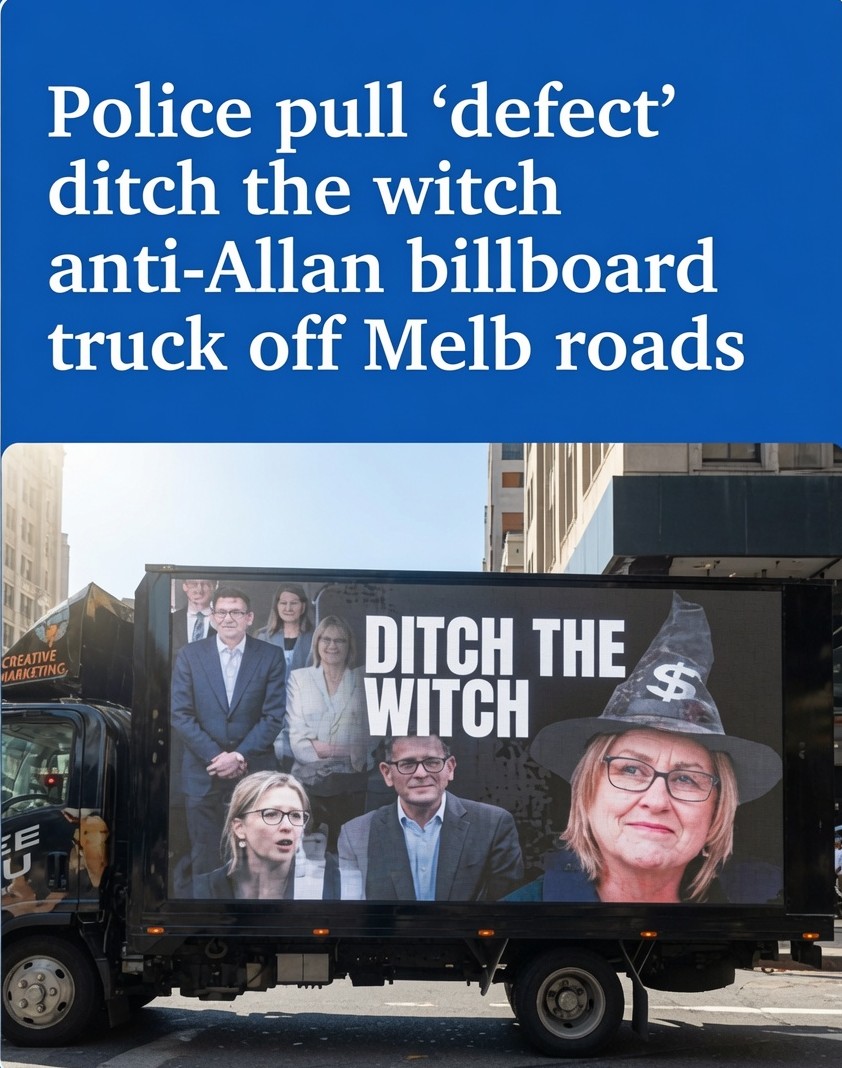
Victoria Police confirmed the truck was not removed because of complaints about its political message but because investigators determined the vehicle no longer complied with roadworthiness regulations.
According to police, Melbourne Highway Patrol officers issued a defect notice following an investigation into digital advertising panels mounted on the truck.
The owner will now be required to present the vehicle to VicRoads for inspection before it can legally return to the road.
Authorities said the additional billboards attached to the truck fell outside applicable vehicle standards and must be removed before the defect can be cleared.
Importantly, police indicated the complaint that ultimately resulted in the defect notice had been lodged months before the truck began displaying advertisements targeting Premier Jacinta Allan.
Nevertheless, the timing means the notice has effectively brought an end to one of Victoria’s most controversial political advertising campaigns of the year.
The truck attracted national attention after displaying a digitally altered image of Ms Allan accompanied by the slogan “Ditch the Witch”—a phrase that became infamous during the political attacks directed at former Prime Minister Julia Gillard in 2011.
The advertisements alternated with promotions for Melbourne brothel Gotham City, whose owner Franco Puleo previously acknowledged helping fund the campaign alongside a number of other businesses.
Mr Puleo has previously said approximately $105,000 was spent on the mobile advertising campaign.
The campaign quickly generated condemnation across Australia’s political spectrum.
Premier Jacinta Allan said while people were entitled to disagree with her policies, the advertisements crossed a line by targeting women through sexist language.
“People are entitled to disagree with me. That’s democracy. But I care that this attacks women,” she said during the controversy.
Prime Minister Anthony Albanese also criticised the campaign, describing it as “totally unacceptable” and arguing personal attacks based on gender have no place in Australian public life.
Former Prime Minister Julia Gillard, who was herself subjected to the same slogan during intense political protests fifteen years earlier, said she was “disgusted” to see the phrase revived and described it as a form of visible misogyny.
She urged those responsible to remove the signs, arguing the campaign sent the wrong message to women and girls considering careers in public life.
Significantly, criticism also came from senior Liberal figures despite the advertisements targeting a Labor premier.
Victorian Opposition Leader Jess Wilson described the campaign as inappropriate, while federal Deputy Liberal Leader Jane Hume said criticism of politicians should never rely on sexist language.
“Sexism has no place in politics,” Hume said, arguing policies—not gender—should remain the focus of political debate.
Not everyone agreed with that assessment.
One Nation leader Pauline Hanson publicly dismissed concerns about the campaign and argued politicians should expect harsh criticism, reflecting the broader debate over where political expression ends and unacceptable personal attacks begin.
The case has highlighted two separate issues that became intertwined during the controversy.
One concerns freedom of political expression and the limits of robust campaigning.
The other relates to vehicle safety regulations governing trucks fitted with oversized digital advertising structures.
According to Victoria Police, the enforcement action addressed only the latter issue.
The defect notice was issued because of concerns about compliance with roadworthiness standards rather than the political content displayed on the screens.
Advertising trucks have become an increasingly common feature of political campaigning and commercial promotion across Australian cities.
Because they can move through busy streets and attract considerable public attention, they are often used for high-profile advocacy campaigns as well as traditional advertising.
However, vehicles carrying large digital displays must still comply with road safety regulations governing size, construction and equipment.
Failure to meet those standards can result in defect notices requiring modifications before a vehicle is permitted to operate again.
Although the billboard truck has now been removed from Melbourne’s roads, the broader debate sparked by the campaign continues.
Supporters argued the advertisements reflected legitimate public frustration with the Victorian Government.
Critics maintained that political disagreement should never rely on language historically regarded as sexist or personally abusive.
The episode has therefore become another example of the increasingly heated tone characterising contemporary political campaigning in Australia.
While the roadworthiness notice has effectively ended this particular campaign, the wider discussion about political advertising, respectful public debate and the boundaries of free expression is likely to continue well beyond the truck’s final journey through Melbourne.






