Australia’s richest property developer, Harry Triguboff, has renewed his long-running campaign for higher migration, arguing the nation should welcome more people, ease lending restrictions and encourage greater foreign investment if it wants to restore confidence in the housing market.
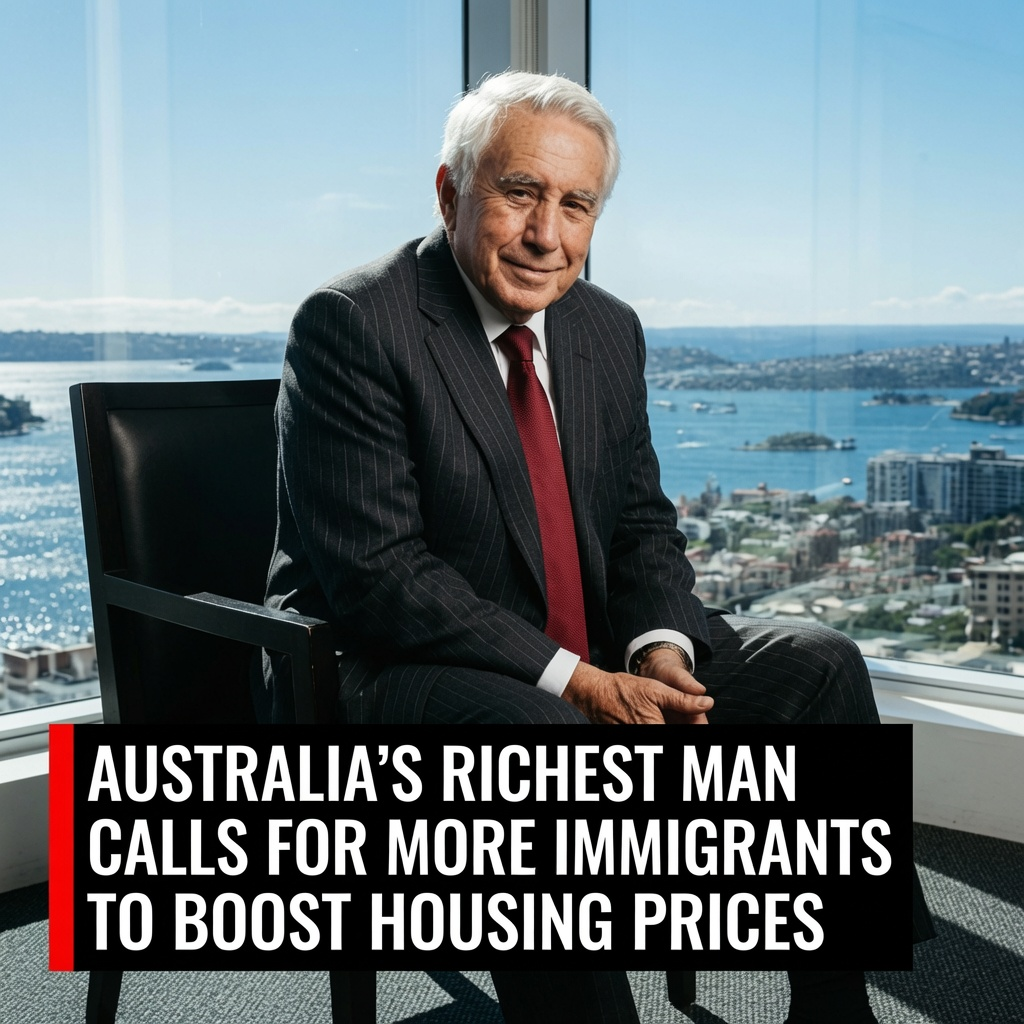
The 93-year-old founder and managing director of Meriton Properties warned Australia risks a “catastrophe in real estate” unless governments take decisive action to stimulate housing demand and investment.
Writing on Meriton’s website, Triguboff argued that migration remains essential to Australia’s long-term economic growth and dismissed suggestions that population growth should be constrained because of housing pressures.
“This country must grow. It’s too big to be left in its present state,” he said.
“To develop we need more people.”
Triguboff said Australia should focus on selecting migrants with skills that contribute to the economy while rejecting claims that new arrivals struggle to integrate into Australian society.
“When they do come here, they mix very well with the local people,” he said.
Beyond migration, the billionaire developer argued the housing market has become increasingly constrained by restrictive lending practices and policy settings that discourage investment.
According to Triguboff, falling property prices encourage prospective buyers to delay purchasing decisions, creating a cycle in which transaction volumes slow, construction weakens and confidence deteriorates.
“Why buy today what will be cheaper tomorrow?” he asked, arguing that buyers naturally adopt a wait-and-see approach when they expect prices to continue falling.
He also criticised Australia’s banking sector, claiming many prospective purchasers who have sufficient income are unable to obtain finance because lending standards have become excessively conservative.
“The banks must give loans otherwise both the banks and the buyers go broke. It is just not sustainable,” he said.
Triguboff further argued that Australia should become more attractive to overseas investors by ensuring property investment remains commercially viable.
He suggested previous foreign investors, particularly from Asia, had experienced disappointing returns under existing policy settings and warned that international capital would continue flowing elsewhere unless governments improved investment conditions.
His comments are consistent with positions he has repeatedly advanced over recent years.
The Meriton founder has regularly called for higher migration, faster planning approvals, lower development costs and policy settings designed to encourage greater housing construction.
He has also consistently argued that Australia’s housing shortage cannot be solved by reducing migration alone, insisting that governments should instead accelerate the construction of new homes.
Triguboff’s latest intervention comes during an increasingly complex period for Australia’s housing market.
After years of rapid price growth, higher interest rates and tighter lending conditions have reduced buyer confidence in parts of the market, while affordability remains one of the country’s biggest economic and political challenges.
Despite recent moderation in some markets, rental vacancy rates remain historically low across many Australian cities and demand for housing continues to outstrip supply in numerous regions.
Australia has simultaneously experienced exceptionally strong population growth following the reopening of international borders after the COVID-19 pandemic.
Net overseas migration reached record levels during the early years of the Albanese Government before easing more recently as the Commonwealth introduced measures to moderate migration growth.
The relationship between migration and housing affordability has become one of Australia’s most hotly debated policy issues.
Economists generally agree that stronger population growth increases demand for housing in the short term.
However, many also argue that Australia’s affordability problems cannot be explained by migration alone.
Housing supply has failed to keep pace with demand for years because of planning restrictions, lengthy approval processes, labour shortages, rising construction costs and limited availability of development-ready land.
As a result, reducing migration without substantially increasing housing construction may relieve some demand pressures but is unlikely, by itself, to resolve the country’s structural housing shortage.
Triguboff’s commercial interests are also central to the debate.
Meriton is Australia’s largest apartment developer, having constructed more than 80,000 apartments across the eastern states.
The company also owns thousands of rental apartments, providing recurring rental income alongside apartment sales.
In previous interviews, Triguboff acknowledged weaker demand from Chinese buyers had influenced his sales strategy, prompting the company to retain a larger proportion of completed apartments as rental properties rather than immediately selling them.
That business model means both apartment sales and rental demand remain closely tied to population growth and investor confidence.
Supporters of Triguboff’s position argue migration supplies skilled workers, expands the tax base and supports long-term economic growth in an ageing society.
They also contend that Australia’s relatively small population limits productivity and constrains infrastructure investment across a geographically vast country.
Critics, however, argue that encouraging stronger migration before significantly increasing housing supply risks placing further pressure on already stretched rental markets and first-home buyers.
Some housing researchers have warned that while migration contributes to demand, governments must simultaneously reform planning systems, accelerate development approvals and improve construction capacity if additional population growth is to remain sustainable.
Those competing views have increasingly shaped Australia’s political debate as both major parties attempt to balance economic growth with community concerns over housing affordability, congestion and infrastructure.
Triguboff’s remarks also arrive at a time when governments are seeking ways to increase housing supply through planning reforms, infrastructure investment and incentives for new residential construction.
Whether policymakers ultimately adopt the changes he advocates remains uncertain.
Nevertheless, the billionaire developer’s comments once again highlight the deep divisions surrounding one of Australia’s defining economic challenges: how to accommodate a growing population while ensuring housing remains affordable, investment remains attractive and sufficient new homes are built to meet future demand.
For Triguboff, the solution is straightforward—more migrants, easier finance and stronger incentives for investors.
For governments and many economists, however, the challenge is considerably more complex, requiring a careful balance between population growth, infrastructure capacity, planning reform and housing supply.






