Australia’s most influential business organisations have dramatically escalated pressure on Victorian Premier Jacinta Allan, demanding she establish a Royal Commission into alleged corruption within the state’s construction industry amid claims the sector has become “rotten to the core”.
The intervention marks one of the strongest public rebukes yet from Australia’s business community as concerns continue to mount over allegations involving the Construction, Forestry, Maritime, Mining and Energy Union (CFMEU), the awarding of government contracts and the integrity of Victoria’s multi-billion-dollar construction sector.
Business leaders argue the issue extends well beyond industrial relations, warning that alleged corruption is driving up the cost of public infrastructure, discouraging private investment and undermining confidence in one of Australia’s largest state economies.
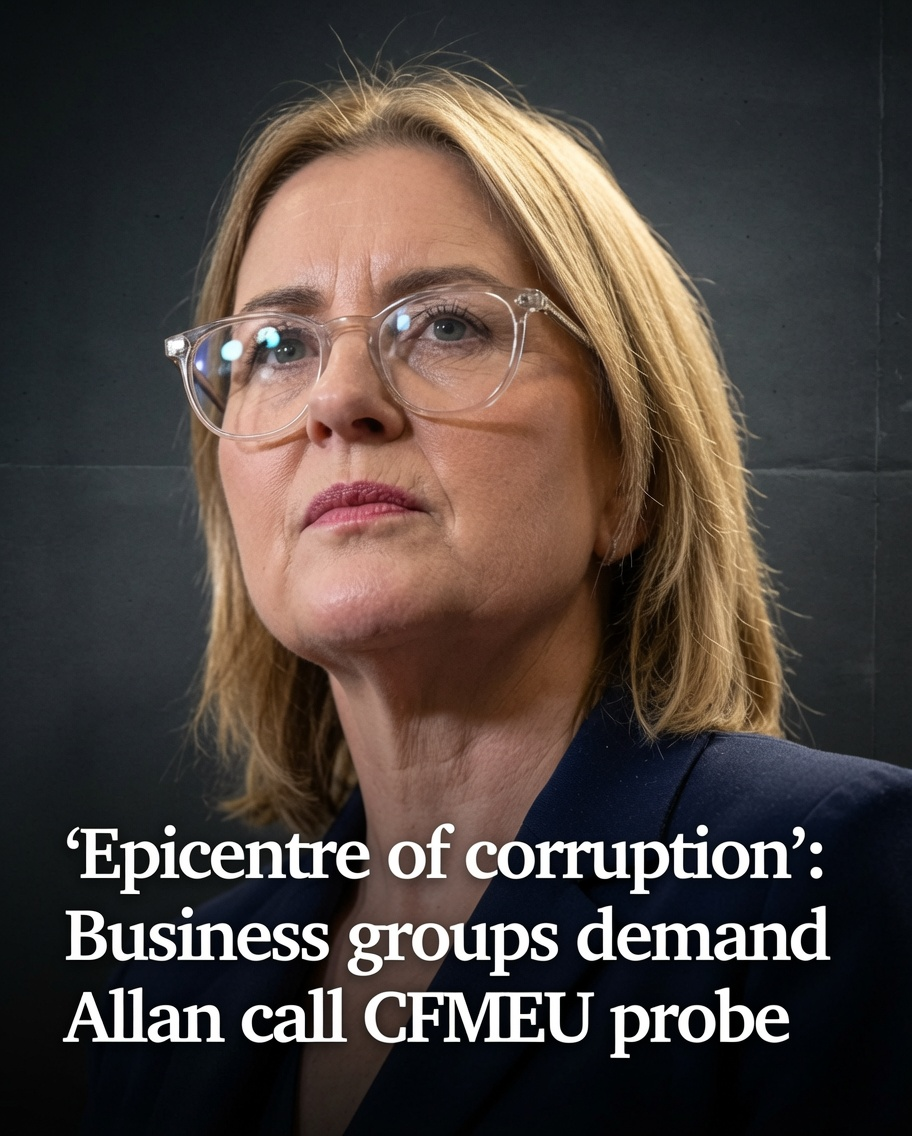
The Victorian Chamber of Commerce and Industry and the Australian Chamber of Commerce and Industry have jointly called on the Allan Government to commission the state’s highest level of public inquiry.
Victorian Chamber chief executive Sally Curtain said Victoria could no longer tolerate a construction system in which criminal behaviour allegedly distorted competition and imposed unnecessary costs on businesses and taxpayers.
“Victoria cannot afford to tolerate a system in which criminal behaviour is embedded, costs are inflated and lawful businesses are at a disadvantage,” Curtain said.
She argued the consequences reach far beyond the building sector, affecting housing affordability, productivity, economic growth and investor confidence across the state.
“This is not just an industry issue — it is an economic one. It impacts productivity, investment, housing supply and, ultimately, every Victorian,” she said.
Australian Chamber chief executive Andrew McKellar delivered an equally forceful message, saying Premier Allan needed to demonstrate stronger leadership as Victoria confronted allegations that have dominated political debate for months.
McKellar described Victoria as having become the “epicentre of corruption” in Australia and argued taxpayers had already paid a heavy financial price through inflated construction costs and compromised procurement processes.
According to the business groups, restoring confidence will require more than individual criminal investigations.
They have also called for Victoria Police to receive enhanced “follow-the-money” powers to investigate unexplained wealth connected to organised crime, while urging the Federal Government to strengthen national oversight of the construction industry through an effective regulator.
The growing pressure follows months of allegations involving the Victorian branch of the CFMEU and claims that organised crime figures infiltrated parts of the construction industry during previous years.
Those allegations have fuelled repeated calls from opposition parties, independent MPs, former anti-corruption officials and now major employer organisations for a judicial inquiry capable of compelling witnesses to give evidence under oath.
Supporters of a Royal Commission argue only an inquiry with extensive investigative powers can fully examine the relationships between unions, contractors, developers, government agencies and organised crime networks.
They also believe such an inquiry would help restore public confidence before billions of dollars in future infrastructure projects are awarded.
Premier Jacinta Allan, however, has consistently rejected demands for a Royal Commission.
The Premier argues her government is already taking action against misconduct through police investigations, licensing reforms and regulatory changes rather than establishing another lengthy judicial inquiry.
Allan has previously maintained that calls for a Royal Commission risk delaying immediate enforcement action while reopening debates already examined by earlier federal inquiries into trade unions.
She has also argued that previous royal commissions consumed significant public resources over several years without delivering the systemic outcomes some supporters had promised.
Despite that position, pressure on the government has continued to build.
Recent reports indicate that some Labor MPs have privately questioned whether resisting a Royal Commission is politically sustainable as Victoria approaches the state election.
Integrity experts and former senior anti-corruption officials have likewise suggested a broader inquiry may now be necessary to restore trust in public procurement and government oversight.
The controversy comes against the backdrop of a wider federal intervention into the CFMEU, whose construction division has faced extensive scrutiny over allegations of criminal infiltration, intimidation, unlawful conduct and governance failures.
In response to those concerns, the Commonwealth previously placed parts of the union into administration while investigations continued.
Although many allegations remain subject to ongoing investigations or have not been tested in court, the issue has become one of the most politically sensitive topics facing the Victorian Government.
Business groups argue the economic consequences are impossible to ignore.
Construction delays, inflated project costs and reduced competition ultimately increase the cost of delivering essential infrastructure such as hospitals, schools, roads and housing developments.
Employer organisations say those additional costs are ultimately borne by Victorian taxpayers while also reducing the state’s attractiveness to domestic and international investors.
Housing affordability has become a central part of their argument.
With Victoria attempting to accelerate residential construction to address housing shortages, business leaders contend that eliminating corruption and improving transparency would help lower development costs and increase industry confidence.
They say a cleaner regulatory environment would encourage greater investment while supporting faster delivery of desperately needed homes.
The debate has also reignited discussion about the appropriate role of Royal Commissions within Australia’s legal system.
A Royal Commission represents the country’s most powerful form of public inquiry, possessing authority to compel witnesses, require production of documents and examine evidence under oath.
Historically, Royal Commissions have been established to investigate issues considered too significant or complex for ordinary police investigations or parliamentary committees.
Supporters believe those extraordinary powers are justified where allegations involve systemic corruption spanning multiple organisations over many years.
Critics, however, argue Royal Commissions can be expensive, time-consuming and sometimes become highly politicised.
The Victorian Government has consistently emphasised those concerns while arguing that existing law enforcement agencies should remain responsible for criminal investigations.
Nevertheless, employer organisations insist confidence in Victoria’s construction industry cannot be fully restored until an independent inquiry establishes the extent of any wrongdoing and identifies reforms capable of preventing similar problems in future.
For Premier Allan, the issue is becoming increasingly difficult to contain.
With opposition parties, crossbench MPs, former integrity officials and now Australia’s peak business groups united in calling for a Royal Commission, pressure is continuing to mount on the government to reconsider its position.
Whether that pressure ultimately results in a formal inquiry remains uncertain.
For now, however, the debate has evolved beyond allegations involving a single union and become a broader argument about transparency, accountability and the future reputation of Victoria’s construction industry.






