Commentary
Few sporting decisions should be capable of dividing an entire country.
Yet Cricket Australia has managed to do exactly that before a ball has even been bowled.
The organisation has confirmed the Big Bash League Final will return to Australia Day in 2027 after a two-year absence.
That decision was widely welcomed.
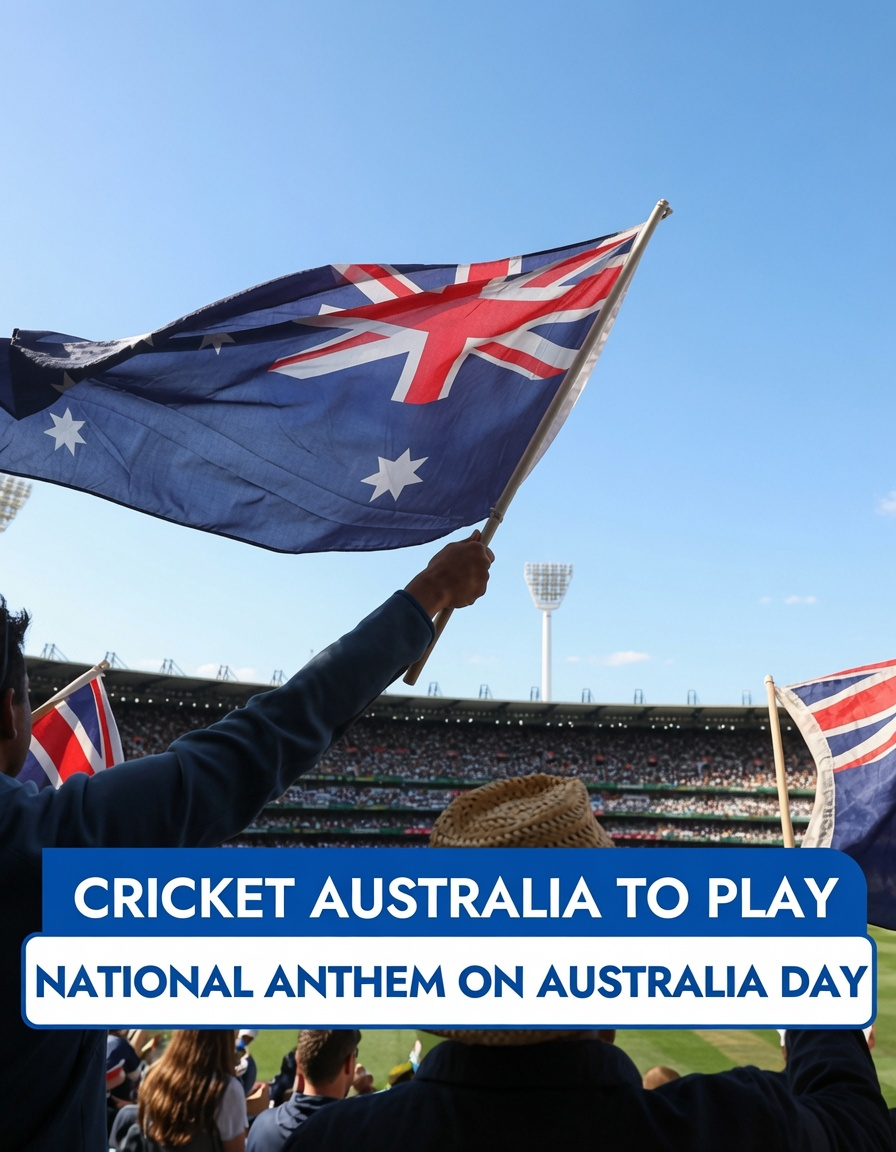
The controversy began with what may happen before the first delivery.
Reports this week indicate Cricket Australia does not currently intend to play Advance Australia Fair before the match unless the host city specifically requests it.
The governing body also says it will consult the National Aboriginal and Torres Strait Islander Cricket Advisory Committee (NATSICA) about how January 26 should be acknowledged.
That immediately raised an obvious question.
If Australia’s biggest domestic cricket final is being played on Australia’s national day…
Shouldn’t Australia’s national anthem be part of the occasion?
For many Australians, the answer is self-evident.
The anthem is not a political slogan.
It is the country’s official national song.
It has traditionally accompanied major international sporting contests for decades.
Many supporters argue that a championship played on Australia Day is exactly the sort of occasion where it belongs.
Former Olympian and Indigenous leader Nova Peris has publicly supported playing the anthem, arguing that national symbols can unite Australians while still recognising the difficult history experienced by First Nations peoples. She has suggested that respect for Indigenous Australians and respect for national symbols do not have to compete with one another.
But Cricket Australia sees a more complicated picture.
January 26 remains one of the most contested dates on Australia’s calendar.
For many Indigenous Australians it represents the beginning of colonisation and dispossession rather than a day of celebration.
Over recent years Cricket Australia has attempted to navigate those competing perspectives.
The organisation previously removed references to “Australia Day” from some promotional material, decisions that themselves generated fierce public criticism.
Its latest approach appears aimed at avoiding making the national anthem another flashpoint while still returning elite cricket to the public holiday.
That balancing act satisfies almost nobody.
Those who want stronger recognition of Australia Day argue Cricket Australia is overthinking something that should be straightforward.
If the final is deliberately scheduled for January 26 because it is a national holiday capable of attracting large crowds and television audiences, they ask why the organisation would hesitate to include the country’s own anthem.
Others argue the opposite.
Sport, they say, should avoid inflaming cultural divisions.
Cricket already occupies a unique place in Australian identity.
Perhaps the game itself should be allowed to unite people without adding symbolic debates that overshadow the players.
There is another point worth remembering.
The Big Bash League has never routinely featured the national anthem before every final.
This is not a long-standing tradition that has suddenly been abolished.
Rather, the controversy exists because the championship is returning to Australia Day itself.
The date has transformed an ordinary pre-match ceremony into a national political discussion.
Is the anthem really the problem?
Perhaps not.
The anthem has become a symbol standing in for a much larger disagreement about what January 26 represents.
Australians disagree about the meaning of the date.
They disagree about history.
They disagree about reconciliation.
They disagree about national identity.
The pre-match ceremony simply becomes another stage on which those disagreements play out.
No sporting administrator can solve that argument.
Nor should they pretend they can.
What should happen?
Reasonable Australians can reach different conclusions.
Some will believe the anthem belongs before any major sporting event held on Australia Day.
Others will believe alternative acknowledgements better reflect modern Australia.
Neither position automatically reflects a lack of patriotism or respect.
The challenge is finding a ceremony that acknowledges Australia’s history without turning one of the country’s biggest sporting events into another culture-war battleground.
Cricket Australia is attempting that balancing act.
Whether it has chosen the right approach will ultimately be judged not only by politicians or commentators, but by the millions of Australians who tune in on January 26.
Sport has always brought Australians together.
The hope is that, whatever pre-match ceremony is ultimately adopted, the cricket itself remains the main event.






