Victoria Police defected the billboard truck — but not because of what it said. The bigger question is whether politics benefits from messages like this

Victoria Police stopped the truck.

But not because police decided the political message was unacceptable.

That distinction matters.

Victoria Police confirmed an Isuzu truck received a vehicle defect notice after investigators concluded the additional billboard structures attached to the vehicle fell outside Victorian vehicle regulations.

The driver was directed to present the truck to VicRoads for inspection before it could continue operating.

The complaint that triggered the investigation had been lodged months earlier, on 16 April, before the truck became nationally controversial for displaying giant electronic signs depicting Victorian Premier Jacinta Allan alongside the slogan “Ditch the Witch.”
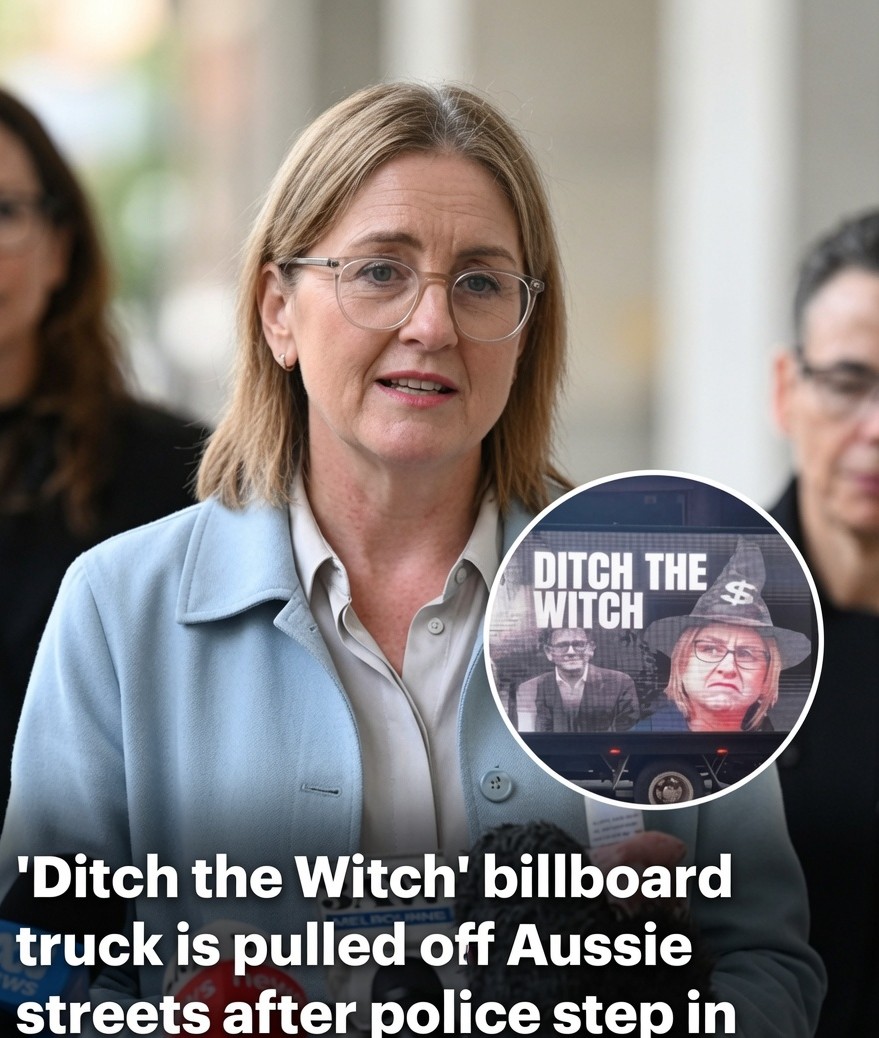
The controversial Melbourne billboard truck displaying political messages

That factual detail has largely disappeared beneath the political outrage.

Instead, Australians have been arguing about something much bigger.

Is this really how political debate should look?

The billboard was impossible to ignore.

Premier Jacinta Allan was portrayed wearing a witch’s hat.

The slogan deliberately echoed the infamous “Ditch the Witch” attacks directed at former Prime Minister Julia Gillard more than a decade ago.

Supporters described it as political satire.

Critics called it sexist.

Former Prime Minister Julia Gillard condemned it.

Prime Minister Anthony Albanese criticised it.

Even Liberal Deputy Leader Jane Hume publicly stated that sexism has no place in Australian politics.

The remarkable part is that criticism came from politicians who disagree about almost everything else.

That alone says something.

Political criticism is not the problem.

Australian democracy depends on people criticising governments.

Premiers should be challenged.

Prime ministers should be mocked.

Governments should expect protests.

Satire has always been part of politics.

Cartoonists exaggerate.

Comedians ridicule.

Campaigners provoke.

No democratic society should outlaw criticism simply because politicians dislike it.

But criticism and personal abuse are not identical.

There is a difference between saying a government has failed…

…and reducing a female political leader to a gendered insult.

The policy disappears.

The woman becomes the target.

Would the slogan exist if the Premier were a man?

That question explains why the billboard generated such a strong reaction.

“Ditch the Witch” was never simply a clever rhyme.

It carried historical baggage from the treatment of Julia Gillard.

Whether people agreed with Gillard’s politics or not, many Australians later accepted that much of the language directed at Australia’s first female prime minister crossed a line.

Seeing the same slogan return years later inevitably reopened that debate.

The issue is not whether Jacinta Allan deserves criticism.

Every elected leader does.

The issue is whether gender becomes the easiest weapon available.

The truck itself illustrates another modern problem.

Political advertising no longer belongs only to election campaigns.

Private businesses.

Interest groups.

Activists.

Individuals.

Anyone with sufficient money can purchase a moving billboard capable of reaching thousands of commuters every day.

Social media then amplifies it nationally.

The original audience may have been drivers stuck in Melbourne traffic.

The real audience became millions of Australians online.

That is exactly what happened here.

Police were regulating the vehicle—not the opinion.

This is another distinction worth protecting.

Victoria Police did not announce that the slogan breached hate speech laws.

They did not ban criticism of the Premier.

They investigated whether modifications to the truck complied with vehicle regulations.

According to police, they did not.

That is why the defect notice was issued.

Under VicRoads rules, a vehicle defect notice simply means authorities believe a vehicle no longer complies with required road standards and must be inspected or repaired before returning to normal use.

That matters because democracies become dangerous when governments appear to silence political speech through regulatory powers.

There is currently no public evidence that occurred here.

The enforcement action related to the vehicle itself.

So was the billboard a success?

If the objective was attention…

Absolutely.

Almost every Australian now knows about it.

Media outlets covered it.

Politicians condemned it.

Social media argued over it.

Mission accomplished.

But attracting attention is not the same thing as improving political debate.

Modern politics increasingly rewards outrage.

The more offensive something becomes…

…the more people share it.

That creates an incentive to make every campaign more provocative than the last.

The result is obvious.

Less discussion.

More insults.

Less policy.

More performance.

Australia should be careful about normalising this style of politics.

Citizens should remain free to criticise governments.

Businesses should remain free to advertise lawful political opinions.

Opposition should never require government approval.

Those freedoms matter.

But Australians are equally entitled to ask whether campaigns built around personal insults actually persuade anyone.

Calling a premier names may generate clicks.

It may generate headlines.

It may even generate donations.

What it rarely generates is better public policy.

Democracy functions best when arguments win because they are stronger—not because they are louder.

The Victoria Police defect notice has become another chapter in a much larger national conversation.

Not simply about one truck.

Not simply about one premier.

But about what Australians want political debate to become.

Every democracy allows hard criticism.

The harder question is whether it should celebrate contempt as a substitute for argument.

Related Posts

Editorial illustration of Steven Miles and David Crisafulli in Queensland politics

Steven Miles Challenges Crisafulli Over Child Safety After Amanda Camm Quits

Queensland Opposition Leader Steven Miles has challenged Premier David Crisafulli to appoint an experienced replacement for Amanda Camm after she announced her decision to step down from the child safety and domestic and family violence portfolios. Miles says the choice will reveal how seriously the government takes services for vulnerable children and families. Crisafulli has praised Camm’s record and defended the reforms initiated during her term. Camm says her decision was personal and followed major surgery and an incomplete recovery. She has also referred to the stress of her ministerial workload and the impact of public harassment. Her resignation should not be portrayed as an admission that the criticism of her administration was correct. The policy dispute and the reasons she has given for leaving office are separate facts.

Editorial illustration of Sharon Freund and Michael Allen with courthouse imagery, not a photograph of proceedings

Judge Sharon Freund Challenges Watchdog Referral Amid Dispute With Michael Allen

NSW Deputy Chief Judge Sharon Freund has taken her challenge to a watchdog referral before the Court of Appeal amid a prolonged dispute involving Local Court Chief Judge Michael Allen. The latest proceedings concern whether decisions and observations arising from a Judicial Commission process were reached and handled lawfully. The legal contest remains unresolved, and the allegations at its centre must not be treated as disciplinary findings against either judge. Published accounts of the Court of Appeal proceedings say Freund’s lawyers have challenged the Attorney-General’s referral of her conduct to the NSW Judicial Commission. The dispute has been linked to questions about the handling of a criminal case involving a judicial colleague’s adult child and to competing allegations about procedural propriety. Those accounts remain contested, and the Court of Appeal’s task is not identical to a final disciplinary inquiry.

Editorial illustration of Angie Bell and Anne Aly, Australian parliamentary debate

Angie Bell Calls Stoning Remarks ‘Regrettable’ After Anne Aly Criticism

Liberal frontbencher Angie Bell has described her earlier parliamentary remarks about Small Business Minister Anne Aly and Prime Minister Anthony Albanese as regrettable, calling them a poor choice of words after a furious public dispute over violent imagery in political debate. Bell says the comment was neither helpful nor planned, and that she withdrew it and tried to rectify the matter with Aly. The new statement follows criticism from Aly, who described the original language as racist and misogynistic. The exchange is significant not because the words have just been spoken, but because Bell has now publicly addressed them. Her expression of regret should be reported accurately without claiming that she accepted every criticism Aly made or that the parties have resolved their disagreement.

Editorial illustration of Nina Taylor and Fishermans Bend urban development

Nina Taylor Defends Fishermans Bend Plans as Rivals Demand Faster Transport

Labor MP Nina Taylor has defended the Victorian government’s approach to Fishermans Bend as rival candidates in the Albert Park electorate demanded faster public transport and better infrastructure for the growing inner-Melbourne precinct. The debate at a local election forum highlighted the gap between plans for a major urban renewal area and the transport connections residents and businesses can already use. Candidates questioned why promised tram and rail links remain distant prospects despite long-running plans to accommodate substantially more homes and jobs. Taylor pointed to recent planning steps, the Metro Tunnel and expanded bus services, while opponents pressed the government to deliver infrastructure earlier. The disagreement concerns priorities, funding and sequencing; a planning announcement should not be confused with a completed railway or tram service.

Editorial illustration of Angus Taylor and Chris Bowen with the Snowy 2.0 hydroelectric project

Angus Taylor Demands Chris Bowen Resign Over Snowy 2.0 Cost Blowout

Opposition Leader Angus Taylor has called for Energy Minister Chris Bowen to resign after Snowy Hydro revised the cost and completion forecast for Snowy 2.0, reviving a political argument over who is responsible for one of Australia’s most expensive energy projects. The company’s updated target is $22.2 billion, with an allowance for a cost of up to $25 billion, while commissioning is now expected in late 2029. The latest assessment is a major test for the Commonwealth-owned company and for governments of both political persuasions. Taylor was energy minister when the project was approved under the Coalition. Bowen, who oversees the project as a shareholder minister under Labor, says the early design and engineering assumptions left a lasting problem. Neither side’s political account changes the figures Australians now need to assess.

Editorial illustration of David Pocock and Anthony Albanese with parliamentary funding documents

David Pocock Challenges Albanese Over Helen Haines Funding Dossier

Independent senator David Pocock has challenged Prime Minister Anthony Albanese’s explanation of a document circulated from his office about fellow independent Helen Haines, drawing a sharp distinction between routine political briefing and material that can cast doubt on an MP’s integrity. Albanese says the file concerned Haines’s requests for funding for her electorate and was not intended as a personal attack. The row has taken on particular sensitivity after the alleged vehicle attack that left Haines critically injured. That incident is the subject of a separate criminal investigation. No established evidence links the circulation of the political document to the alleged attack or identifies political briefing as a motive. Treating the two events as causally connected would go beyond the facts.





