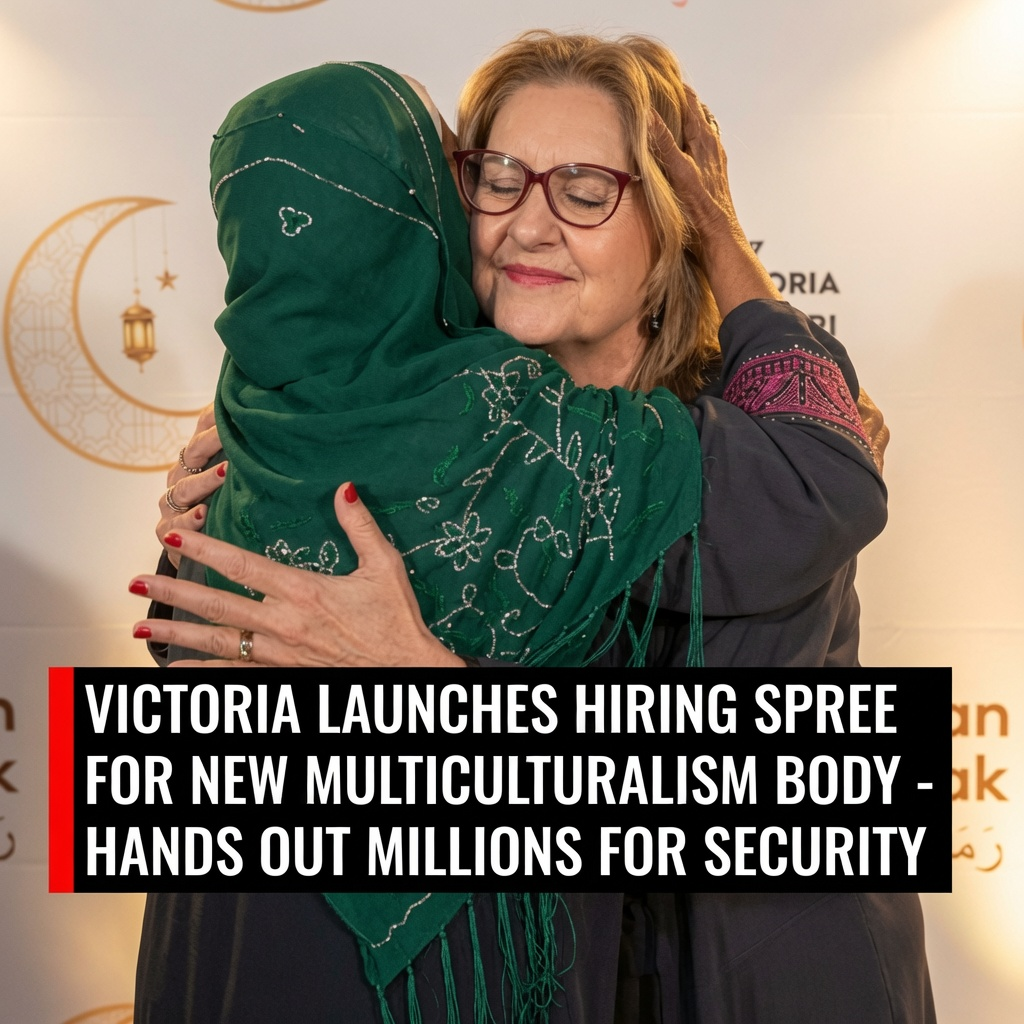
Victoria’s Labor government is building a new multicultural bureaucracy, recruiting a fresh layer of senior leadership and distributing millions of dollars to community organisations for infrastructure and security.
And this time, the government is not even pretending the political context is irrelevant.
In its own announcement of almost $6 million in multicultural infrastructure and security grants, the Allan Government explicitly warned about the prospect of a “One Nation Liberal coalition”.
“We know the harm a One Nation Liberal coalition will cause,” the government’s statement said.
“They’ve gone after multicultural communities before and we know they’ll do it again.”
That is unusually direct language for a government media release announcing grants for lighting, security cameras, bollards and community facilities.
But Victoria is heading towards an election in November.
Pauline Hanson’s One Nation has become a serious factor in state political calculations.
Labor is under pressure.
And multicultural policy, once treated largely as an administrative and community affairs portfolio, is being pulled directly into the electoral fight.
The government is now moving on two fronts.
First, it is preparing to establish a new statutory body called Multicultural Victoria, subject to legislation passing Parliament.
Second, it is accelerating funding to multicultural and multifaith organisations, including millions of dollars for physical security at communal gathering places.
The government says this is about representation, safety, unity and social cohesion.
Critics will see another bureaucracy, more senior positions and public money flowing to politically important community organisations.
What cannot seriously be disputed is the timing.
Labor has decided multiculturalism will be a political dividing line at the Victorian election.
It is now saying so in its own press releases.
A new statutory body is coming — if Labor gets the legislation through
Multicultural Victoria is one of the major institutional changes to emerge from the Victorian Government’s Multicultural Review.
The review followed extensive consultation with multicultural and multifaith communities and examined how the state government should respond to growing concerns about social cohesion.
Under Labor’s plan, the new entity will bring together the functions of the Victorian Multicultural Commission and Multicultural Affairs.
It will not simply be a renamed commission.
The government says Multicultural Victoria will have expanded responsibilities, including community engagement, advocacy, accountability and policy development.
It will also develop safety plans for communities affected by “serious and distressing events”.
The proposed organisation will be led by a Multicultural Coordinator General.
Two Deputy Coordinators General will support the position, with one deputy coming from regional Victoria.
There will also be members of a Multicultural Community Advisory Group.
Applications for those positions are due to open shortly.
Minister for Multicultural and Multifaith Victoria Ingrid Stitt says the purpose is to give communities a stronger voice inside government.
“We are backing Victoria’s multicultural and multifaith communities – ensuring their voices are represented and heard,” she said.
The government says the new body will improve the way it listens and connects with communities on the ground.
There is, however, an important legal qualification.
Multicultural Victoria does not yet exist as the fully established statutory body described by the government.
Its establishment remains subject to the passage of legislation through the Victorian Parliament.
The government’s own material says the legislation is expected to be debated in 2026.
In other words, Labor is preparing the leadership structure while the parliamentary process is still to be completed.
That will inevitably attract scrutiny.
Supporters will call it sensible transition planning.
Opponents will ask why applications for a Coordinator General and deputies are being prepared before the statutory entity has formally cleared Parliament.
Either way, the government is clearly moving on the assumption that Multicultural Victoria will become a significant part of the state’s administrative landscape.
The titles alone will guarantee a political argument
Coordinator General.
Two Deputy Coordinators General.
A Multicultural Community Advisory Group.
A new statutory body with advocacy, accountability and community engagement functions.
For a government already facing relentless attacks over debt and the size of the Victorian public sector, those words are politically combustible.
The Allan Government is simultaneously pursuing machinery-of-government changes and savings while creating a new institutional structure for multicultural affairs.
Labor’s answer is that Multicultural Victoria combines functions currently split between the Victorian Multicultural Commission and Multicultural Affairs.
The argument is therefore not as simple as saying an entirely new bureaucracy is being dropped on top of two untouched existing agencies.
The government says the functions are being brought together and the mandate strengthened.
But institutional consolidation does not remove the obvious questions.
How many staff will Multicultural Victoria employ?
What will the Coordinator General and two deputies be paid?
What is the total operating budget?
Which existing positions will disappear when the functions are combined?
How will success be measured?
What accountability will apply to its advocacy function?
And where does community representation end and political lobbying inside government begin?
Those are not anti-multicultural questions.
They are the ordinary questions taxpayers should ask whenever a government restructures public administration.
Victoria’s multicultural communities deserve effective representation.
Victorian taxpayers deserve to know whether the institutional model is effective.
The two principles are perfectly capable of existing together.
The $6 million security program is funding cameras, lighting and bollards
Two days after the latest Multicultural Victoria announcement, the government revealed the successful recipients of the 2025–26 Multicultural Infrastructure and Security Program.
Fifty-seven organisations will share close to $6 million.
The projects support about 24 ethnicities and 14 faiths.
Fifteen are based in regional and rural Victoria, while 42 support metropolitan communities.
The funding is intended to upgrade, maintain and secure communal gathering spaces.
That includes physical security measures.
Kali Mata Mandir in Craigieburn is receiving more than $80,000 to upgrade its security camera system and lighting at the Hindu temple.
The Holy Apostolic Catholic Assyrian Church of the East in Coolaroo is receiving more than $380,000 for work including exterior security lighting, a security camera system and inground bollards.
Other funded organisations will carry out infrastructure and security improvements at facilities used by multicultural and faith communities.
There is a serious public policy case for some of this spending.
Religious and community facilities have faced genuine security threats.
Australia has experienced a period of heightened social tension linked to overseas conflicts, antisemitism, Islamophobia, political extremism and increasingly aggressive public debate.
Places of worship are soft targets precisely because they are designed to welcome people.
A temple, mosque, synagogue or church cannot operate like a military installation and still perform its basic community function.
Security cameras, better lighting and vehicle barriers can be practical protective measures.
The question is not whether every dollar spent on security is waste.
The more difficult question is why the Allan Government chose to announce that security spending with an explicit attack on One Nation and the Liberals.
Labor itself turned a security grants announcement into an election argument
The government’s language deserves close attention.
Its announcement said Labor would always help ensure Victorians could participate safely in community life, free from racism, vilification and discrimination.
Then came the political line.
“We know the harm a One Nation Liberal coalition will cause.”
“They’ve gone after multicultural communities before and we know they’ll do it again.”
This was not a comment extracted from a minister during an aggressive press conference.
It appeared in the Victorian Government’s own published announcement about the grants.
Labor therefore made the political connection itself.
The government is effectively asking multicultural voters to view the November election partly through the lens of protection.
Labor will support multicultural communities.
One Nation represents a threat.
The Liberals, if politically dependent on One Nation, would be pulled into that threat.
That is the frame.
It also explains why the phrase “One Nation Liberal coalition” is appearing in Labor’s political language.
One Nation’s growth has created the possibility of a complicated Victorian Parliament after the election.
ABC analysis in June reported that Labor MPs and insiders were increasingly discussing the possibility of a hung parliament involving a significant One Nation bloc.
Whether that scenario eventuates is impossible to know before votes are counted.
But Labor does not need a formal Coalition–One Nation agreement to campaign against the possibility.
It needs voters to imagine one.
For multicultural communities wary of Hanson’s politics, that may be a powerful message.
The grants are arriving in rapid succession
The almost $6 million infrastructure and security announcement did not arrive in isolation.
Only days earlier, the Victorian Government announced $4.9 million for close to 200 multicultural organisations through the 2025–26 Multicultural Capacity Building Program.
Those grants support organisations representing more than 46 ethnic communities and 15 faith groups.
More than $1.6 million was directed to new, emerging and smaller organisations.
The purpose of that program is different from the security grants.
It is designed to help multicultural organisations strengthen governance, build organisational capacity and expand their impact.
But viewed together, the announcements show the scale of the government’s current activity in the multicultural portfolio.
Nearly $5 million for capacity building.
Close to $6 million for infrastructure and security.
A proposed new statutory body.
A Coordinator General.
Two deputies.
An advisory group.
A new four-year whole-of-government multicultural strategy.
And a social cohesion values commitment being attached to government grant arrangements.
This is not a minor policy adjustment.
Labor is redesigning the way Victoria manages multicultural affairs.
The social cohesion agenda goes much further than grants
Multicultural Victoria is only one part of the government’s response to the Multicultural Review.
Labor is also developing a four-year whole-of-government multicultural strategy.
Government departments will have actions under that strategy and will be required to report on what they are doing to meet them.
The government has also introduced a Social Cohesion Values Commitment for organisations receiving grants administered through the multicultural and multifaith portfolio.
According to the government’s published review response, grant recipients agree to champion social cohesion, reject division and contribute to community harmony.
The commitment is being rolled out in stages and is intended to extend to other government grant programs.
Again, the stated purpose is easy to understand.
A government does not want to hand taxpayer money to an organisation that uses public funding to promote hatred or social division.
Few reasonable Victorians would argue that it should.
But values clauses always raise questions about definitions and enforcement.
Who decides what constitutes “division”?
Can a community organisation strongly criticise government policy without being accused of undermining cohesion?
How are political, religious and cultural disagreements treated?
Will the standards be applied consistently to every group?
What appeal or review mechanisms exist if funding is threatened?
The government’s earlier response to the Multicultural Review said the commitment was not intended as a punitive instrument.
But any values requirement linked to public money will attract scrutiny because access to funding creates leverage.
The stronger Multicultural Victoria becomes as an advocacy and accountability institution, the more important those governance boundaries will be.
Vivienne Nguyen’s departure marks the end of one model
The recruitment announcement coincides with the end of Vivienne Nguyen AM’s term as chair of the Victorian Multicultural Commission.
Nguyen was appointed in August 2019.
Her term covered an extraordinary period for Victoria’s multicultural communities.
The COVID-19 pandemic created major communication challenges, particularly when health information needed to reach communities speaking hundreds of languages.
Victoria’s floods created another need for community engagement and recovery support.
Nguyen convened the Multifaith Advisory Group and served on Victoria’s Anti-Racism Taskforce.
She also led major community events including Cultural Diversity Week.
Louise Perry has been appointed interim VMC chair from 16 July to support the transition until Multicultural Victoria is established.
Perry, a Victorian of Burmese descent, began her career as a journalist and has worked in community organisations, international development and human rights before joining the Victorian Public Service.
The transition is symbolically important.
The Victorian Multicultural Commission has long been the most recognisable public institution in the portfolio.
The Multicultural Review concluded the system needed to change.
Labor is now moving towards a body with a more powerful central leadership structure and broader functions.
Whether that produces better outcomes will depend on much more than the titles given to its executives.
Victoria is extraordinarily diverse — which is precisely why the policy deserves scrutiny
The Victorian Government says about one-third of the state’s population was born overseas.
Its multicultural institutions deal with communities spanning hundreds of languages and ancestries.
This creates practical challenges that are easy to underestimate.
Emergency warnings have to reach people who may not read English confidently.
New migrants need to understand government services.
Faith communities can become targets during periods of international tension.
Overseas wars can produce fear and anger in Melbourne suburbs thousands of kilometres from the conflict.
Governments need relationships with community leaders before a crisis occurs, not only after it begins.
Those are legitimate reasons to have specialist multicultural policy capacity.
But Victoria’s diversity is also why the government must avoid treating multicultural communities as a single political constituency.
An Indian-Australian small business owner does not necessarily share the politics of a Sudanese community organisation.
A Greek Orthodox family may have very different concerns from a recently arrived Muslim refugee.
Jewish Victorians facing antisemitism may disagree sharply with other community groups about the Middle East.
Chinese Australians, Vietnamese Australians, Lebanese Australians and African Australians are not voting blocs with one collective political mind.
“Multicultural communities” is administratively convenient language.
Real communities are much more complicated.
A new statutory body that claims to raise their voices will have to demonstrate that it is hearing disagreement as well as consensus.
Pauline Hanson’s rise has forced Labor to choose a sharper political message
One Nation’s growing relevance in Victoria has changed the language of the election.
Hanson has spent decades attacking what she describes as government-sponsored multiculturalism.
Her supporters argue Australian institutions divide citizens into identity groups, fund advocacy organisations and create bureaucracies that elevate cultural difference over a common national identity.
Labor takes almost the opposite position.
It describes multiculturalism as one of Victoria’s greatest strengths and argues governments must actively ensure diverse communities are represented, heard and protected.
Those positions are not minor variations on the same policy.
They are competing ideas about what government should do in a diverse society.
The proposed Multicultural Victoria makes that ideological divide unusually clear.
Hanson’s side will look at a Coordinator General, two deputies, an advisory group, safety planning functions, grant programs and values commitments and see exactly the multicultural bureaucracy it has spent years opposing.
Labor will look at the same structure and see a government finally giving culturally diverse communities the influence and institutional support they need.
That argument was coming whether Labor mentioned One Nation in the security grants announcement or not.
The government simply brought it into the open.
The real test is whether Victorians receive measurable value
The debate over Multicultural Victoria will quickly become tribal if both sides allow it.
One side will shout “waste”.
The other will shout “racism”.
Neither response is sufficient.
The government should be required to explain the cost and structure of the new statutory body clearly.
It should publish meaningful measures of performance.
If Multicultural Victoria is supposed to improve communication during serious events, Victorians should eventually be able to see evidence that communication improved.
If it is supposed to strengthen community engagement, the government should demonstrate that a broader range of organisations are being heard.
If security grants are intended to reduce risk, funding decisions should be based on transparent criteria and credible assessments of need.
If grant recipients are bound by social cohesion commitments, those rules should be applied consistently and fairly.
And if existing government functions are being consolidated, taxpayers should be shown whether duplication is actually being removed.
That is how a government proves a new institution is more than a political symbol.
Labor has made a large promise.
It says Multicultural Victoria will improve the way government listens, connect directly with communities and help strengthen unity and cohesion.
At the same time, it is directing millions of dollars towards multicultural organisations and security projects.
Then it is telling those communities a One Nation-linked government could cause them harm.
There is policy here.
There is genuine security concern here.
There is also unmistakable election politics.
Victorians should be capable of examining all three at the same time.
The temples, churches and community centres receiving cameras, lighting and bollards deserve to be safe.
Multicultural Victorians deserve a government capable of communicating with them and responding to serious threats.
But a government spending public money and creating a new statutory institution also deserves scrutiny.
Especially when it has chosen to put Pauline Hanson and the Liberal Party into the press release itself.
Victoria’s multicultural policy is no longer sitting quietly in the community affairs portfolio.
Labor has placed it directly on the election battlefield.






