One Nation’s extraordinary rise in the polls is forcing the party to confront a problem that matters far more when voters begin to see a political movement as a genuine contender for power: how much will its promises cost, and who is checking the numbers?
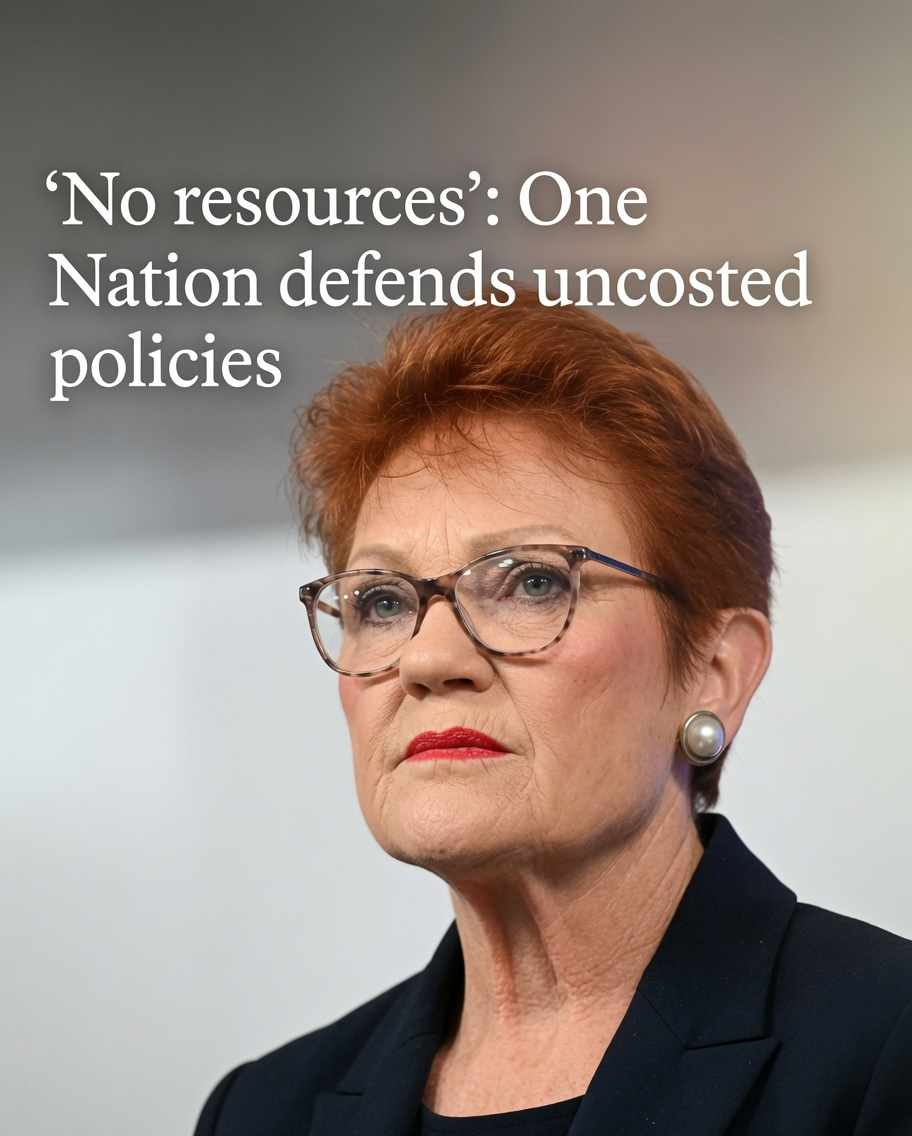
The Pauline Hanson-led party is facing renewed questions over its economic platform after treasury spokesman Barnaby Joyce declined to guarantee that every One Nation policy would be submitted to the Parliamentary Budget Office for independent costing.
Joyce said the party would make its “very best attempts” to have its commitments assessed, but argued One Nation did not have the resources available to Australia’s established major parties.
“You’ve got to realise and I think it’s fair to accept that we don’t have the resources,” Joyce told Sky News.
“We have … a real trap where they say we want you to act like a major party, but we’re not going to give you the resources.”
It is a defence that goes to the heart of One Nation’s transformation. For years, the party could operate primarily as an insurgent political force, campaigning against the major parties and promoting policies without facing the same expectation that it produce a government-ready fiscal program.
That position is becoming harder to maintain.
One Nation has surged from the margins of federal politics to levels of support that have placed it ahead of the Coalition in multiple polls and, in some surveys, within striking distance of Labor.
A Roy Morgan survey conducted from June 15 to 21 put One Nation’s primary support at 31.5 per cent, ahead of Labor on 27 per cent and the Liberal-National Coalition on 17.5 per cent. In a hypothetical Labor-One Nation contest, the poll estimated Labor leading by a narrow 51 to 49 margin after preferences.
Individual polls are snapshots rather than election results, and Australia’s preferential voting system makes the conversion of a national primary vote into House of Representatives seats particularly complicated. But the political significance of One Nation’s rise is difficult to dismiss.
The party is no longer being scrutinised only for what it opposes. Increasingly, its rivals and the public are asking what a One Nation economic program would actually do to the Commonwealth budget.
The defence spending promise exposed the problem
One of the clearest examples has been Senator Hanson’s proposal to lift Australian defence spending to five per cent of gross domestic product.
The scale of such a commitment immediately attracted attention because defence spending is already one of the largest and most consequential areas of federal expenditure. Moving towards five per cent of GDP would represent an enormous increase and could add hundreds of billions of dollars to government spending over time, depending on the policy’s design, timetable and economic assumptions.
Hanson has since stepped back from the five per cent position, illustrating why detailed costings matter before a headline commitment becomes embedded in public debate.
A percentage of GDP can sound straightforward on a podium. Translating it into annual appropriations, borrowing requirements, competing budget priorities and long-term fiscal consequences is considerably more difficult.
The same problem applies to tax cuts, fuel measures, housing policies and other cost-of-living promises. A policy may be popular in isolation while creating a much more complicated picture when combined with every other commitment a party intends to take to an election.
Opposition Leader Angus Taylor has seized on that vulnerability, sharpening the Coalition’s economic attack on its rival on the political right.
Taylor has claimed that just four One Nation commitments could cost the federal budget $1 trillion over a decade and accused the party of having no credible explanation for how the promises would be funded.
Joyce has challenged the trillion-dollar figure, but has offered limited detail about the scale of spending cuts or savings One Nation would use to balance its program.
He has pointed to reducing duplication between levels of government as one area where savings could be found.
“We only have four people and I’m doing a lot of work on my own,” Joyce said.
“I’m back to accountancy and being an economist at the moment. I need further resources to get to the bottom of this.”
The exchange reveals an unusual reality in Australian politics. One Nation’s electoral support has expanded much faster than the parliamentary machinery behind the party.
A political organisation can experience a rapid polling surge in months. Building the staff, policy expertise and internal processes expected of a prospective government is a much slower task.
What the Parliamentary Budget Office actually does
The argument over resources is also drawing attention to the role of the Parliamentary Budget Office, an independent and non-partisan institution established to provide analysis of fiscal policy and the financial implications of policy proposals.
The PBO produces costings using the information and assumptions available at the time a proposal is assessed. Its published guidance also warns that cost estimates can change as economic conditions and budget data change.
That qualification is important. An independent costing is not a prediction carved in stone. It is an estimate built around a defined policy and a set of assumptions.
But the process forces politicians to answer questions that campaign slogans often avoid.
When does the policy begin? Who is eligible? How will it be administered? Does it change behaviour? What happens to tax revenue? Does the commitment expire or continue indefinitely? Is it funded by higher taxes, lower spending elsewhere or additional borrowing?
Those details can dramatically alter the price of a promise.
The PBO’s election commitments process is designed, in part, to create a public record of election promises and their budget impacts. Major parties are included in the post-election reporting framework, while minor parties and independents can choose to participate.
The office itself says the process helps create a more even playing field by giving non-government parties and independents access to costing expertise.
That does not mean every political idea must be sent immediately for public assessment. Costing requests outside election caretaker periods can involve confidentiality, and parties routinely develop or revise policies before taking final positions to voters.
The question for One Nation is different: at what point does a party’s political strength create a reasonable expectation that its major promises should be presented as a coherent, costed program?
Its polling rise suggests that point may already have arrived.
One Nation’s outsider status is becoming harder to use as a shield
One Nation’s appeal has been built in large part on voter frustration with the established political system.
Housing affordability, migration, household costs and distrust of government have provided fertile ground for a party that presents itself as willing to say what Labor and the Coalition will not.
That outsider identity can be politically powerful. It also creates a difficult transition if the party becomes a serious contender for a large bloc of lower house seats.
A protest party can point to a problem. A party seeking power must eventually explain the mechanism, the price and the trade-offs involved in fixing it.
If One Nation wants lower taxes, voters can reasonably ask which taxes, by how much and over what period. If it wants substantially higher defence spending, the money must come from somewhere. If it proposes major changes to government agencies or federal-state responsibilities, the savings need to be demonstrated rather than assumed.
This is not a standard applied only to One Nation.
Governments are routinely criticised for budget blowouts, failed forecasts and programs that cost more than initially promised. Oppositions face intense pressure during election campaigns to explain how their commitments will be funded. The Greens have also faced repeated attacks over the assumptions behind major spending and revenue proposals.
The difference is that One Nation’s recent success has abruptly moved it into the same arena.
The party’s critics are effectively arguing that it cannot ask voters to treat it as a major political alternative while asking for the financial latitude traditionally afforded to a small minor party.
Joyce’s response is that One Nation is caught between expectations and resources: being told to behave like a major party without receiving the institutional support of one.
There is some political force in that argument. A small parliamentary team cannot easily replicate the policy operations of Labor or the Coalition, organisations with larger caucuses, established networks and extensive experience in government and opposition.
But the counterargument is equally straightforward. The Commonwealth budget does not become less complex because a party has fewer staff.
The Coalition now has a reason to make costings a central political issue
The pressure on One Nation is not occurring in a political vacuum.
The Coalition has watched support migrate to Hanson and is searching for an effective way to distinguish itself from a party competing for many of the same dissatisfied voters.
Attacking One Nation solely on cultural or ideological grounds risks reinforcing Hanson’s claim that the political establishment is united against her.
Economic scrutiny offers the Coalition a different line of attack.
Taylor can argue that voters frustrated with Labor should not replace it with a party whose most expensive commitments have not been fully explained. It allows the Coalition to frame itself as the more experienced conservative economic alternative while avoiding a direct rejection of every concern driving voters towards One Nation.
Labor, meanwhile, has sought to portray One Nation as a grievance-driven movement offering simple answers to difficult problems.
Both strategies depend on the same political calculation: the closer Hanson gets to power, the more voters may demand evidence that her party is prepared for the practical responsibilities of government.
One Nation’s challenge is to prove that greater scrutiny will strengthen rather than weaken its appeal.
Joyce also wants a Reserve Bank shake-up
The debate over costings comes as Joyce promotes a broader One Nation economic agenda, including changes to the role and public voice of the Reserve Bank.
He has argued that the central bank should be “more independent” and should be able to speak publicly about government spending.
Joyce said he had some sympathy for the Reserve Bank because interest rates were effectively a blunt instrument being used against a much wider range of economic pressures.
The argument reflects a frustration felt by many mortgage holders. When inflation remains too high, higher interest rates can place enormous pressure on households with debt, even when those households have little control over the government spending, supply constraints or international shocks contributing to price pressures.
But changing the Reserve Bank’s role would itself require careful policy design. Questions about central bank independence, fiscal policy and public commentary by monetary authorities can have significant implications for financial markets and confidence.
Again, the details matter.
The next test is whether One Nation can turn momentum into a governing platform
Australian politics has entered unfamiliar territory as One Nation’s polling strength disrupts the traditional Labor-Coalition contest.
The party’s surge has already forced strategists to reconsider how preference flows and three-way contests could shape the next federal election. Electoral analyst Antony Green has previously noted that a One Nation vote around 25 per cent could make the party highly competitive across rural and regional Australia, particularly in seats held by the Liberals and Nationals.
Yet winning support and administering a national government are different tests.
One Nation’s policies will now be examined not simply for their ability to capture anger or dominate a news cycle, but for whether they can survive fiscal scrutiny.
The “no resources” explanation may accurately describe the pressure on Joyce and a small parliamentary team trying to keep pace with a dramatic rise in voter support.
It is also an explanation that becomes less politically sustainable with every poll showing One Nation as a potential major force.
If Australians are seriously considering handing the party substantially more power, many will want to know what its promises cost before they cast a ballot.
For Hanson and Joyce, that is the price of political success: the closer One Nation moves towards the centre of the contest for government, the less room it has to operate like an outsider.






