Anthony Albanese believes he has a simple explanation for Welcome to Country ceremonies.
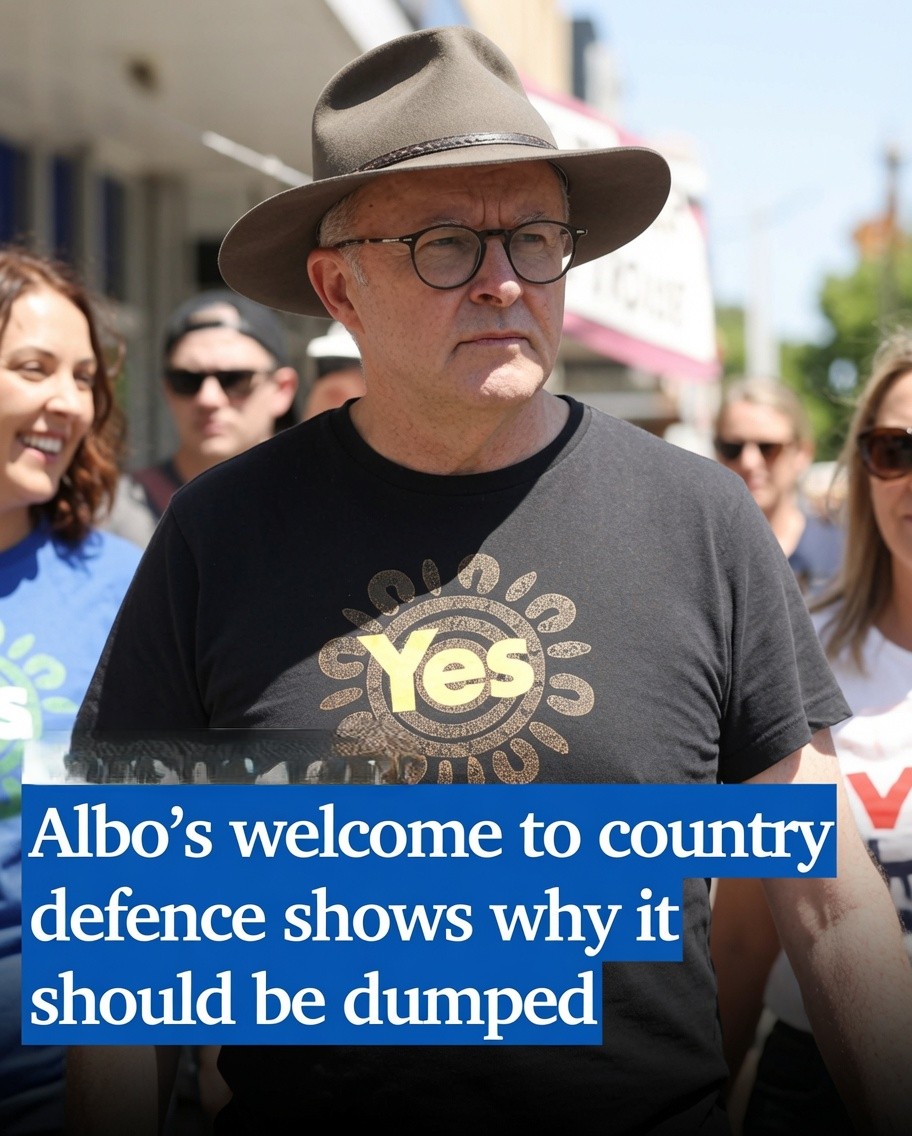
They are an act of respect.
An act of politeness.
A recognition of Aboriginal and Torres Strait Islander Australians as the nation’s First Peoples.
For Rita Panahi, the Prime Minister’s explanation does not settle the argument.
She believes it exposes the problem.
The conservative columnist has launched a fierce attack on Albanese as Labor moves to formalise its support for Welcome to Country and Acknowledgement of Country ceremonies in the party’s national platform.
Her central accusation is confronting.
After Australians rejected the Indigenous Voice to Parliament at the 2023 referendum, Panahi argues Albanese has failed to understand the public’s message and is continuing with a politics that divides citizens according to ancestry.
She says the language surrounding Welcome to Country creates the impression that some Australians possess a deeper claim to the nation than others.
Albanese sees courtesy.
Panahi sees exclusion.
And that disagreement explains why a ceremony once treated by many Australians as largely symbolic has become one of the country’s most persistent cultural battles.
The dispute is not really about the words spoken at the beginning of a football match, conference or government event.
It is about a much larger question.
Who belongs to Australia?
And can the country recognise the unique history of its Indigenous peoples without making millions of other Australians feel they are permanent guests in their own nation?
Albanese says it is like welcoming someone into your home
The Prime Minister has repeatedly defended Welcome to Country ceremonies as criticism of their frequency and meaning has intensified.
His argument is built around manners.
Albanese has described a Welcome to Country as an act of politeness and compared the practice with welcoming someone into a home.
Supporters of the ceremonies understand the analogy immediately.
A welcome does not necessarily mean the visitor has no rights.
It does not need to imply hostility.
It can simply be an expression of generosity and recognition.
Welcome to Country ceremonies are conducted by Traditional Owners or Aboriginal and Torres Strait Islander people authorised to welcome visitors to a particular traditional area.
An Acknowledgement of Country is different.
It can be delivered by Indigenous or non-Indigenous people and recognises the Traditional Owners of the land on which an event is taking place.
For Albanese and many supporters of reconciliation, these practices acknowledge a historical reality.
Aboriginal and Torres Strait Islander cultures existed on the Australian continent for tens of thousands of years before British colonisation.
Those cultures were connected to particular lands, languages and communities.
Recognition of that history, supporters argue, does not remove the citizenship or belonging of anyone alive today.
It adds context to the Australian story.
Panahi’s objection is that the “home” analogy can be heard in a radically different way.
If one group is welcoming another into a home, who is the owner?
Who is the guest?
And how many generations must an Australian family live in the country before its descendants no longer require a symbolic welcome?
That is the emotional centre of her criticism.
Panahi says the ceremony divides Australians into hosts and guests
Panahi’s argument is not that Indigenous Australians should be erased from Australian history.
Her attack is directed at the political meaning she believes has become attached to ceremonial language.
She argues Australians should possess an equal claim to the country as citizens regardless of race.
A person whose ancestors arrived from Britain two centuries ago.
A child of Greek migrants.
A Vietnamese Australian family.
An Indian migrant who became a citizen last year.
An Aboriginal Australian whose family history on the continent stretches back thousands of generations.
These people have profoundly different histories.
Panahi’s position is that modern citizenship must nevertheless place them on equal political ground.
Her concern is that repeated official language about being “welcomed” onto land can suggest otherwise.
In her interpretation, one racial group becomes the permanent host and everyone else becomes a permanent visitor.
That is why Albanese’s politeness defence has not persuaded critics.
The disagreement is not over whether politeness is good.
It is over the premise behind the welcome.
Critics ask why an Australian born in Melbourne, Sydney, Perth or Brisbane should conceptually require permission or welcome to stand in the country of their birth.
Supporters respond that no permission is being demanded.
The ceremony is cultural recognition, not a legal declaration of ownership or citizenship.
Both sides are often responding to meanings the other side says it does not intend.
That is one reason the debate has become so difficult to resolve.
The Voice referendum hangs over every Indigenous policy debate
Panahi directly links the current controversy to the 2023 Voice referendum.
The result was decisive.
Australians were asked whether the Constitution should be altered to recognise the First Peoples of Australia by establishing an Aboriginal and Torres Strait Islander Voice.
The proposal failed.
About 60.1 per cent voted No and 39.9 per cent voted Yes.
It failed to achieve a national majority.
It also failed to win a majority in any state.
The Australian Capital Territory recorded a Yes majority, but territories do not count towards the constitutional requirement for a majority of states.
For Albanese, the result was a devastating political defeat.
He had invested enormous political capital in the referendum.
Labor entered government promising to implement the Uluru Statement from the Heart in full.
The Voice was the first element of the sequence commonly described as Voice, Treaty and Truth.
After the referendum failed, the political landscape changed.
But what exactly did Australians reject?
This is where Panahi’s argument and Labor’s defence sharply diverge.
The referendum question did not ask Australians whether they supported Welcome to Country ceremonies.
It did not ask whether Indigenous history should be acknowledged at public events.
It did not ask voters to approve or abolish Acknowledgements of Country.
It asked whether the Constitution should be changed to establish a Voice able to make representations to Parliament and the executive government on matters relating to Aboriginal and Torres Strait Islander peoples.
Legally and constitutionally, the referendum result cannot simply be described as a national vote against Welcome to Country.
Politically, however, the meaning of the No vote remains fiercely contested.
Many No voters opposed the specific constitutional model.
Some believed the proposal lacked sufficient detail.
Some opposed creating an Indigenous advisory body in the Constitution.
Some rejected what they regarded as race-based political representation.
Others distrusted Albanese’s campaign or believed the Voice would not improve outcomes in Indigenous communities.
There was no single motivation shared by every person who voted No.
Panahi nevertheless sees the scale of the defeat as evidence of a wider rejection of racial division in Australian public life.
Labor does not accept that interpretation.
That unresolved argument is now being fought through Welcome to Country.
Labor is moving to formalise support for the ceremonies
The immediate political trigger for Panahi’s criticism is Labor’s national conference.
The party is moving to formally reaffirm support for Welcome to Country and Acknowledgement of Country practices.
That matters because a party platform is not merely a passing comment from a minister.
It records the political principles and policy direction Labor chooses to endorse collectively.
For supporters, formal support is a response to growing attacks on the ceremonies.
Welcome to Country became a major national controversy during the 2025 federal election campaign after ceremonies were booed at Anzac Day events.
Conservative politicians increasingly questioned whether the practice had become excessive.
Then-opposition leader Peter Dutton argued Welcome to Country ceremonies were overdone and should be reserved for significant occasions.
Albanese defended the practice.
The argument did not disappear after the election.
In April 2026, the Prime Minister publicly praised a lengthy Welcome to Country and dismissed criticism by saying it had not hurt anyone.
Now Labor’s decision to embed support in its platform ensures the issue remains politically alive.
Panahi sees that as doubling down after the Voice defeat.
Labor sees it as refusing to abandon respect for Indigenous culture because of a separate constitutional referendum.
Those positions begin from entirely different interpretations of what Australians decided in 2023.
The ceremonies themselves are frequently misunderstood
Part of the public frustration comes from confusion between Welcome to Country and Acknowledgement of Country.
The terms are often used interchangeably in political debate.
They are not the same.
A Welcome to Country is performed by a Traditional Owner or an authorised Aboriginal or Torres Strait Islander person connected to the country where the event is held.
It may include a speech, dance, smoking ceremony or other cultural elements.
An Acknowledgement of Country can be delivered by anyone.
It commonly recognises Traditional Owners and pays respect to Elders.
The distinction matters because many of the complaints about ceremonies being repeated at meetings, workplaces or minor events actually concern Acknowledgements of Country rather than formal Welcome to Country ceremonies.
A large conference may begin with a Welcome to Country.
Then individual speakers may each deliver their own Acknowledgement of Country.
A workplace meeting may begin with an acknowledgement.
An email signature may contain one.
A corporate website may display one.
Government agencies, universities and businesses have incorporated acknowledgements into institutional routines.
It is this repetition that has changed the politics of the practice.
A ceremony experienced occasionally can feel significant.
A statement repeated mechanically several times during the same event can begin to feel performative.
Even some people who strongly support Indigenous recognition have questioned whether excessive repetition weakens the meaning of the practice.
That criticism is different from saying the ceremonies should disappear completely.
Australian politics has struggled to maintain that distinction.
The debate increasingly demands a binary answer.
You either support Welcome to Country or oppose it.
You either respect Indigenous Australians or reject racial division.
The possibility that a person might support meaningful ceremonies at major events while opposing formulaic repetition is often lost.
The real political danger for Albanese is not the ceremony — it is the perception of compulsion
Australians have a long history of resisting instructions about what they are required to believe.
A cultural practice can attract broad goodwill when participation feels genuine.
The same practice can generate resentment when people believe institutions are enforcing a political script.
This is where Labor faces a difficult problem.
There is no national law requiring every Australian to deliver an Acknowledgement of Country before speaking.
People do not lose their citizenship if they reject the practice.
A Welcome to Country does not legally convert non-Indigenous Australians into visitors.
But political arguments are driven by perception as much as formal law.
When acknowledgements appear at countless institutional events, some Australians begin to experience them as compulsory.
When employees feel unable to question the practice without being accused of racism, resentment can deepen.
When political leaders respond to criticism by simply repeating that the ceremony is polite, they may fail to engage with the actual concern.
The concern is not always “I refuse to respect Indigenous Australians”.
For some critics, it is: “Why does official Australia keep speaking as though my belonging is conditional?”
Albanese’s challenge is to answer that question without accepting Panahi’s premise that Indigenous recognition is inherently racial division.
So far, his emphasis has remained on respect and politeness.
That satisfies supporters.
It has done little to persuade opponents.
Indigenous supporters say the ceremony is being deliberately misrepresented
For many Indigenous Australians, the suggestion that Welcome to Country is designed to make other citizens feel foreign is a distortion of the tradition.
Welcome practices existed in different forms between Aboriginal groups long before modern Australian political arguments.
Protocols varied across nations and communities.
Modern public ceremonies have developed within contemporary Australia, but supporters say the principle of welcoming people to country reflects older cultural practices.
They argue “country” has a meaning deeper than real estate ownership.
It can encompass land, waters, community, ancestors, culture and spiritual connection.
From that perspective, a Welcome to Country is not equivalent to a homeowner checking the title deed and deciding whether a stranger may enter the lounge room.
It is a cultural act.
Critics such as Panahi respond that the political environment surrounding the ceremonies matters more than the explanation of their cultural intent.
If millions of Australians hear the message as exclusionary, telling them they have misunderstood may not solve the problem.
A national ceremony succeeds only if its meaning can survive contact with the people experiencing it.
That is the larger challenge facing Welcome to Country.
The practice has moved from Indigenous communities into the centre of government, sport, corporate Australia and public institutions.
With that expansion comes scrutiny.
The more frequently a ceremony is performed, the more Australians will ask what it means.
And the answers cannot depend entirely on whether the questioner already supports the politics associated with reconciliation.
Australia is arguing about equality and history at the same time
The reason this debate becomes so emotional is that both sides are defending values many Australians consider fundamental.
Panahi is defending civic equality.
Her argument is that race should not determine a person’s political or moral entitlement to Australia.
Every citizen should be equally Australian.
Albanese is defending historical recognition.
His argument is that equality in modern citizenship does not require pretending every Australian community arrived at the same time or experienced the country’s history in the same way.
Aboriginal and Torres Strait Islander peoples are Australia’s First Peoples.
That fact remains true whether a person voted Yes or No in the Voice referendum.
The difficulty comes when symbolic recognition is interpreted as a hierarchy of belonging.
Can Australia say Indigenous people were here first without saying everyone else belongs second?
That is the question beneath Panahi’s column.
It is also the question Albanese’s “politeness” explanation does not fully answer for critics.
A mature national identity should theoretically be capable of holding both ideas.
Indigenous Australians possess a unique historical and cultural connection to the continent.
Australian citizenship belongs equally to Australians of every racial and ethnic background.
Neither statement logically requires the rejection of the other.
Politically, however, the two are increasingly presented as competing principles.
The Voice defeat did not end the argument Albanese hoped it would settle
When Albanese launched the Voice referendum campaign, he spoke about changing the country.
The proposal was intended to create constitutional recognition through an Indigenous advisory body.
Instead, the referendum exposed profound disagreement over how Australia should approach Indigenous recognition.
The No victory settled the constitutional question that appeared on the ballot.
It did not create a shared interpretation of the result.
Panahi and other conservative commentators believe the referendum demonstrated Australians are tired of race-based politics.
Many Indigenous leaders and Yes supporters believe misinformation, political opposition and uncertainty destroyed a modest proposal for recognition and advice.
Labor has spent the years since trying to determine how much of its original Indigenous agenda can continue without appearing to ignore the referendum.
That has produced political tension around the Uluru Statement from the Heart.
The government has adjusted its language and position while continuing to support broader principles of recognition and reconciliation.
At the same time, pressure from parts of the labour movement for renewed Indigenous representative structures has not disappeared.
The result is a government caught between two accusations.
If Albanese retreats, supporters say he has abandoned Indigenous Australians after the referendum defeat.
If he continues, critics say he refuses to listen to the voters who rejected his signature proposal.
Welcome to Country has become a convenient battlefield because it compresses that entire disagreement into a ceremony Australians can see and hear.
Panahi’s argument will resonate because belonging is not an abstract political issue
Millions of Australians have family histories shaped by migration.
Some arrived recently.
Others descend from people who arrived generations ago.
They may have no other country they regard as home.
They work here.
Raise children here.
Pay taxes here.
Vote here.
Serve in the Australian Defence Force.
Support Australian sporting teams.
And expect to be regarded as fully Australian.
Any political message that appears to qualify that belonging is dangerous.
That is why Panahi’s framing is potent.
She is not asking readers to master the constitutional detail of the Voice.
She is asking a personal question.
Do you need someone else’s permission to call Australia yours?
Supporters of Welcome to Country will say the question is based on a false premise.
No ceremony removes anyone’s right to belong.
No traditional owner standing on a stage is cancelling another Australian’s citizenship.
But effective political arguments often operate through emotional interpretation rather than literal legal consequences.
If Australians increasingly hear “welcome” as “you are a guest”, the practice faces a communication problem regardless of its intended meaning.
Albanese’s challenge is to make recognition feel inclusive rather than hierarchical
The Prime Minister is unlikely to abandon Welcome to Country.
His support for the practice is consistent with his long-standing approach to Indigenous recognition.
Labor’s formal platform support will strengthen that position.
But simply dismissing opposition as hostility to politeness would be a mistake.
There are Australians who oppose Indigenous recognition outright.
There are racists who exploit every cultural controversy.
There are also people with a genuine philosophical objection to public practices they believe distinguish citizens by ancestry.
A serious government has to know the difference.
The same applies to critics.
Opposing repetitive or compulsory acknowledgements does not require pretending Indigenous history began in 1788.
Australia can debate the frequency and place of ceremonies without erasing the people whose cultures are the oldest continuing cultures on the continent.
The political centre of this debate should be large enough for Australians who believe in equal citizenship and honest history at the same time.
At present, the argument is moving in the opposite direction.
Panahi accuses Albanese of toxic racial politics.
Supporters of the ceremonies see conservative attacks as another retreat from reconciliation.
The Voice referendum is invoked as proof by one side and declared irrelevant to the specific ceremony by the other.
Every Welcome to Country becomes a test of political loyalty.
That is a remarkable amount of national conflict to place on a few minutes at the beginning of an event.
But the ceremony is now carrying the weight of a much larger unresolved question about Australia.
Is national unity achieved by treating every citizen identically, or can a country recognise a unique Indigenous status without weakening equal belonging?
Albanese believes the answer is yes.
Rita Panahi believes the government has crossed the line.
The 2023 referendum proved Australians were prepared to reject a constitutional change they did not support.
It did not tell the country exactly what Indigenous recognition should look like instead.
Three years later, that vacuum remains.
And every time a political leader says “Welcome to Country”, Australia is once again arguing about who is doing the welcoming — and whether anyone should still feel like a guest.






