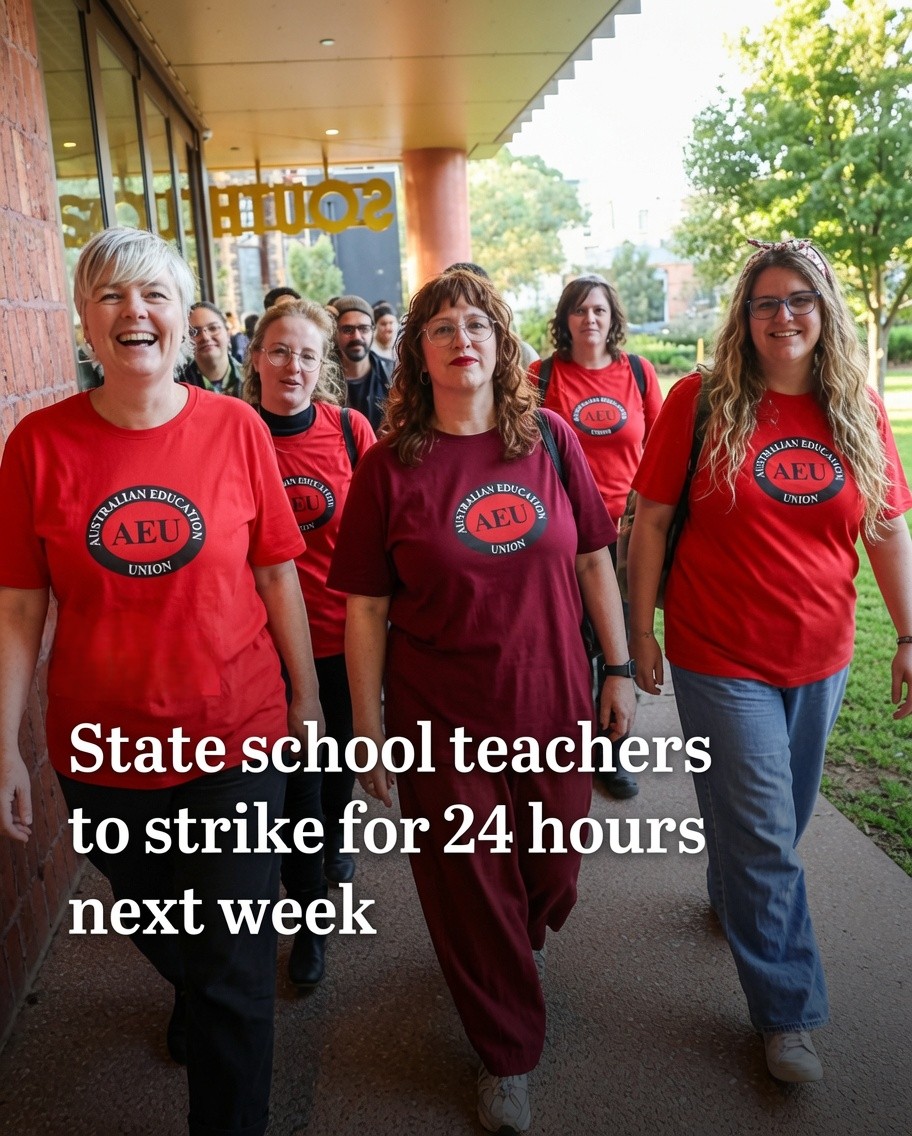
Victorian public school teachers and education staff will walk off the job for 24 hours next week, escalating a bitter pay and workload dispute that has already disrupted hundreds of schools across the state.
The Australian Education Union’s Victorian Branch has confirmed a statewide stopwork for Thursday, July 23.
But the latest industrial action includes another measure that goes directly to the heart of the dispute.
School staff are also banning unpaid overtime.
For parents, the immediate consequence is likely to be disruption at government schools across Victoria.
For teachers, the overtime ban is intended to expose a much larger argument about how the public education system actually operates.
The union says staff are routinely working additional unpaid hours to keep schools functioning.
Planning lessons.
Marking student work.
Responding to emails.
Preparing reports.
Completing administrative requirements.
Attending meetings.
Managing increasingly complex student needs.
If teachers simply stop donating those extra hours, the union’s argument is that Victorians may finally see how much invisible labour is holding the system together.
The July 23 strike will be the second statewide walkout in four months
The decision was endorsed at a meeting of more than 100 union representatives on Tuesday evening.
AEU members backed a full 24-hour stopwork and the ban on unpaid overtime as negotiations over a revised Victorian Government Schools Agreement remain unresolved.
The action follows the major statewide strike on March 24.
That walkout was the first Victorian public school teachers’ strike in 13 years.
Tens of thousands of teachers, principals and education support staff participated.
More than 500 schools were significantly affected.
The dispute was supposed to move back towards negotiation.
Instead, four months later, teachers are preparing to leave classrooms again.
AEU Victorian Branch president Justin Mullaly said staff had reached a point where further industrial action was necessary.
The union argues that Victoria’s public schools remain the lowest funded in Australia.
Mullaly has accused the Allan Labor government of denying the system at least $2.4 billion in funding.
“Every student deserves access to a qualified teacher and the wellbeing support they need,” he said in announcing the union’s position.
The union’s case is that pay cannot be separated from workload, staffing and school funding.
If experienced teachers leave because the job has become unsustainable, students lose.
If schools cannot recruit specialist staff, students lose.
If teachers spend excessive time on administration rather than preparation and teaching, students lose.
The union is trying to turn a wage dispute into a much broader argument about the condition of Victoria’s public education system.
Teachers already rejected a deal worth up to 32 per cent for some classifications
The strike is particularly significant because the government and union leadership had previously appeared close to resolving the dispute.
In May, an in-principle agreement was reached.
The proposed four-year deal included substantial salary increases and changes to conditions.
Depending on classification and career stage, reported pay increases ranged from about 28 per cent to more than 32 per cent across the life of the agreement.
Experienced classroom teachers were expected to earn more than $151,000 by 2029 under the proposed structure.
Education Minister Ben Carroll promoted the package as a major improvement for Victorian educators.
AEU leadership also recommended the agreement to members.
Then the teachers voted.
They rejected it.
In a remarkable result, 57.7 per cent of voting AEU members opposed the proposed agreement.
The result exposed a serious gap between union negotiators and a large section of the membership.
Teachers who campaigned against the agreement argued that the headline pay figures did not resolve the problems they experience inside schools.
They wanted a shorter agreement.
Many had pushed for a three-year deal rather than four years.
They wanted stronger protection against inflation.
They wanted smaller class sizes.
They wanted more preparation time.
They wanted fewer compulsory meetings and administrative tasks.
And some campaigners continued to support the original claim for a 35 per cent pay increase over three years.
The rejection created an extraordinary industrial situation.
Teachers were not merely fighting the government. They had voted down a compromise supported by their own union leadership.
The unpaid overtime ban may be more revealing than the one-day strike
A 24-hour strike is highly visible.
Schools close or operate with reduced capacity.
Parents scramble to organise care.
Teachers march through Melbourne.
Politicians face television cameras.
Then the next day arrives.
The unpaid overtime ban is different.
It targets the daily work that usually remains invisible to parents and the broader public.
Teaching does not begin when students enter a classroom and end when the final bell rings.
Lessons must be prepared.
Assessment must be designed and marked.
Individual learning needs must be considered.
Parents must be contacted.
Student wellbeing issues must be managed.
Reports must be completed.
Meetings and professional requirements consume additional time.
Research cited in reporting on the dispute has estimated teachers perform an average of 12.4 hours of unpaid overtime each week.
The exact workload varies between roles, schools and periods of the academic year.
But the political purpose of the ban is straightforward.
Teachers are being asked to work only the hours for which they are paid.
If school operations begin to strain under that restriction, the union can argue that unpaid labour was previously filling the gap.
It is a powerful industrial tactic because it challenges the public perception that teacher workload is defined by classroom hours and school holidays.
The government faces a difficult response.
It can argue that industrial action is disruptive.
It can defend the pay offer.
It can insist negotiations continue.
But telling employees they should continue performing unpaid overtime is a much harder public argument to make.
Victoria’s teacher shortage sits behind the pay fight
The dispute is occurring as Victorian schools struggle with workforce pressure.
Teacher shortages are not unique to Victoria.
Schools across Australia have faced difficulty recruiting and retaining educators, particularly in regional communities and specialist subjects.
But Victorian teachers argue the state’s relative pay and workload conditions have made the problem worse.
A school can advertise a vacancy.
It cannot manufacture a qualified teacher.
When a position remains empty, the work does not disappear.
Classes may be combined.
Casual relief teachers may be used where available.
Existing staff may absorb additional responsibilities.
School leaders spend more time managing staffing gaps.
The workload on remaining teachers increases.
Some become exhausted and leave.
That creates another vacancy.
It is a cycle the union says Victoria has failed to break.
Pay matters because teachers can compare salaries across state borders and against other professions requiring university qualifications.
Workload matters because a salary increase may not retain a teacher who believes the job is damaging their health or family life.
Conditions matter because experienced educators have options.
This is why the argument over the rejected agreement became so intense.
The government could point to very large percentage increases for some teachers.
Members could look at their actual working week and conclude the fundamental structure of the job had not changed enough.
The $2.4 billion school funding argument is becoming politically dangerous for Labor
The AEU has repeatedly linked the industrial dispute to Victoria’s failure to reach full funding under the Schooling Resource Standard.
The SRS is the funding benchmark developed following the Gonski review.
It estimates the amount of public funding a school requires to meet student educational needs, with additional loadings for disadvantage.
Victoria has faced sustained criticism over the level of funding provided to public schools relative to that benchmark.
The union says the funding gap is at least $2.4 billion.
The Allan government disputes the union’s political framing and has argued that negotiations over the enterprise agreement should focus on employment conditions.
But separating the two issues is difficult in practice.
A teacher’s workload is affected by whether a school can employ enough staff.
Classroom conditions are affected by available support services.
Student wellbeing needs become a teacher workload issue when specialist support is unavailable.
Administrative pressure grows when schools lack resources.
That allows the union to make a simple argument.
Underfunded schools create overworked teachers.
For Labor, this is uncomfortable political territory.
Victoria has branded itself the Education State.
Labor traditionally presents itself as the defender of public education.
The Allan government is heading towards a state election in November.
And tens of thousands of public education workers are openly challenging its record.
Parents will again carry the immediate disruption
The government has repeatedly emphasised the effect of strike action on families.
A statewide school walkout creates immediate practical problems.
Parents may need to take leave.
Some will work from home.
Grandparents and relatives may be asked to help.
Families without flexible employment can face lost income or additional childcare costs.
For students, another disrupted school day arrives after years in which education has already been affected by pandemic closures and staffing problems.
Those concerns are real.
The union knows they are real.
Industrial action is designed to create disruption because disruption creates political pressure.
The question is whether parents blame the teachers or the government.
That battle over public opinion will become increasingly important if the dispute continues.
During the March strike, Premier Jacinta Allan urged educators to abandon the walkout and argued families should not face disruption.
Teachers responded that years of staffing and workload problems were already disrupting students every day.
The same arguments will return on July 23.
A missed day of school is visible to parents. A child spending months without a permanent specialist teacher can be less visible, but potentially far more consequential.
The rejected pay deal changed the government’s political position
Before the June vote, the Allan government had a relatively simple argument.
It had negotiated with the AEU.
A deal had been reached in principle.
The union leadership supported it.
The package contained significant pay increases.
From the government’s perspective, the dispute should have been close to resolution.
The membership vote destroyed that assumption.
When 57.7 per cent of voting members reject a deal recommended by their union, ministers can no longer dismiss the opposition as a small group of activists.
The dissatisfaction was broad enough to defeat the agreement.
A subsequent AEU survey of more than 23,000 educators found almost 90 per cent supported strike action.
About three-quarters indicated they were prepared to participate in multiple 24-hour strikes.
Those are union survey figures and should be understood in that context.
But they suggest the July action may not be the end of the campaign.
The AEU’s branch council has endorsed the latest stopwork.
Further industrial action remains possible if negotiations do not produce a revised agreement members will accept.
That creates the prospect of a prolonged education fight during an election year.
The government says teachers should return to negotiations
The Allan government has urged the union to stop industrial action and continue bargaining.
It argues that the previously negotiated package represented a substantial investment in teacher pay and conditions.
The cost of the proposed agreement was reported at about $4.6 billion.
From the government’s perspective, there are also wider budget constraints.
Victoria is carrying enormous debt.
Interest costs are rising.
Health workers, council employees and other public sector groups are also pursuing pay and conditions claims.
A government cannot negotiate one public sector agreement in isolation from every other workforce.
A very large teacher pay settlement can influence expectations elsewhere.
That does not mean teachers’ claims are unjustified.
It explains why Treasury and government negotiators are cautious about the precedent created by a major wage agreement.
The union, however, argues the cost of failing to retain teachers is also enormous.
Vacancies must be covered.
Recruitment programs cost money.
Teacher shortages reduce educational quality.
Burnout pushes experienced staff out of classrooms.
The two sides are therefore arguing about different kinds of cost.
The government sees the immediate fiscal cost of a more generous agreement.
Teachers see the long-term cost of continuing with a workforce model they believe is already failing.
July 23 will test whether Victoria’s education dispute is becoming something larger
The first strike in March was historic because Victorian public school teachers had not taken statewide strike action for 13 years.
The second strike carries a different message.
The dispute survived a major government offer.
It survived an in-principle agreement.
It survived a recommendation from union leadership.
Teachers voted the deal down.
Now they are walking out again.
And they are refusing unpaid overtime.
That progression suggests this is no longer a routine bargaining disagreement over a few percentage points of salary.
It has become a fight over what teachers believe their profession has turned into.
For the Allan government, the timing could hardly be worse.
Labor is defending more than a decade in power.
Victoria’s finances are under intense scrutiny.
Hospitals are under pressure.
Road maintenance has become a political issue.
And now the workers at the centre of the state’s “Education State” identity are preparing to shut down hundreds of schools for a second time.
The most damaging question for Labor may not be why teachers want more money.
It may be why a pay package worth billions, backed by their own union leadership, still failed to convince a majority of educators that staying on the current path was good enough.
On Thursday, July 23, Victorian families will feel the disruption for 24 hours.
The teachers’ message is that the problems inside their schools have been building for years.






