Andrew Bolt has launched an extraordinary attack on Pauline Hanson over her decision to record a podcast with British far-right activist Tommy Robinson, warning the One Nation leader that she has handed her political enemies exactly the controversy they wanted.
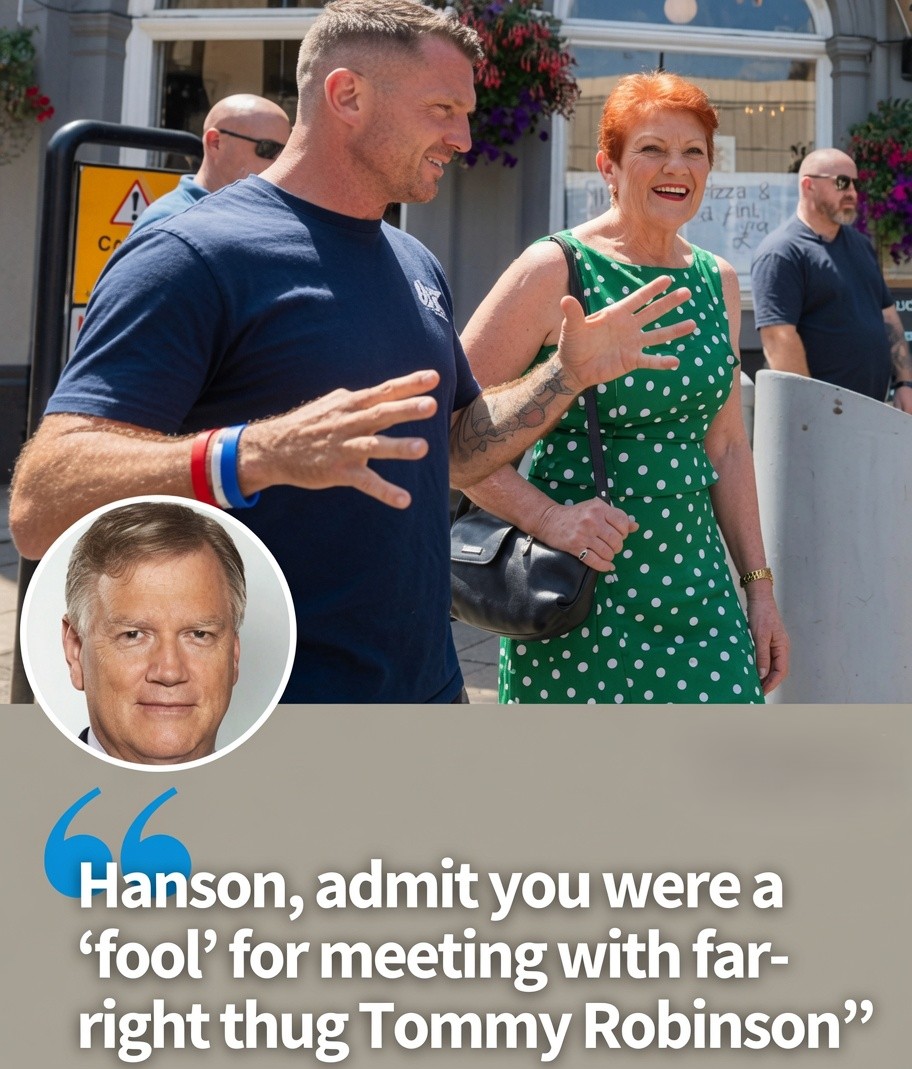
Bolt, one of Australia’s most prominent conservative commentators and a frequent defender of Hanson voters against what he sees as lazy media caricatures, has made clear he believes the One Nation leader committed a serious political error.
His question was blunt.
“What was Hanson thinking?”
The criticism centres on Hanson’s decision to meet Robinson in Britain and sit down with him for a podcast interview during a highly publicised overseas visit.
Robinson, whose real name is Stephen Yaxley-Lennon, is a deeply controversial British activist with a history of criminal convictions and years of involvement in anti-Islam campaigning.
Bolt described him in extraordinarily harsh terms as a far-right “thug” and a convicted “Christian” criminal.
He then delivered an equally direct message to Hanson.
Admit you were a fool to meet him.
The intervention matters because this is not a predictable attack from Labor, the Greens or a progressive activist group.
It is Andrew Bolt.
And at a time when One Nation is attempting to convert extraordinary polling momentum into a credible national political force, a public warning from a major conservative commentator raises a much more difficult question for Hanson.
Is One Nation’s hunger for anti-establishment publicity beginning to create unnecessary political risks?
Hanson knew exactly how controversial Tommy Robinson had become in Australia
The timing of the meeting is impossible to ignore.
Only weeks earlier, Karl Stefanovic had interviewed Robinson for his independent podcast.
The episode was released and then removed from Stefanovic’s platforms within hours.
Pauline Hanson subsequently republished the interview through her own media operation and defended Stefanovic amid the backlash.
Nine later confirmed that Stefanovic would leave the network effective immediately.
The controversy dominated Australian media coverage for days.
That means Hanson cannot plausibly claim she was unaware that appearing with Robinson would trigger an enormous reaction.
She had watched the Stefanovic controversy unfold.
She had personally intervened in it.
She had republished the disputed interview.
Then she travelled to Britain and met Robinson herself.
The two recorded a podcast.
Robinson publicly shared images of the meeting and described Hanson as “hopefully the next leader of her nation”.
The symbolism was immediate.
One of Australia’s most successful insurgent political leaders was appearing alongside one of Britain’s most controversial anti-Islam activists.
For Hanson’s supporters, the meeting demonstrated that she was willing to speak with people the mainstream political and media establishment wanted excluded.
For her opponents, it was evidence supporting every accusation they have made about One Nation’s political direction.
For Bolt, it appears to have been an entirely avoidable mistake.
Bolt’s argument is political, not merely moral
Andrew Bolt has spent years arguing that Australia’s political and media class frequently misunderstands Pauline Hanson.
He has criticised people who dismiss her voters as stupid or racist.
He has repeatedly warned that concerns about immigration, Islam, national identity and social cohesion cannot simply be silenced through moral condemnation.
That history makes his latest criticism more significant.
Bolt is not suddenly arguing that Hanson must become a progressive politician.
His concern is that she has chosen the wrong person through whom to prosecute arguments that are already gaining support among Australian voters.
Robinson brings baggage that Hanson does not need.
His criminal record is extensively documented.
He has served prison sentences.
He has repeatedly been involved in confrontations and controversies in Britain.
He founded the English Defence League and later became one of the country’s most recognisable anti-Islam activists.
Whatever Hanson hoped to learn from him about migration, integration or Britain’s social problems, her opponents can now avoid debating those subjects entirely.
They can talk about Tommy Robinson.
That is the political trap Bolt appears to believe Hanson walked into.
If One Nation wants to argue that Australia’s migration system is unsustainable, it can point to population data.
If it wants to discuss housing pressure, it can point to rents and construction shortages.
If it wants to debate Islamist extremism, it can examine terrorism cases, intelligence warnings and government policy.
If it wants to question multiculturalism, it can make that argument directly to Australian voters.
None of those arguments requires Tommy Robinson.
By appearing with him, Hanson has allowed the personality of a controversial British activist to compete with her political message.
One Nation is no longer a minor protest party with nothing to lose
This is where Hanson’s political circumstances have changed dramatically.
For much of One Nation’s history, controversy was part of the party’s oxygen.
Hanson could provoke outrage, dominate the news cycle and speak directly to voters who believed the political establishment despised them.
Attacks from mainstream politicians often strengthened her anti-establishment credentials.
Being condemned was not necessarily a political cost.
Sometimes it was the point.
But One Nation in 2026 is operating in a different environment.
The party has surged in national and state polling.
It is attracting voters who previously supported Labor and the Coalition.
In Victoria, recent polling has placed One Nation in a three-way contest with the two major political blocs.
Nationally, Hanson’s party is increasingly discussed not merely as a protest vehicle but as a force capable of reshaping conservative politics.
That creates a new problem.
The closer a party moves towards power, the more voters examine the people around it.
They ask whether its candidates are credible.
They ask whether its leaders exercise judgment.
They ask whether the party can distinguish between a useful political ally and an unnecessary liability.
Controversy that energises a five per cent protest vote may frighten a voter considering whether to support a party polling above 20 per cent.
Bolt’s criticism should be understood against that backdrop.
He appears to believe Hanson is behaving as though One Nation still has nothing to lose.
Polling suggests otherwise.
Hanson’s supporters will argue the controversy proves why the meeting mattered
There is, however, another interpretation.
Hanson has built her political career by refusing to accept the boundaries established by her critics.
When political opponents tell her a subject should not be discussed, she often discusses it more aggressively.
When the media declares a person beyond the acceptable mainstream, Hanson frequently asks who made that decision.
Her defence of Stefanovic after the Robinson podcast followed precisely that pattern.
Hanson argued Australians should hear the interview and make up their own minds.
She accused Nine management of weakness.
Her media operation republished the episode after it disappeared from Stefanovic’s channels.
From that perspective, refusing to meet Robinson after defending the right to interview him might have appeared inconsistent.
Hanson’s supporters will also argue that Britain offers legitimate warnings for Australia.
They point to failures of integration, extremist networks, grooming gang scandals and intense political conflict over immigration.
Hanson has said her visit was intended to examine what Australia could learn from Britain’s experience.
During her time with Robinson, she toured parts of his hometown of Luton and said she was left “gobsmacked” by what she saw.
She later declared that she wanted to “protect Australia”.
For supporters, Robinson’s personal history does not invalidate every observation he makes about Britain.
They will say journalists should challenge his claims where necessary rather than demand that political figures refuse to speak with him.
That argument has become particularly powerful among voters who distrust mainstream media.
The attempt to make a person untouchable can increase curiosity about what that person is saying.
Hanson understands that dynamic better than almost any Australian politician.
She has spent 30 years benefiting from it herself.
But meeting someone is not politically neutral when you lead a party
The defence that “it is only a conversation” becomes more complicated when the person involved is a national political leader.
Hanson is not an independent journalist.
She leads One Nation.
Her meetings carry political symbolism whether she intends them to or not.
A photograph can become an endorsement in the eyes of the public.
A friendly podcast can create the impression of an alliance.
Robinson’s own description of Hanson as potentially Australia’s next leader strengthened that impression.
Political leaders understand this principle when dealing with foreign governments, lobbyists and domestic organisations.
Who they meet matters.
How the meeting is presented matters.
Who controls the resulting content matters.
This is one reason critics have questioned the value of Hanson’s podcast appearance.
If Robinson conducts the interview, he helps determine the framing.
He gains access to Hanson’s Australian audience.
He can present the meeting to his British supporters as evidence of international political legitimacy.
Hanson receives attention and access to Robinson’s audience in return.
That exchange may be deliberate.
Researchers who study far-right political communication have argued that One Nation’s recent strategy increasingly relies on creating its own digital content and generating controversy capable of reaching voters who do not consume conventional political news.
The method is effective.
But effectiveness and political wisdom are not always the same thing.
The entire strategy may be designed to produce exactly this argument
Hanson’s British trip has generated an extraordinary amount of Australian media coverage.
She has met controversial figures.
She has toured locations associated with Britain’s immigration debate.
She has produced social media videos.
She has recorded podcast content.
And Australian news outlets have followed almost every development.
From a pure attention perspective, the strategy has worked.
Hanson has dominated political discussion without announcing a major new domestic policy.
Her critics have repeated her name.
Her supporters have shared her videos.
Robinson has promoted her to his own audience.
Now Andrew Bolt has written about her.
Even criticism can feed the distribution machine.
That is one of the central features of modern populist politics.
Traditional politicians often try to avoid scandal.
Insurgent movements can use scandal to demonstrate that they are fighting the institutions their voters already distrust.
Every condemnation becomes evidence of establishment hostility.
Every hostile television segment can be clipped and redistributed to supporters.
Every newspaper column asking “what was she thinking?” creates another reason for people to search for the original content.
Hanson has spent decades operating inside that cycle.
The difference now is that One Nation has more political capital at risk.
Conservative criticism is more dangerous to Hanson than predictable outrage from the left
Hanson knows how to respond when the Greens attack her.
She knows how to use condemnation from progressive activists.
She knows how to turn hostile coverage from media organisations into fundraising and social media content.
Andrew Bolt is a more difficult opponent.
His audience overlaps with voters One Nation wants.
They are concerned about migration.
Many distrust Labor.
Many are sceptical of progressive cultural politics.
Some have abandoned the Liberal Party or are considering doing so.
These are precisely the voters Hanson needs if One Nation is to transform polling momentum into sustained political power.
Bolt’s argument gives them permission to support Hanson’s policies while questioning her judgment.
That is politically dangerous.
A voter can believe migration is too high and still think meeting Robinson was foolish.
A voter can worry about Islamist extremism and still dislike Robinson.
A voter can distrust the mainstream media and still believe a potential national leader should choose political associations carefully.
Hanson cannot dismiss all of those people as woke critics.
They may be her prospective voters.
Coalition MPs have also begun questioning the political value of the meeting
The criticism is spreading beyond commentators.
Coalition MP Garth Hamilton described Hanson’s meeting with Robinson as extraordinary and questioned its relevance to Australian politics.
His criticism reflects the emerging contest between One Nation and the Coalition for conservative voters.
The Coalition has an obvious incentive to highlight every controversy involving Hanson.
One Nation’s rise threatens Liberal and National primary votes.
But Coalition figures must also be careful.
An overly aggressive attack on Hanson can alienate voters who agree with her concerns and view the major parties as dismissive.
The Robinson controversy gives the Coalition a potentially useful line.
It can avoid directly attacking One Nation voters.
Instead, it can question Hanson’s judgment.
That is a much more targeted political strategy.
The argument becomes: your concerns may be legitimate, but is this the person Australia wants representing them?
Bolt is effectively asking a similar question.
Hanson is not apologising
Anyone expecting the One Nation leader to respond to the controversy by quietly retreating is likely to be disappointed.
Hanson has already defended her British trip and her engagement with Robinson.
She has framed the experience as a fact-finding mission and a warning about Australia’s future.
She says Britain demonstrates what can happen when governments lose control of immigration and fail to confront social division.
And she has continued producing content from the visit despite intense criticism.
A new 7NEWS Spotlight interview is now expected to push the controversy further.
In a preview of the program, Hanson defends her meeting with Robinson during a tense exchange with journalist Liam Bartlett.
The interview is scheduled to air on Sunday.
That may be the “show coming up” referred to in discussion surrounding the controversy.
Rather than apologise, Hanson appears ready to argue her case on national television.
It is a familiar strategy.
She will likely insist the media is focusing on Robinson instead of the warnings she says she encountered in Britain.
Her critics will argue that Hanson created the distraction herself by choosing to associate publicly with him.
Both sides will emerge convinced the other has missed the point.
Andrew Bolt may have identified One Nation’s biggest problem at the moment of its greatest opportunity
The question facing Hanson is no longer whether controversy can generate attention.
Three decades of Australian politics have already answered that.
It can.
The question is whether One Nation now needs something more.
Discipline.
Candidate quality.
Policy depth.
Political judgment.
The ability to reassure voters who want change but do not want chaos.
Hanson has spent most of her career fighting for the right to be heard.
In 2026, millions of Australians are clearly listening.
That changes the standard.
When a minor protest party makes a controversial choice, the story may disappear within days.
When a party polling competitively with Labor and the Coalition does it, voters ask what the decision reveals about how that party might exercise power.
That is why Bolt’s intervention matters.
He is not telling Hanson to abandon her position on immigration.
He is not asking her to become politically correct.
He is arguing that Tommy Robinson was an unnecessary liability.
Hanson clearly disagrees.
Her supporters may disagree too.
And the coming Spotlight interview suggests she intends to fight rather than apologise.
But One Nation’s remarkable rise has created a paradox for its leader.
The anti-establishment instincts that helped build her movement can still generate enormous attention.
They can also become more expensive as the party moves closer to real political power.
Andrew Bolt has now drawn that line publicly.
His message to Hanson is brutal: the issues she wants to discuss may matter, but she did not need Tommy Robinson to discuss them.
The bigger question is whether One Nation voters agree — or whether another wave of establishment condemnation simply makes Hanson more popular.






