Karl Stefanovic has unleashed a blistering attack on Anthony Albanese, branding him potentially one of Australia’s worst prime ministers as the former Today host embraces a new, uncensored life outside mainstream television.
The veteran broadcaster held little back during a fiery new interview with Piers Morgan, using the appearance to take aim at the Prime Minister and deliver an unmistakable message to critics who have attacked his recent move into independent media.
Asked about Albanese, Stefanovic initially appeared to qualify his assessment.
Then came the punchline.
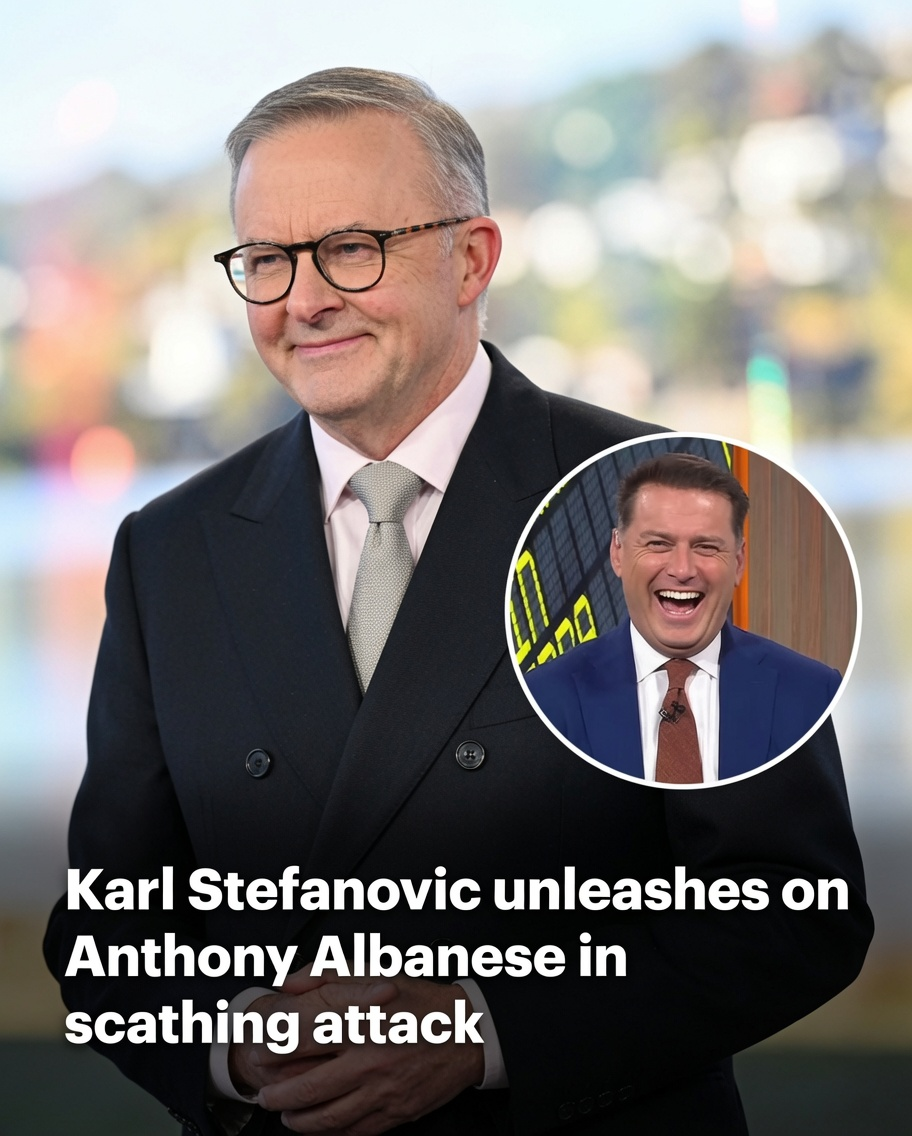
“I think personally — and I don’t want to overstate it or draw too many conclusions at this point in his prime ministership — but I think he could be one of the worst prime ministers since Keir Starmer,” Stefanovic said.
Morgan burst into laughter.
“That bar is low,” the British broadcaster replied.
The exchange was delivered with humour, but there was little ambiguity about Stefanovic’s broader attitude towards the Australian Prime Minister.
What might once have been an awkward television interview between a breakfast host and a political leader has become something far more personal.
Stefanovic is no longer sitting behind the Today desk.
He is no longer constrained by a morning television format or the expectations that come with representing a major commercial network.
And after more than two decades as one of Nine’s most recognisable faces, he appears determined to make that freedom part of his new public identity.
When Morgan raised the people who have criticised Stefanovic and campaigned against him, the Australian broadcaster offered a three-word response.
They could “go f*** themselves”.
The remark has already become the defining line from the interview preview.
But the confrontation with Albanese reveals the deeper story behind Stefanovic’s increasingly combative public persona.
The feud did not begin with Stefanovic’s ‘worst prime minister’ insult
The tension between Stefanovic and Albanese intensified after the broadcaster interviewed controversial British activist Tommy Robinson for his independent podcast.
The interview was conducted outside Stefanovic’s Today show role and covered subjects including migration, free speech and distrust of mainstream media.
It rapidly became a major controversy.
The episode was removed from Stefanovic’s online platforms after publication, although copies continued circulating elsewhere.
Nine subsequently confirmed Stefanovic would leave the network effective immediately.
His departure ended a relationship stretching across more than 20 years and removed one of Australian breakfast television’s most familiar personalities from the Today show.
Albanese was drawn into the controversy when asked about Stefanovic’s position.
The Prime Minister said he would not comment directly on Nine’s internal employment decisions.
But he added an observation that clearly landed with Stefanovic.
Albanese suggested the broadcaster had moved towards the “edges of mainstream political debate”.
For Stefanovic, that comment appears to have transformed the issue from a dispute with a television network into a broader argument about who gets to define acceptable political conversation in Australia.
He hit back shortly after leaving Nine.
“I did an interview and he lied to the country and still has his job,” Stefanovic told his podcast audience in an earlier response to the Prime Minister.
Now, sitting opposite Morgan, he has escalated the attack again.
Stefanovic is turning his Nine exit into an argument about free speech
The former Today host’s defence of the Robinson interview has been consistent.
He has not argued that every audience member should agree with his guest.
Instead, he has argued that controversial people should be questioned and heard.
That distinction sits at the centre of his dispute with critics.
Opponents say giving a large platform to extremist or far-right figures can amplify their ideas, normalise their rhetoric and expose new audiences to political movements they might otherwise never encounter.
Stefanovic’s position is that interviewing a person is not the same as endorsing them.
He has presented himself as a broadcaster willing to enter conversations that established media organisations increasingly find too risky.
The argument is hardly new.
Journalists have debated the ethics of interviewing extremists, dictators, conspiracy theorists and political radicals for generations.
The question is rarely whether such figures can be reported on.
It is how they should be challenged, what context audiences require and whether the interviewer is capable of testing false or dangerous claims rather than simply providing a microphone.
Stefanovic’s critics believe his Robinson episode failed that test.
Stefanovic believes the reaction to the interview proved his larger point about the narrowing boundaries of acceptable discussion.
His appearance with Morgan places him in front of perhaps the ideal interviewer for that argument.
Morgan has built much of his post-mainstream broadcasting career around the word “uncensored”.
He routinely presents his program as an alternative to cautious corporate media and has made confrontational interviews central to his brand.
For Stefanovic, recently removed from one of Australia’s largest television networks, the symbolism is difficult to miss.
Twenty years at Today have ended with Karl sounding nothing like a breakfast TV host
Stefanovic’s public image was built over decades of live morning television.
Today required him to move constantly between political interviews, celebrity conversations, breaking news, weather crosses and light entertainment.
That format made him one of the most recognisable broadcasters in Australia.
It also required a particular kind of television discipline.
A breakfast host may challenge a prime minister at 7.15am and be laughing over a cooking segment shortly afterwards.
The program must keep moving.
The audience is broad.
The network has advertisers, executives and reputational considerations.
Independent podcasting operates differently.
There is more time.
There are fewer structural limits.
And the personality of the host can become the product itself.
Stefanovic now appears to be testing exactly how different that world can be.
His message to critics would never have appeared in a standard Today show introduction.
His description of Albanese is far more openly opinionated than the language Australians were accustomed to hearing from him while he was interviewing political leaders on breakfast television.
That shift will delight some viewers and alienate others.
But it may also explain why Stefanovic appears so unapologetic.
For the first time in decades, he does not need to sound like the host of Today.
Albanese has become a natural target for Stefanovic’s anger
The Prime Minister’s “edges of mainstream political debate” comment is particularly significant because it touches the exact question Stefanovic is now building his independent career around.
Who decides where the mainstream ends?
A television executive?
A prime minister?
An editor?
An audience?
Stefanovic appears to believe the boundaries have become too restrictive.
His critics argue those boundaries exist for a reason and that broadcasters have a responsibility to consider the consequences of amplifying extreme political movements.
That disagreement is bigger than either man.
Australia’s media landscape is fragmenting rapidly.
Politicians increasingly appear on podcasts and online programs that do not operate like traditional news interviews.
Broadcasters who once depended on television networks can build direct relationships with audiences through YouTube, podcasts and social media.
Viewers who distrust mainstream outlets can choose political content designed specifically around that distrust.
The old gatekeepers have less control.
That can create space for interviews and opinions that would previously have struggled to reach a mass audience.
It can also create environments where misinformation and extremism spread without effective scrutiny.
Stefanovic has placed himself directly inside that tension.
Albanese’s criticism suggested the broadcaster had moved too far from the political centre.
Stefanovic’s response is essentially that the Prime Minister has no authority to determine which interviews Australians are allowed to hear.
His attack on Albanese must be understood in that context.
The Keir Starmer joke carried its own political sting
Stefanovic did not simply describe Albanese as a bad prime minister.
He compared him with Keir Starmer.
The British Labour leader announced his resignation in June after a deeply troubled period in office and a collapse in political authority.
Starmer had entered Downing Street in 2024 after Labour’s overwhelming election victory.
But his government was soon battered by unpopular policy decisions, internal party tensions and falling public support.
His removal of the universal winter fuel allowance from many pensioners became an early political liability.
Tax decisions and wider dissatisfaction with Labour’s direction added to the pressure.
By 2026, Starmer was facing a leadership crisis and eventually announced he would step down as Labour leader and prime minister once a successor was chosen.
That is why Morgan laughed at Stefanovic’s comparison.
Calling Albanese the worst prime minister “since Keir Starmer” deliberately set an extremely recent and politically damaged benchmark.
The joke also allowed Stefanovic to make a brutal political attack while maintaining a layer of humour.
He did not present a detailed policy assessment of the Albanese government.
He did not produce an economic scorecard or compare every Australian prime minister.
It was a broadcaster delivering a deliberately provocative verdict in an interview designed to generate attention.
That distinction matters.
Stefanovic’s claim is an opinion, not an objective ranking of prime ministers.
But political insults often become powerful precisely because they compress complicated dissatisfaction into a memorable line.
“Worst prime minister” is easy to repeat.
“Since Keir Starmer” gives it a punchline.
And Morgan’s laughter completes the clip.
The attack arrives as Albanese faces a much more unsettled political environment
Albanese won a historic second term in 2025 and Labor emerged with a commanding parliamentary position.
A large majority, however, does not guarantee political comfort.
The government has continued to face intense pressure over the cost of living, housing affordability, inflation and interest rates.
Migration has become an increasingly divisive political issue.
One Nation has attempted to capitalise on voter dissatisfaction with both major parties.
Debates over national identity, free speech and the boundaries of political discussion have become more aggressive.
That is the environment in which Stefanovic’s attack will circulate.
People who already dislike Albanese will treat the former Today host’s comments as confirmation that frustration with the government is spreading beyond traditional conservative media.
Labor supporters will see a broadcaster who has just left Nine after a major controversy attacking the Prime Minister who criticised him.
Both interpretations contain part of the truth.
Stefanovic clearly has a personal grievance with Albanese’s remarks.
He is also speaking into a political environment where dissatisfaction with the government is real.
The mistake would be to treat his interview as a neutral assessment of the Prime Minister.
It is not.
This is a feud.
And both men have already contributed to it.
Albanese’s own move into podcast culture has given Stefanovic another line of attack
The dispute has become more complicated because the Prime Minister himself has increasingly entered less traditional media spaces.
Albanese recently faced criticism over a crude exchange involving Kylie Minogue during a comedy podcast appearance.
The controversy gave Stefanovic and Morgan an obvious opening.
If the Prime Minister is willing to enter informal podcast environments and participate in conversations that would sound unusual in a conventional political interview, Stefanovic can ask why his own move away from traditional formats is portrayed as dangerous.
The two situations are not identical.
A crude joke is not the same editorial question as interviewing a controversial political activist.
But politically, Stefanovic does not need them to be identical.
He needs the contrast to appear hypocritical.
His argument is that Albanese criticised him for moving towards the edges of mainstream political debate while the Prime Minister himself is experimenting with media formats outside the conventional press gallery and breakfast television circuit.
That is a potent argument for an audience already suspicious of political and media elites.
It also demonstrates why the fight is likely to continue.
Stefanovic is no longer simply defending one podcast episode.
He is turning his experience into a broader narrative about double standards.
‘Go f*** themselves’ may be the clearest statement yet of Karl’s new strategy
There is an obvious risk in Stefanovic’s approach.
For decades, his strength was broad appeal.
Australians who disagreed with his politics could still watch him interview a celebrity, cover a disaster or joke with colleagues.
An independent media personality who becomes increasingly associated with political grievance can narrow that audience.
The people who love the new Karl may become more loyal.
The people who dislike him may leave completely.
That is often how digital media works.
Mass television tries to avoid giving millions of viewers a reason to switch off.
Independent broadcasting can succeed by giving a smaller but intensely committed audience a reason to keep returning.
Stefanovic’s blunt response to critics suggests he understands the trade-off.
He does not appear interested in winning everyone back.
He appears interested in establishing that his voice is now his own.
Whether that becomes a successful long-term media business remains to be seen.
But the first weeks after his Nine departure have already shown the direction.
He has defended the interview that contributed to the controversy.
He has attacked the Prime Minister.
He has appeared with Piers Morgan.
And he has told his critics, in language impossible to sanitise, exactly what he thinks of them.
This is no longer the Karl Stefanovic Australians watched over breakfast
There is a strange symmetry to Stefanovic’s new interview.
For years, he was the person asking prime ministers difficult questions.
Now he is openly offering his own political verdict.
For years, his career depended on one of Australia’s largest media companies.
Now he is talking about freedom outside that system.
For years, critics could complain about him and know he still had to return to a national breakfast program the next morning.
Now his response is that they can “go f*** themselves”.
The change may be liberating.
It may be commercially risky.
It may also produce exactly the kind of controversy Stefanovic needs as he attempts to establish a new chapter after Nine.
His assessment of Anthony Albanese will be fiercely disputed.
There is no objective league table that can prove the Prime Minister is one of Australia’s worst.
Stefanovic’s comments are plainly his opinion, sharpened by a very public dispute with a political leader who criticised his move towards the “edges” of mainstream debate.
But that does not make the exchange politically irrelevant.
It reveals how quickly the relationship between politics and media is changing.
A former breakfast television host can leave a major network, sit down with one of the world’s most confrontational broadcasters and deliver a savage assessment of the Australian Prime Minister directly to an online audience.
No network introduction is required.
No morning television rundown needs to accommodate the segment.
No one needs to pretend the conversation is politically neutral.
Stefanovic thinks Albanese could be one of the worst prime ministers.
Albanese believes Stefanovic moved towards the edges of mainstream political debate.
And after more than 20 years inside Australian commercial television, Karl Stefanovic appears determined to prove that he no longer cares where the mainstream thinks its edges should be.






