Lee Hanson has accused Australia’s media and political establishment of using “lies and distortions” against One Nation, pushing back against a month of intense scrutiny as Pauline Hanson’s party confronts its first serious test after a dramatic surge in national support.
In a message promoted through One Nation’s official social media channels, Lee Hanson argued that attacks on the party had become increasingly desperate as its political influence grew.
“Lee Hanson calling out some of the lies and distortions that have been employed against One Nation over the past month by the media and political establishment,” the party said in its accompanying post.
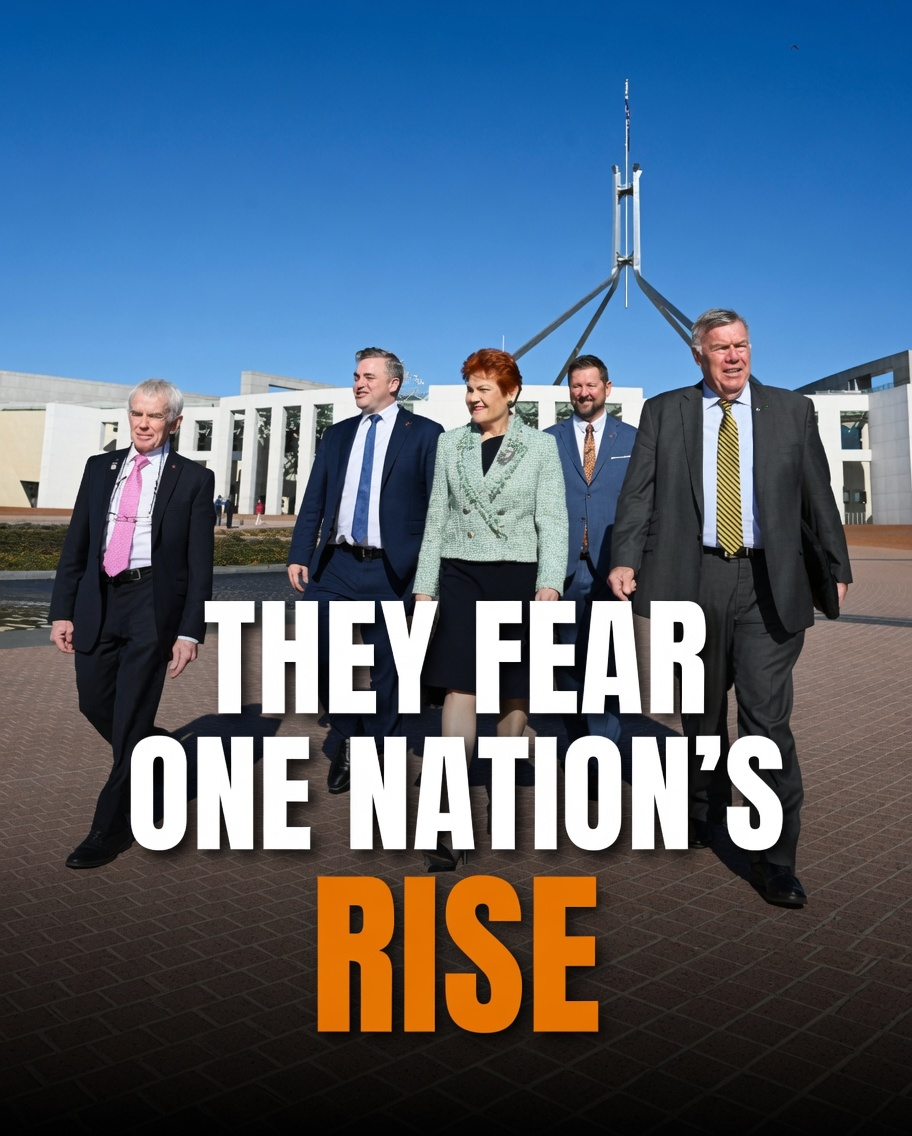
“Fortunately, more and more voters are seeing through it.”
The party described the criticism as the work of a “desperate establishment” frightened by the growth of a political movement pursuing what One Nation calls common-sense policies and seeking to change the status quo.
That is One Nation’s version of what has happened over the past month.
Its opponents tell a very different story.
They argue the party is finally receiving the level of scrutiny that should accompany any political organisation polling as a potential major force in Australian politics. They say questions about policy costings, immigration, multiculturalism, economic management and Pauline Hanson’s judgment are not a conspiracy but the inevitable consequence of One Nation asking voters to consider it as a serious alternative government.
The political battle is no longer simply about whether One Nation is rising. It is about who gets to explain why the party has come under attack — and whether voters believe the criticism or the counterattack.
For One Nation, that distinction could determine whether its extraordinary 2026 momentum becomes a lasting realignment of Australian politics or another surge that fades under pressure.
A month of scrutiny has changed the political atmosphere
The immediate background to Lee Hanson’s intervention is a remarkable shift in the way One Nation is being treated by its political rivals.
For years, major parties could largely present One Nation as a protest party operating on the edge of the national contest.
That became much harder as the party’s support climbed dramatically.
Recent polling has placed One Nation in the high 20s, with some surveys showing the party ahead of the Coalition and competitive with Labor on primary support.
A RedBridge and Accent Research poll published by the Australian Financial Review in June recorded One Nation on 27 per cent, ahead of Labor on 24 per cent and the Coalition on just 18 per cent.
Other polls produced different numbers, but the direction was unmistakable: One Nation was no longer drawing the single-digit support traditionally associated with a minor protest party.
It was threatening the structure of the Australian political system.
That changed the incentives for everyone else.
Labor had reason to challenge One Nation because the party was attracting working-class and outer-suburban voters who could once have been regarded as part of Labor’s natural constituency.
The Coalition faced an even more immediate threat.
One Nation was drawing support from conservative voters who believed the Liberals and Nationals had become too cautious, too disconnected or too similar to Labor on major national questions.
As One Nation’s numbers rose, the scrutiny intensified.
Angus Taylor launched the Coalition’s strongest attack yet
Opposition Leader Angus Taylor dramatically escalated the fight in a Sydney Institute speech in July.
Taylor accused One Nation of offering policies that could create an “eternity of pain” for Australians.
His attack focused heavily on economics.
The Liberal leader argued One Nation’s promises were poorly costed and warned the party’s agenda could increase inflation, drive interest rates higher, force cuts to essential services and expose Australia to a sovereign debt crisis.
He also characterised One Nation as a political operation built around one leader rather than a disciplined alternative government.
The intervention was significant because it represented a strategic choice.
The Coalition could have concentrated almost exclusively on Anthony Albanese and Labor.
Instead, Taylor chose to confront Pauline Hanson directly.
For One Nation supporters, that decision reinforced the very argument Lee Hanson is now making.
If the Coalition believes Labor is taking Australia in the wrong direction, they ask, why is the opposition devoting so much political energy to attacking another party that also wants Labor defeated?
Pauline Hanson made precisely that argument in her response to Taylor.
She accused the Coalition of adopting positions One Nation had advocated for years, including lower immigration and opposition to net zero, while simultaneously attacking her party.
Hanson urged Taylor to stop fighting One Nation and focus on defeating Labor and the Greens.
Taylor rejected the proposed political olive branch.
Yet the argument has exposed disagreement inside conservative politics about how One Nation should be handled.
Deputy Liberal leader Jane Hume has since said the Coalition’s fight must be against Labor “first and foremost”, while other Liberal figures have argued One Nation deserves sustained scrutiny.
That strategic divide matters.
Every attack on One Nation may weaken the party among uncertain voters.
But it may also tell disillusioned conservatives that the traditional political establishment considers Pauline Hanson’s movement a more urgent threat than the Albanese government.
The polls suggest scrutiny has had an effect — but not a decisive one
There is evidence One Nation’s momentum has slowed.
The latest Resolve Political Monitor reported the party falling three percentage points to 26 per cent after four months of gains.
The Coalition rose three points to 23 per cent, while Labor remained on 28 per cent.
Pauline Hanson’s personal numbers also weakened.
Anthony Albanese returned to the lead as preferred prime minister on 33 per cent, while Hanson fell to 25 per cent. Angus Taylor improved to 21 per cent.
The results followed controversy surrounding Hanson’s National Press Club address and renewed debate over One Nation’s policies.
Critics quickly presented the polling movement as evidence that greater scrutiny was working.
Liberal MP Andrew Hastie argued voters deserved detailed and credible policy alternatives, including proper costings through the Parliamentary Budget Office.
Others suggested Australians were beginning to reconsider One Nation once the party was examined as a potential government rather than simply a vehicle for political protest.
But there is another way to read the numbers.
One Nation was still polling at 26 per cent.
That is an extraordinary level of support for a party that won roughly 6 per cent of the national primary vote at the previous federal election.
A three-point decline may represent the beginning of a sustained retreat.
Or it may simply be normal volatility after a rapid political rise.
Barnaby Joyce, now a One Nation MP, dismissed the significance of the fall and described polls as indicators rather than final judgments.
Political analysts are confronting the same uncertainty.
Australia’s electoral system has decades of experience modelling contests between Labor and the Coalition. Preference flows, seat demographics and campaign strategies have traditionally been interpreted through that two-bloc competition.
A One Nation primary vote in the high 20s changes the equation.
Recent analysis has suggested the party could reach the final count in more than 100 electorates if its support remained near current levels.
That would create three-way contests on a scale modern Australian federal politics has rarely experienced.
One Nation’s most powerful defence is its anti-establishment identity
Lee Hanson’s accusation of “lies and distortions” is politically important because it goes directly to the reason many voters appear to be considering One Nation.
The party’s appeal is not based solely on individual policies.
It is also based on distrust.
One Nation presents itself as an opponent of a political system in which Labor and the Coalition alternate in government while, according to the party, failing to confront fundamental problems.
Its supporters frequently point to immigration, housing, energy costs, net zero and national identity as examples.
They argue that the major parties may disagree over implementation but have accepted too many of the same assumptions.
That argument has become particularly potent as Australians confront a housing affordability crisis and years of cost-of-living pressure.
When voters already distrust institutions, a media attack does not necessarily persuade them.
Sometimes it produces the opposite reaction.
A supporter who believes the political system is protecting itself may interpret negative coverage of an anti-establishment party as proof that the party is threatening powerful interests.
This is the political dynamic One Nation is attempting to exploit.
The party’s message is straightforward: the attacks are becoming louder because One Nation is becoming stronger.
It is an effective narrative because almost any criticism can be incorporated into it.
If Labor attacks One Nation, the party can say the government fears losing working-class voters.
If the Coalition attacks One Nation, it can say the Liberals fear losing conservatives.
If journalists investigate One Nation’s policies, the party can accuse the media establishment of attempting to destroy a political challenger.
The danger for One Nation is equally obvious.
An anti-establishment identity cannot answer every policy question.
If the party wants to be treated as a potential government, voters will eventually expect detailed explanations of how its promises would work and what they would cost.
The fight over immigration shows how the argument works
Immigration has become one of One Nation’s strongest political issues.
The party has advocated reducing net migration closer to what it describes as the 20th-century average of about 70,000 a year.
Pauline Hanson has also called for a stronger emphasis on assimilation and used her National Press Club appearance to argue Australia should move away from official multiculturalism towards a “monocultural” national identity.
Critics condemned the language.
Hanson’s opponents argued the proposal ignored the reality of modern Australia and risked dividing communities.
One Nation supporters responded that media coverage focused overwhelmingly on the word “monoculture” while failing to seriously engage with public concerns about migration levels, housing and infrastructure.
This is exactly the type of dispute behind Lee Hanson’s broader accusation.
One Nation believes its positions are repeatedly presented in the most politically damaging possible terms.
Its critics believe the party uses claims of media distortion to avoid responsibility for its own language.
Both sides are now fighting over context.
What is clear is that immigration itself is not a fringe concern.
Australia experienced historically high net overseas migration following the pandemic, placing population growth at the centre of debates over housing supply and infrastructure capacity.
Migration is not the sole cause of the housing crisis. Construction constraints, planning systems, interest rates and years of inadequate supply all matter.
But population growth increases demand for accommodation.
Voters do not need to support every One Nation policy to ask whether Australia’s migration program has been properly aligned with the number of homes and public services available.
If major parties fail to answer that question convincingly, One Nation retains political space.
Economic scrutiny is a much harder test for the party
The Coalition’s strongest line of attack may not be culture or immigration.
It may be money.
One Nation has promoted a broad range of policies aimed at Australians who believe the economic system is no longer working for them.
The party has discussed allowing pensioners and students to work more hours without losing support payments and reducing the tax paid on overtime.
It supports lower immigration and has opposed net zero policies while advocating a greater role for coal, gas and nuclear energy.
Individual proposals can be popular.
The challenge is demonstrating how the entire program fits together.
How much would each measure cost?
What revenue would be lost?
What spending would be reduced?
What would happen to inflation?
How quickly could major energy changes be implemented?
Those are ordinary questions for a party seeking government.
They are also questions One Nation will face with increasing intensity if its polling remains high.
Taylor’s attack attempted to move the political debate onto precisely this ground.
Instead of arguing that One Nation is offensive or extreme, he argued that it is economically dangerous.
That may be a more effective strategy with voters who agree with Hanson on immigration or national identity but remain cautious about mortgages, inflation and retirement savings.
One Nation’s response cannot rely indefinitely on accusing critics of desperation.
At some point, the party will need to convince voters its numbers add up.
But the major parties face a credibility problem of their own
The scrutiny of One Nation does not occur in a political vacuum.
Labor and the Coalition are asking voters to examine Hanson’s party closely at a time when trust in the traditional political system has already weakened.
That creates an awkward question.
Why did One Nation rise so rapidly in the first place?
The answer cannot simply be that voters were misled.
The party’s support has been strongest among Australians who feel economic and political institutions are no longer responding to them.
Analysis of One Nation’s recent electoral performance has identified particularly strong swings in areas with more low-income earners and blue-collar workers.
Those voters are not necessarily committed One Nation loyalists.
Many previously supported the Coalition or Labor.
Their movement towards Hanson is therefore also a judgment on the major parties.
If Labor wants those voters back, it must explain why they should believe economic and social conditions will improve under the existing government.
If the Coalition wants them back, it must show that it offers a meaningful alternative rather than simply warning that One Nation is worse.
This is where aggressive attacks can become politically risky.
Telling a voter that their new political choice is dangerous does not automatically answer why they abandoned their old political choice.
The next few months will show whether One Nation has built a movement or a moment
Lee Hanson’s intervention captures the new phase of Australia’s political contest.
One Nation is under attack because One Nation is now relevant.
A party polling in the high 20s cannot expect to receive the same level of attention it received when it was on 5 or 6 per cent.
Its candidates, policies, costings and leadership decisions will be examined more closely.
Some criticism will be fair.
Some reporting will inevitably simplify complicated positions.
Political opponents will also select the arguments most likely to damage the party, just as One Nation selects the arguments most likely to damage Labor and the Coalition.
That is politics.
The real question is whether voters still trust the institutions delivering the criticism.
If they do, sustained scrutiny may continue to erode One Nation’s support and return disillusioned conservatives to the Coalition.
If they do not, every new attack risks strengthening the party’s claim that an anxious establishment is trying to protect itself.
The latest polling offers evidence for both interpretations.
One Nation has fallen from its recent highs.
It also remains one of the most powerful electoral forces in the country.
That is why Lee Hanson’s accusation of “lies and distortions” matters beyond one social media video.
Australia is entering a contest not only over immigration, energy, cost of living and national identity.
It is entering a contest over political credibility itself.
One Nation says the establishment is lying about the party because it fears change.
The major parties say closer scrutiny is exposing a movement unprepared to govern.
Voters will have to decide which explanation they believe.
And if One Nation’s extraordinary rise has demonstrated anything, it is that millions of Australians are no longer automatically giving the benefit of the doubt to the people and institutions that once expected it.






