A young Sydney woman allegedly used graphic violent extremist videos and social media accounts to glorify martyrdom and promote allegiance to terrorist organisations, in a case that exposes one of Australia’s most difficult modern counter-terrorism problems.
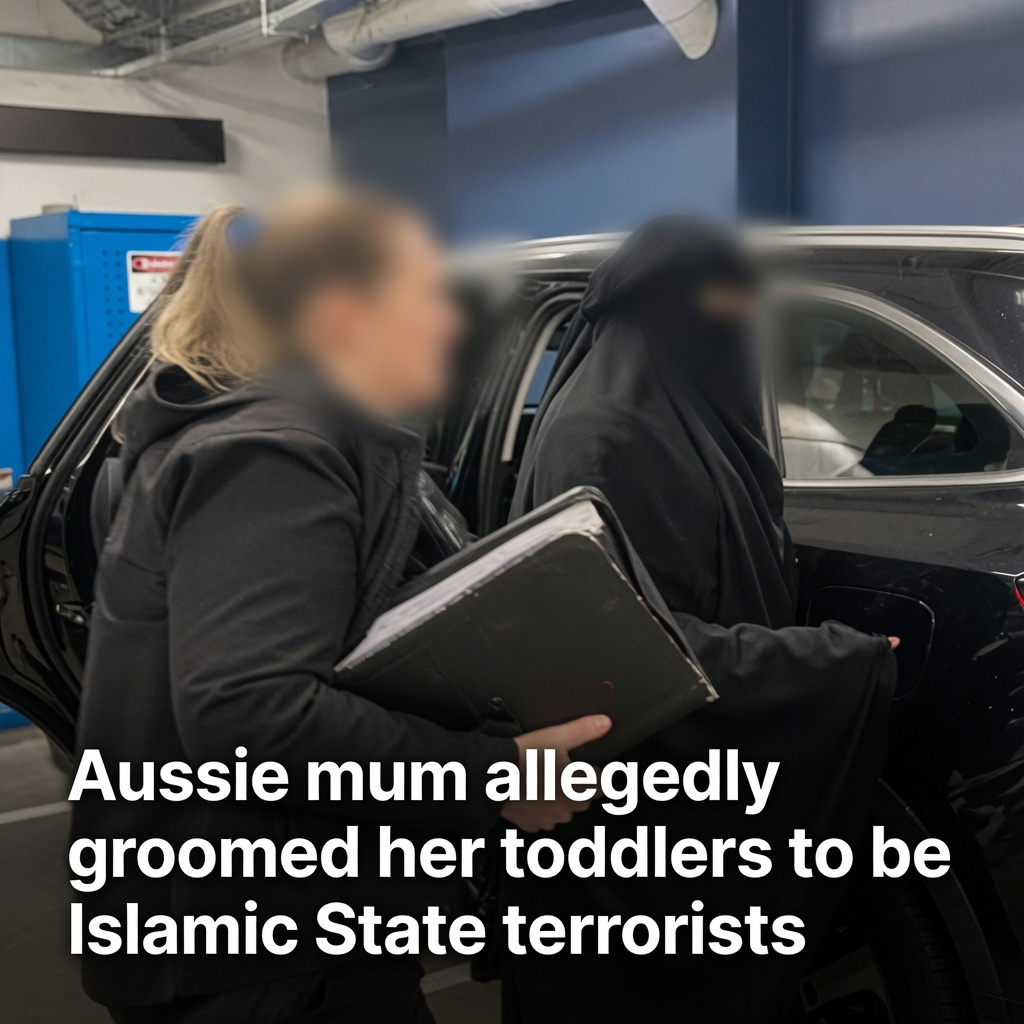
The woman, 23, came to the attention of the Australian Federal Police after authorities received information about a Sydney-based person allegedly promoting and sharing extremist material online.
Police allege the content went far beyond controversial political or religious opinion.
According to the AFP, a forensic examination of a mobile phone seized during the investigation uncovered 43 files allegedly classified as violent extremist material.
Investigators also allegedly identified a second social media account used to publish the material to a wider audience.
The files are alleged to have encouraged serious violent acts, been intended to motivate or inspire people to commit violence, and glorified martyrdom and allegiance to known terrorist groups.
Some of the alleged material was presented through religious content, including material described in court proceedings as extremist propaganda “dressed up as religious hymns”.
Behind the audio, investigators allege, were graphic videos and violent extremist imagery.
The case is not simply about what one young woman may have watched on her phone. The far more serious allegation is that extremist propaganda was being repackaged and pushed back into the social media ecosystem for other people to find.
The woman has been charged with offences relating to the possession and dissemination of violent extremist material.
The allegations have not been proven in court and she is entitled to the presumption of innocence.
But the case arrives at a deeply sensitive moment for Australia’s national security agencies.
Police and intelligence officials have repeatedly warned that the process of radicalisation has changed.
The traditional image of a person being slowly recruited into an extremist organisation through secret meetings and personal contact is increasingly outdated.
Today, a person can encounter extremist ideology alone in a bedroom.
They can watch a video.
An algorithm can recommend another.
They can move into a private group, follow an encrypted channel and begin communicating with people on the other side of the world.
The entire process can happen without family, teachers or colleagues understanding what is taking place.
ASIO Director-General Mike Burgess has previously described the internet as the world’s most potent incubator of extremism and social media as its most potent accelerator.
Evidence presented to a federal parliamentary inquiry into extremism highlighted a particularly alarming feature of the online environment.
People are not always taking years to radicalise.
Authorities have warned that some individuals can move towards violent extremist ideology in days or weeks.
Young Australians are considered particularly vulnerable.
The AFP has investigated children as young as 13 in connection with extremist concerns.
Most radicalisation involving minors now has a significant online component, according to evidence cited by the parliamentary inquiry.
That is why the alleged conduct in the Sydney woman’s case matters beyond the individual prosecution.
Terrorist propaganda is designed to travel.
Islamic State understood this earlier and more effectively than many governments initially realised.
At the height of its territorial power in Syria and Iraq, ISIS developed an extraordinarily sophisticated media operation.
Its propaganda was not limited to grainy recordings of speeches by militant leaders.
The organisation produced professionally edited videos, magazines, audio material and social media content tailored for international audiences.
Some material displayed extreme violence.
Other propaganda attempted to portray life under Islamic State as orderly, religious and purposeful.
The objective varied depending on the audience.
Some content was intended to terrify enemies.
Some was designed to recruit fighters.
Some targeted women.
Some glorified martyrdom.
And some attempted to convince people living thousands of kilometres from Syria that they could participate in the cause without ever travelling to the Middle East.
That final category has become particularly important since the destruction of Islamic State’s physical caliphate.
ISIS lost the vast territory it once controlled.
It did not lose the internet.
Old propaganda continues to circulate through social media, encrypted applications, file-sharing services and online archives.
Videos can be downloaded, edited and uploaded again.
Accounts can disappear and be replaced.
Material removed from one platform can reappear somewhere else.
Australian authorities have described the online extremist environment as borderless.
A person in Sydney does not need direct physical contact with an overseas terrorist organisation to access its ideology.
This creates an enormous challenge for police.
Simply viewing disturbing material is not automatically the same as committing a terrorism offence.
Journalists, academics, researchers and law enforcement officers may legitimately access extremist material for professional purposes.
Australian law therefore has to distinguish between legitimate access and conduct involving violent extremist material that falls within criminal offences.
That legal distinction became more important after Commonwealth laws targeting violent extremist material came into force.
The offences were designed to give authorities additional tools to intervene when people access, possess or distribute material that advocates or instructs serious violence.
Prosecutors still have to prove the elements of an offence.
That is why the exact nature of the material, the circumstances in which it was possessed and the way it was allegedly distributed can become central issues in court.
In the Sydney case, the AFP alleges the woman did more than privately retain files.
Police say two social media accounts were involved in publishing and sharing extremist material.
Investigators allege the files encouraged serious violent acts and were intended to motivate or inspire others.
The alleged glorification of martyrdom is also significant.
Martyrdom has long been a central feature of jihadist propaganda.
Extremist organisations use the concept to transform death in an act of violence into a narrative of heroism, religious duty and reward.
The propaganda deliberately removes the victim from the story.
A terrorist attack is reframed as sacrifice.
The attacker is presented as a hero.
Graphic footage can then become part of the recruitment process.
Experts have warned that repeated exposure to extremist violence can desensitise vulnerable viewers.
Material that initially produces shock may become normal.
Online communities can reinforce the process.
A person who expresses increasingly extreme views may receive approval from others in the group rather than criticism.
The result can be an ideological echo chamber.
Australia’s parliamentary inquiry into extremism examined this process in detail.
Evidence before the inquiry warned that violent extremist propaganda can aid recruitment, radicalise new adherents and reinforce the beliefs of people already moving towards an extremist ideology.
Some propaganda can also increase an individual’s practical capability by providing instructions related to violence.
The Australian Institute of Criminology has cited evidence suggesting as many as 60 per cent of violent extremist offenders may now radicalise primarily online or experience significant online influences during radicalisation.
The quality of the material matters.
Professionally produced videos can be emotionally powerful.
Livestreamed attacks can create an immersive experience.
Extremist groups understand the same basic reality that drives mainstream social media.
Video is powerful.
Emotion creates engagement.
Graphic content attracts attention.
And an audience can be segmented according to its grievances.
Religiously motivated extremists may appeal to identity and perceived persecution.
Far-right networks may exploit immigration, race or demographic fears.
Other extremist communities build around misogyny, anti-government conspiracy theories or a sense of personal alienation.
The ideologies differ.
The online mechanics can look remarkably similar.
Find a grievance.
Build a community around it.
Convince the individual that mainstream institutions are lying.
Gradually introduce more extreme material.
Normalise violent language.
Then present violence as justified, necessary or heroic.
This is why a propaganda video does not have to contain a direct instruction to carry out an attack to concern counter-terrorism investigators.
Radicalisation can be cumulative.
A single piece of content may have little effect.
Hundreds of pieces of material, reinforced by an online community and delivered repeatedly to a vulnerable person, can create a completely different environment.
The challenge is becoming even more complicated as artificial intelligence transforms digital media.
Extremist organisations and supporters no longer require sophisticated production studios to generate convincing material.
Artificial intelligence can dramatically reduce the cost of producing text, images, audio, video, memes and translations.
Security researchers warn that propaganda can increasingly be tailored to particular audiences.
One person may receive content focused on religious identity.
Another may be targeted through anger about immigration.
A third may be vulnerable to conspiracy theories or anti-government resentment.
The underlying extremist objective can remain the same while the message is personalised.
Deepfake technology adds another problem.
Fabricated audio or video can be used to impersonate political leaders, religious figures or victims.
False atrocity footage can be produced to inflame anger.
Extremist groups do not necessarily need every viewer to believe the content completely.
Confusion, outrage and polarisation can be valuable by themselves.
Australia’s security agencies are therefore fighting a problem that cannot be solved simply by arresting members of formal terrorist organisations.
The propaganda network is decentralised.
A supporter does not need to receive an order from an ISIS commander.
They may never speak directly with a member of the organisation.
They can discover the ideology through content produced years earlier and circulated by people who have no formal position in the terrorist group.
That is the alleged significance of social media distribution cases.
Every account that republishes violent extremist material can potentially place it in front of a new audience.
One person downloads a video.
Another edits it.
A third adds music or religious audio.
Someone else uploads it to a new account.
The original terrorist media operation no longer needs to control the distribution chain.
Its supporters can keep the material alive.
Recent Australian investigations demonstrate the scale of concern.
In Victoria, multiple men have been charged after allegedly accessing and distributing ISIS-inspired violent extremist material online.
The AFP has alleged material uncovered in those investigations included images and videos of previous terrorist attacks and other ISIS propaganda.
In New South Wales, separate investigations have focused on people allegedly advocating terrorism or possessing violent extremist material.
The cases are distinct and allegations against each accused person must be considered individually.
But together they show why authorities are increasingly focused on the digital movement of extremist content.
The threat is not limited to people returning from Syria.
Australia is currently dealing with the legal consequences of citizens who travelled to Islamic State territory during the rise of the caliphate.
Several women have faced terrorism, slavery or crimes against humanity charges following their return.
Those prosecutions involve allegations about conduct in Syria and Iraq.
The online propaganda problem is different.
It can reach Australians who have never left the country.
It can reach teenagers.
It can enter a home through an ordinary smartphone.
And in some cases, authorities fear the period between first exposure and serious extremist intent is shrinking.
Police cannot monitor every phone.
Intelligence agencies cannot read every private message.
Technology companies remove large volumes of terrorist material, but extremist networks continually adapt.
They change platforms.
They use coded language.
They deliberately alter spelling to evade automated detection.
They move followers from mainstream social media to encrypted or less heavily moderated services.
Telegram has repeatedly been identified by extremism researchers as an important environment for the circulation of propaganda texts, images and videos.
Mainstream platforms remain valuable because they offer access to a much larger audience.
The pattern can involve using a public platform to find people before moving conversations into more private digital spaces.
That leaves governments facing an uncomfortable balance.
Australia is a liberal democracy with strong expectations of political and religious expression.
Authorities cannot treat unpopular or offensive opinions as terrorism.
Nor should they.
But violent extremist material designed to inspire serious violence presents a fundamentally different problem.
The courts will ultimately determine whether prosecutors can prove the allegations against the Sydney woman.
Her case must be decided on evidence, not public fear about terrorism or assumptions based on the allegations.
Yet the broader security problem exists regardless of the outcome of one prosecution.
Extremist propaganda is no longer something Australians need to travel overseas to encounter.
It can be packaged as a video.
It can be mixed with religious audio.
It can appear between ordinary social media posts.
And when one account disappears, another can take its place.
Australia once worried about people leaving the country to find terrorist organisations.
The harder problem now may be terrorist propaganda finding vulnerable Australians before they ever leave home.






