Pauline Hanson has suffered her sharpest personal polling setback in months, losing eight points as preferred prime minister and surrendering the lead she briefly held over Anthony Albanese.
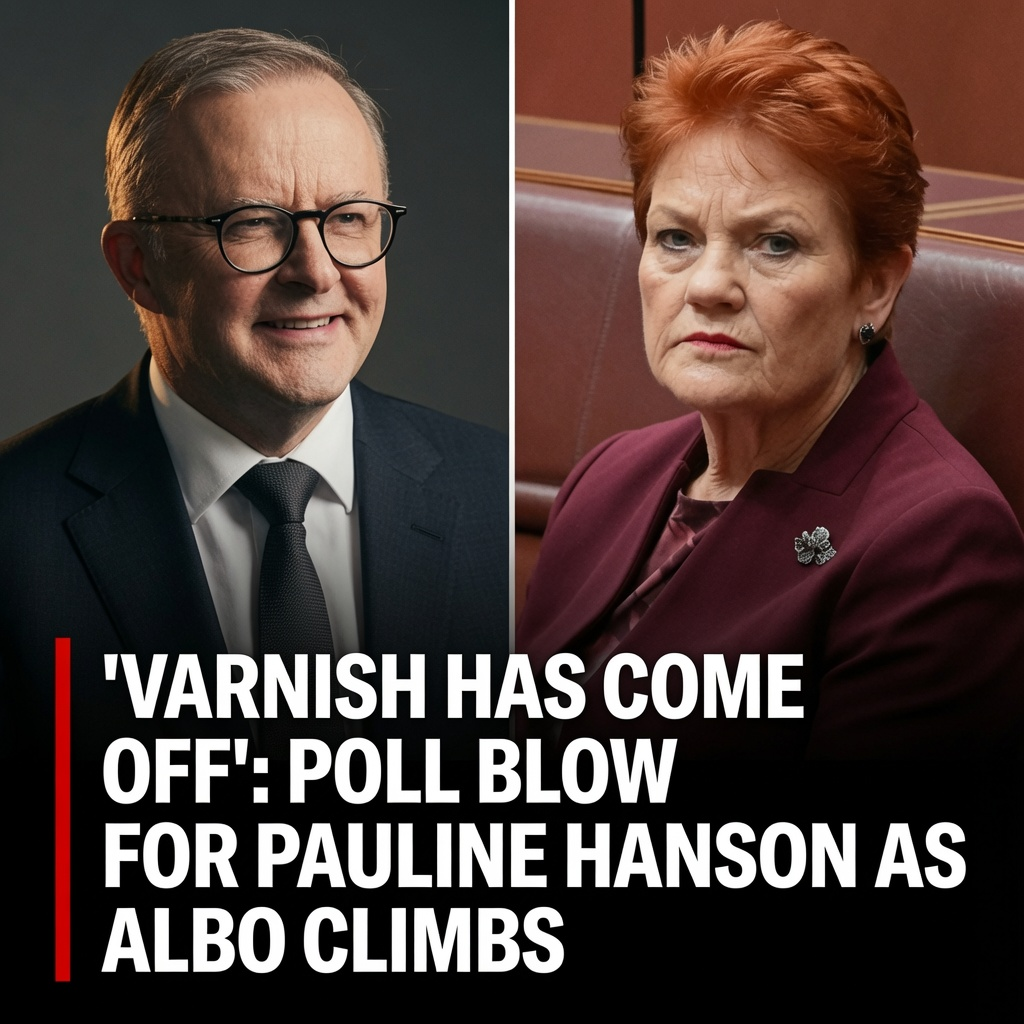
For One Nation’s critics, the latest Resolve Political Monitor will be presented as evidence that Hanson’s extraordinary political surge has finally hit its ceiling.
That conclusion may be premature.
Hanson fell from 33 per cent to 25 per cent as preferred prime minister, while Albanese climbed four points to 33 per cent and Opposition Leader Angus Taylor rose five points to 21 per cent.
One Nation’s primary vote also slipped three points to 26 per cent.
Labor remained on 28 per cent and the Coalition recovered three points to 23 per cent.
Those numbers are a setback for Hanson.
But they also expose a much larger strategic problem for Australia’s political right.
Labor is sitting on 28 per cent of the primary vote while One Nation and the Coalition are fighting over a conservative vote that, combined, is dramatically larger.
The last thing conservative voters who want Anthony Albanese removed from office need is another election campaign dominated by Angus Taylor and Pauline Hanson attacking each other.
Yet that is increasingly the risk.
The Coalition sees One Nation as a direct threat to its survival.
One Nation sees the Coalition as a failed political establishment that abandoned conservative voters on immigration, energy, climate policy and cultural issues.
Both parties have obvious reasons to compete.
But Australia’s preferential voting system means the political consequences of that competition are far more complicated than a simple contest for first place.
If the objective is to defeat Labor, conservatives may eventually have to confront an uncomfortable reality.
They do not necessarily need to merge. They do not need to agree on every policy. But they may need to stop behaving as though destroying each other is more important than defeating Albanese.
The latest Resolve poll should sharpen that debate.
Only one month ago, Hanson had achieved something once considered almost impossible.
She overtook the sitting Prime Minister as the country’s preferred leader.
One Nation had also surged past both major political blocs on primary vote in Resolve polling, reaching 29 per cent.
It was a remarkable political transformation for a party that received just 6.4 per cent of the House of Representatives vote at the 2025 federal election.
Hanson was no longer simply a protest figure on the edge of Australian politics.
For the first time, national polling was forcing serious discussion about whether One Nation could become one of the country’s dominant political parties.
The July Resolve results have interrupted that momentum.
Hanson’s preferred prime minister rating fell eight points to 25 per cent.
One Nation’s primary vote dropped from 29 per cent to 26 per cent, ending a four-month period of uninterrupted growth in the Resolve series.
Albanese recovered to 33 per cent as preferred prime minister.
Taylor also improved, climbing from 16 per cent to 21 per cent.
The Coalition’s primary vote rose from 20 per cent to 23 per cent.
On the surface, the movement appears straightforward.
One Nation fell three points.
The Coalition gained three points.
The two parties are fishing in overlapping political waters.
When Hanson loses some support, Taylor can benefit.
When the Coalition collapses, One Nation can surge.
That dynamic creates an obvious incentive for both parties to attack each other.
The Liberals want former Coalition voters back.
One Nation wants to convince those voters the Coalition has learned nothing from its electoral defeats.
The problem is that every attack can deepen the hostility between two groups of voters whose preferences may ultimately be required to remove Labor.
Veteran broadcaster Ray Hadley has now publicly warned Taylor about precisely that danger.
His message was simple: stop concentrating political fire on Hanson and start concentrating it on Albanese.
South Australian Liberal senator Alex Antic has expressed a similar strategic concern, arguing that attacking One Nation risks insulting and alienating conservative voters the Liberal Party eventually needs to win back.
It is not difficult to understand the logic.
A voter who has abandoned the Liberal Party for One Nation is unlikely to return because a Liberal politician repeatedly tells them Hanson is dangerous, irresponsible or economically reckless.
That voter may hear the attack as criticism of their own political judgement.
The result can be to harden their support for One Nation.
The same problem works in the opposite direction.
When One Nation treats every Liberal as indistinguishable from Labor, it risks making cooperation on preferences and parliamentary votes more difficult.
Australia has seen versions of this political problem before.
The Coalition itself exists because separate conservative parties eventually recognised the electoral value of cooperation.
The Liberal and National parties do not agree on everything.
They represent different constituencies and have regularly fought over energy, agriculture, regional policy and leadership.
Yet the Coalition model is built around a basic political calculation.
Fragmenting the centre-right vote can make it easier for Labor to govern.
One Nation’s extraordinary rise has now disrupted that old arrangement.
The party is no longer a minor Senate force that can be treated as a peripheral protest vote.
Recent polling has placed One Nation in the mid-to-high 20s nationally.
Its support has expanded dramatically since the 2025 election.
At the South Australian election, the party demonstrated it could convert a large vote into a substantial parliamentary presence.
It is now building permanent political infrastructure outside Queensland.
Political analysts are warning the next federal election could enter unknown territory because One Nation may reach the final preference count in a large number of electorates.
At the last federal election, One Nation was in the final two-candidate contest in only 26 seats.
With support at current levels, analysts have suggested it could be competitive in more than 100 electorates.
That would fundamentally change the mathematics of an Australian election.
Traditional two-party-preferred models assume Labor and the Coalition are the final two candidates in most seats.
Pollsters can estimate preference flows using decades of electoral data.
But what happens when One Nation reaches the final count against Labor in dozens of seats?
What happens when One Nation faces the Coalition?
And what happens when voters who previously supported Labor or the Coalition are asked to distribute preferences in political contests they have rarely encountered before?
No one can answer those questions with complete confidence.
This is why the conservative unity debate matters.
A “conservative bloc” does not necessarily mean One Nation joining the Coalition.
Hanson has built much of her political identity by attacking the major parties.
One Nation supporters would likely resist any arrangement that appeared to return the party to Liberal control.
The Liberal Party would also face enormous internal resistance to a formal partnership with Hanson.
Moderate Liberals and some metropolitan MPs would argue such a deal could cost the party votes in urban electorates.
A formal coalition is therefore politically difficult and may be completely unrealistic.
But there are other forms of political cooperation.
The first is rhetorical.
Taylor could make Albanese and Labor the central target of the Coalition’s political campaign rather than using One Nation as the primary threat.
That does not require the Opposition Leader to endorse Hanson’s policies.
He can criticise specific One Nation proposals when necessary.
But there is a difference between policy disagreement and a campaign designed to delegitimise the voters who have moved to One Nation.
The second issue is preferences.
Australia’s compulsory preferential voting system requires voters in House of Representatives elections to number every candidate.
Political parties cannot control those votes.
But how-to-vote cards and party recommendations can influence the order in which some supporters distribute their preferences.
If conservative parties place each other behind Labor, they increase the possibility that their own internal war helps elect a Labor MP.
That may be ideologically satisfying to party strategists determined to punish a rival.
It can also be electorally self-defeating.
The third issue is parliamentary cooperation.
If the next election produces a hung parliament or a large One Nation crossbench, the ability of conservative parties to negotiate could determine who governs.
Recent analysis of One Nation’s polling surge has highlighted how difficult it remains for Hanson to win an outright majority.
The party’s support is weaker in many inner metropolitan electorates.
To form government alone, One Nation would need extraordinary success across outer suburban and regional Australia.
That is possible in theory but remains an enormous electoral challenge.
The more realistic scenario may be a parliament in which One Nation and Coalition MPs collectively hold substantial numbers.
In that environment, years of personal attacks and political warfare could suddenly become extremely expensive.
Labor understands the danger of a divided opposition.
Albanese does not need One Nation and the Coalition to like each other.
He benefits if they spend their time fighting.
Every day Taylor attacks Hanson is a day Labor’s record receives less attention.
Every day Hanson attacks the Coalition as no different from Labor is a day conservative voters become more divided.
The Prime Minister can remain above the conflict and present himself as the stable alternative.
The latest preferred prime minister figures demonstrate how quickly that can work.
One month ago, Hanson led Albanese.
Now Albanese is eight points ahead of her.
That does not necessarily mean millions of Australians suddenly embraced Labor’s agenda.
Leadership polling can be volatile.
It can respond to media coverage, controversial comments and short-term political events.
Hanson’s recent call for Australia to pursue a “monoculture” generated significant debate and appears to have hurt her among some voters.
The Resolve poll showed particularly significant movement among women and voters from immigrant backgrounds.
Thirty-nine per cent of respondents opposed the idea of a monocultural Australia, compared with 33 per cent who supported it.
Pollster Jim Reed argued that One Nation was beginning to look increasingly outdated to some voters.
Those are genuine warning signs for Hanson.
If One Nation wants to become a governing party rather than a protest movement, it must persuade voters far beyond its traditional base.
Language that energises committed supporters can simultaneously create a ceiling on broader support.
Hanson’s eight-point fall should therefore not simply be dismissed as meaningless polling noise.
One Nation needs to examine why the movement occurred.
But the Coalition should be equally careful about celebrating.
Taylor remains third in the preferred prime minister contest on 21 per cent.
The Coalition’s primary vote is 23 per cent.
One Nation, even after its fall, remains ahead of it on 26 per cent.
This is not a restored Liberal Party.
It is a party that has recovered slightly from an extraordinary political collapse.
If Taylor interprets Hanson’s setback as permission to launch an all-out war against One Nation, he risks repeating the strategic mistake conservative critics are warning about.
The Liberal Party needs to understand why voters left.
One Nation needs to understand why some voters are now stepping back.
Both parties need to decide whether their primary objective is defeating each other or defeating Labor.
There will be legitimate disagreements.
One Nation’s economic policies will face scrutiny.
The Coalition will continue to argue it is a more experienced and credible alternative government.
Hanson will continue to accuse the Liberals of abandoning conservative principles.
None of that is going away.
But political strategy requires recognising the difference between a rival and the government you are trying to replace.
The latest Resolve poll gives Albanese 28 per cent for Labor.
One Nation and the Coalition together account for 49 per cent of the primary vote.
Those numbers cannot simply be added together to predict an election result. Voters are individuals, preferences are complicated and One Nation draws support from former Labor voters as well as former Coalition voters.
But the broad political message is impossible to ignore.
Australia’s non-Labor vote is powerful, fragmented and increasingly hostile to itself.
Albanese’s best political outcome may be for that hostility to continue all the way to polling day.
Hanson has just lost eight points as preferred prime minister.
Taylor has recovered five.
The temptation for the Coalition will be to see One Nation’s pain as its opportunity.
Perhaps it is.
But if the next federal campaign becomes a conservative civil war while Labor watches from government, both sides may discover that winning their battle against each other has delivered the one result their voters least wanted.
Another Albanese government.






