Victorian Premier Jacinta Allan has dismissed explosive warnings from the state’s peak business group that Labor’s new work-from-home laws could drive investment and jobs interstate, insisting her government’s own data provides a more accurate picture of the economic impact.
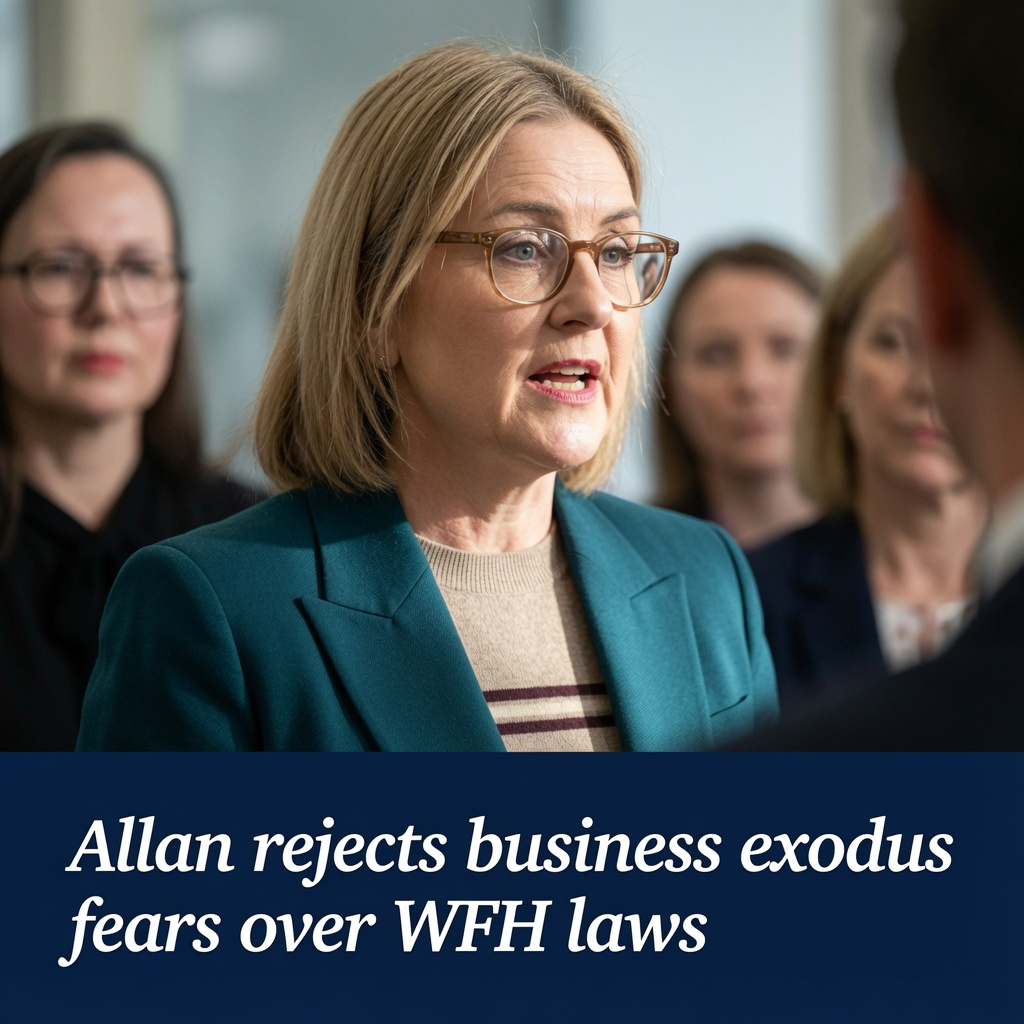
The Premier’s response came after a Victorian Chamber of Commerce and Industry survey revealed deep concern among employers about the government’s decision to create a legal right for eligible workers to work from home two days a week.
Almost half of businesses surveyed — 47 per cent — said the new laws made them more likely to invest or establish operations outside Victoria.
Another 44 per cent said they would be less likely to hire workers in Victoria, while 47 per cent warned they would be less inclined to employ inexperienced staff who may require greater levels of face-to-face supervision and mentoring.
The financial concerns were even more striking.
Ninety-two per cent of respondents expected the laws to impose additional costs on their businesses, with one in four estimating the annual cost could reach at least $50,000.
For a state already struggling with business confidence and economic pressure, the figures delivered a blunt warning to Spring Street.
Allan, however, is not backing away.
She has argued the government’s consultation and research show working from home is good for families, workers and the broader economy, pointing to evidence of productivity benefits and significant household savings.
“We have got data and information that was provided through the biggest-ever Victorian Government survey that tells us that working from home is good for the economy,” Allan said while defending the reforms.
The Premier said businesses consulted by the government had not told her they intended to leave Victoria because of the laws.
That has created an extraordinary divide between the government and the state’s most prominent business representative body.
Both sides say they have data. Both sides say they understand the modern workplace. And both are reaching dramatically different conclusions about what Labor’s laws will do to Victoria.
The disagreement goes to the heart of a policy that could fundamentally change the relationship between employers and employees in the state.
Labor’s Equal Opportunity Amendment (Work from Home) Bill 2026 was introduced into the Victorian Parliament in June.
Under the proposed framework, employees whose jobs can reasonably be performed remotely will gain a protected right to work from home for two days each week.
The laws are scheduled to begin on September 1 for employers with 15 or more workers. Smaller businesses are expected to come under the system from July 1, 2027.
The government has promoted the policy as a cost-of-living and family reform.
According to Labor, Victorians who work from home can save an average of more than $5,000 a year, or roughly $110 each week.
Those savings can come from reduced transport costs, parking, fuel, tolls, lunches and other expenses associated with travelling to a workplace.
There is also the value of time.
For a Melbourne worker spending an hour or more commuting each way, two days at home can return several hours to the household every week.
Parents can gain more flexibility around school and childcare. Workers living in regional areas may have access to jobs that would otherwise require lengthy travel or relocation.
Allan has repeatedly framed the reform as a recognition that the workplace changed permanently during the COVID era.
“Work from home works for families, because it saves time and money and it gets more parents working,” the Premier said when promoting the policy.
The government’s largest consultation on the issue reportedly attracted tens of thousands of responses and was used by Labor to support its argument that remote work is both popular and economically beneficial.
But business groups say that is precisely where the government’s analysis is missing the point.
The Victorian Chamber is not arguing that working from home should be abolished.
Its own survey found 77 per cent of businesses already provide some form of remote work.
That figure is critical to understanding the dispute.
Working from home is already deeply embedded in Victoria’s economy without a statutory two-day entitlement.
Employers and workers have spent years developing arrangements based on individual jobs, industries, teams and business requirements.
For many professional workplaces, hybrid work has become normal.
The business community’s objection is therefore less about whether employees should ever work from home and more about who should decide the arrangement.
Victorian Chamber chief executive Sally Curtain has warned the government’s approach risks replacing workplace flexibility with legal complexity.
The Chamber argues that once remote work becomes a protected legal right under the Equal Opportunity Act, decisions that were previously handled between a manager and employee could become formal disputes.
Under the government’s framework, an eligible employee can request to work from home.
An employer can refuse on genuine operational grounds, including circumstances where the employee’s physical presence is required or remote work would affect productivity, training or business operations.
But employers will need to justify their decisions.
Disputes may be taken to the Victorian Equal Opportunity and Human Rights Commission and, potentially, the Victorian Civil and Administrative Tribunal.
That is where business groups see a major risk.
A large corporation with an internal human resources department and employment lawyers may be able to absorb the compliance burden.
A small or medium-sized business may have a very different experience.
The owner of a 20-person company could suddenly be required to document decisions, respond to formal requests and potentially defend a refusal through an external dispute process.
Even if the employer ultimately wins, the process itself can consume time and money.
This helps explain why 92 per cent of businesses surveyed by the Victorian Chamber expected additional costs.
It also explains the Chamber’s warning about hiring inexperienced workers.
Remote work is not equally suitable for every employee, even when two people technically hold similar jobs.
An experienced professional who understands a company’s systems and has established relationships with colleagues may work effectively with minimal supervision.
A graduate or new employee may require regular mentoring, informal conversations and observation of experienced colleagues.
Some of the most valuable workplace training does not happen in a scheduled video call.
It happens when a junior worker listens to a senior colleague handle a difficult client, asks a quick question across a desk or receives immediate feedback after making a mistake.
Employers fear that if the legal system makes different arrangements harder to manage, businesses may simply avoid hiring workers who require greater supervision.
The Victorian Chamber survey found 47 per cent of businesses were less likely to hire inexperienced workers because of the reforms.
If that warning proves accurate, the workers Labor says it wants to protect could face an unintended consequence.
Experienced employees may enjoy stronger work-from-home protections while younger Victorians find it more difficult to secure their first professional opportunity.
The investment warning is potentially even more serious.
Victoria is competing with New South Wales, Queensland and other jurisdictions for business capital.
A company considering a new office, national headquarters or expansion does not examine a single government policy in isolation.
Executives consider taxes, labour costs, regulation, property costs, energy, infrastructure and the overall difficulty of doing business.
A work-from-home law may not be enough by itself to convince a company to leave Melbourne.
But business groups argue it can become another item on a growing list of reasons to put the next investment somewhere else.
This is the significance of the Victorian Chamber’s finding that 47 per cent of surveyed businesses were more likely to invest interstate because of the new laws.
Allan has challenged that conclusion by pointing to the government’s own consultation.
She said no business involved in the government’s process had indicated it planned to leave Victoria.
But the conflicting claims raise an obvious question.
Why are businesses apparently telling the government one thing and their own peak industry body something so different?
Part of the answer may lie in the questions being asked.
A broad public consultation about working from home will naturally capture the views of workers who value flexibility and employers who already operate successful hybrid systems.
A business survey focused specifically on the consequences of a new legal entitlement is more likely to capture concerns about compliance, investment and hiring.
Neither dataset necessarily tells the entire story.
The government’s claim that working from home can save families money is entirely plausible.
A worker who commutes less will generally spend less on transport and related costs.
There is also evidence that well-designed hybrid arrangements can improve employee satisfaction and, in some workplaces, productivity.
But that does not automatically prove a legislated entitlement will produce the same economic results as a voluntary arrangement negotiated between an employer and employee.
That distinction is central to the debate.
A business that voluntarily allows staff to work remotely has usually concluded that the arrangement suits its operations.
A business complying with a statutory right may be operating under a completely different calculation.
The government’s policy assumes legal protection is necessary because employees can otherwise lose remote working arrangements at the discretion of management.
Business groups argue that discretion is exactly what allows workplaces to adapt.
The Victorian Chamber and a coalition of industry organisations have proposed a 10-point plan seeking changes to Labor’s model.
The group includes major business and property representatives and has urged the government to provide greater certainty for employers.
Among the concerns are the grounds available to businesses when refusing a work-from-home request, the complexity of the dispute system and the timetable for smaller employers.
The business coalition wants clearer managerial discretion and protections against unreasonable compliance costs.
It has also pushed for the system to recognise that the needs of a workplace can change rapidly.
A remote arrangement that works during a quiet period may become unsuitable when a major project begins, a team is restructured or an employee takes on different responsibilities.
The government insists operational grounds will allow employers to deal with those circumstances.
Business groups remain unconvinced that the legislation gives managers enough certainty.
Allan has said she will examine the industry’s proposals, but her broader position remains firm.
Labor believes working from home is now part of modern life and should not depend entirely on the goodwill of an employer.
Politically, the policy is easy to understand.
Millions of workers experienced remote work during the pandemic and many do not want to return to five days of commuting.
For parents, carers and people living far from Melbourne’s central business district, hybrid work can significantly improve daily life.
A government promising to protect those arrangements can present itself as defending workers against corporate demands for a compulsory return to the office.
But Victoria’s employers are asking a different question.
If 77 per cent of businesses already offer remote work, why is a new legal entitlement necessary?
And if almost half of businesses surveyed say the law will influence where they invest, should the government dismiss that warning because its own consultation produced a more favourable result?
Those questions will become harder to avoid as the September 1 commencement date approaches.
The true economic impact will not be measured by government surveys or business press releases.
It will be measured in hiring decisions, investment flows, workplace disputes and productivity data over the years ahead.
If Labor is right, the laws could establish Victoria as a leader in modern employment, giving workers greater flexibility while improving workforce participation and household finances.
If the Victorian Chamber is right, the state could add another layer of cost and complexity to employers already questioning whether Victoria is the best place to expand.
Jacinta Allan is confident the government’s data supports her position.
Victoria’s peak business group is now presenting data that points in the opposite direction.
For a government about to turn work-from-home flexibility into a legal right, simply insisting its numbers are better may not settle the argument.






