Prime Minister Anthony Albanese has found himself on the personal side of Australia’s housing downturn, with the estimated value of his multimillion-dollar Central Coast beach house falling by hundreds of thousands of dollars as property prices weaken across the country.
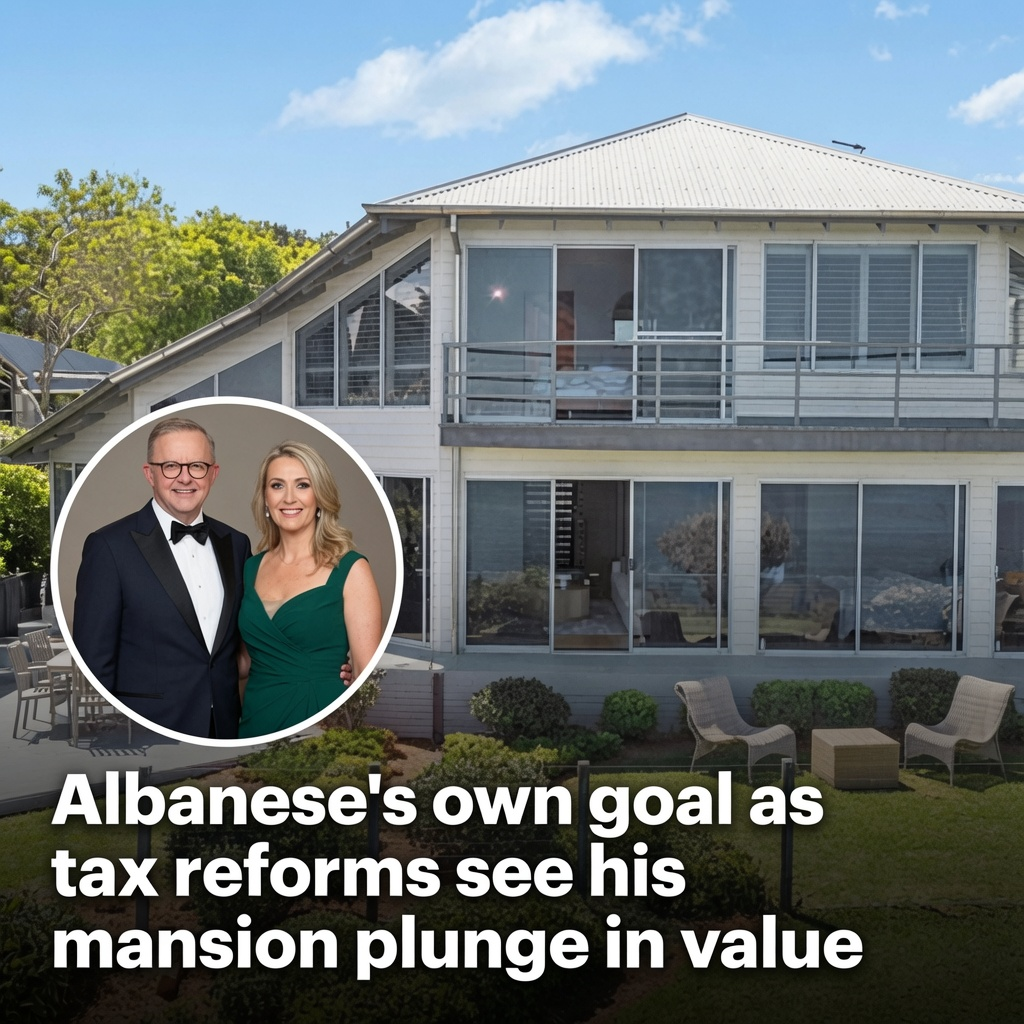
The Copacabana property, bought by Albanese and his then-fiancée, now wife, Jodie Haydon, for $4.3 million in 2024, has reportedly suffered a substantial decline in its estimated market value.
Property analytics estimates have put the home at roughly $3.9 million, implying a paper loss of about $400,000 from the couple’s purchase price. Other market estimates suggest the gap could be even larger depending on the valuation methodology and timing used.
For Albanese, it is an awkward piece of political symbolism.
His government has deliberately embarked on major changes to the tax treatment of property investment, arguing Australia must move away from a system that gives investors an advantage over aspiring homeowners.
Now, as the housing market turns down, the Prime Minister’s own expensive slice of coastal real estate is moving in the same direction.
That does not mean Labor’s tax reforms alone caused the fall in the value of Albanese’s home. Nor does an estimated decline represent a realised financial loss unless the property is sold at a lower price.
But the timing has ensured the Prime Minister’s personal property story has become entangled with a much bigger question confronting the government: can Labor make housing more affordable without inflicting deeper damage on housing investment and supply?
The answer is becoming increasingly important as Australia’s once-resilient property market shows broader signs of weakness.
Cotality’s national home value data showed dwelling values fell 0.4 per cent in June, the largest monthly decline since late 2022. Weakness that initially appeared concentrated in Sydney and Melbourne has increasingly spread across the market.
Sydney has been among the hardest hit major capitals. Cotality data showed values falling sharply through the June quarter, while Melbourne also recorded significant weakness.
Research director Tim Lawless has described the housing market as changing rapidly, pointing to a combination of cost-of-living pressure, poor consumer sentiment and softer property demand.
The shift matters because for years Australia’s housing debate was dominated by one seemingly unstoppable problem: prices kept rising faster than many households could save.
For first-home buyers, the consequences were brutal.
A deposit target could move further away even while a buyer was saving. Rising property prices increased the amount required for a deposit, while rents and everyday living costs consumed more household income.
Labor’s political argument has been that the tax system helped create this imbalance by allowing property investors to use negative gearing and capital gains tax concessions while competing for homes against people trying to buy somewhere to live.
The 2026 federal budget represented a major shift in that approach.
From July 1, 2027, negative gearing for residential property will be limited to new builds under the government’s reforms. Properties held before the budget announcement are protected from the negative gearing changes, while new housing will continue to qualify.
The policy is designed to redirect tax-supported investment towards additional housing supply rather than established homes.
The government has also overhauled capital gains tax arrangements.
The existing 50 per cent CGT discount is being replaced with a system linked to inflation, alongside a minimum 30 per cent tax rate on gains. The changes apply to gains arising after July 1, 2027, with different treatment available for eligible investment in new builds.
In simple terms, Labor wants to change the financial calculation facing property investors.
If an investor wants access to the most favourable tax treatment, the government wants more of that money flowing into new housing rather than bidding up the price of an existing suburban house or apartment.
It is a policy with an obvious political appeal.
Australia has spent years hearing stories of younger workers locked out of home ownership while investors accumulated multiple properties. Albanese and Treasurer Jim Chalmers can argue that a tax system should not indefinitely preserve advantages that contribute to the gap between existing asset owners and people without property.
Falling house prices, viewed through that lens, are not necessarily a policy failure.
For a prospective buyer with stable employment and a deposit, lower prices can improve purchasing power. A home that falls from $1 million to $900,000 requires a smaller deposit and, all else being equal, a smaller mortgage.
Albanese himself has publicly presented softer property prices as potentially positive for first-home buyers.
But that is only one side of the housing equation.
The danger for Labor is that a controlled cooling in prices becomes a broader investment retreat.
Australia does not merely have an affordability problem. It also has a chronic shortage of homes in the places where people want and need to live.
The National Housing Supply and Affordability Council has repeatedly highlighted the scale of the challenge facing the country’s housing system, including the consequences of insufficient supply and worsening affordability.
New South Wales is under particularly intense pressure.
Australian Bureau of Statistics building activity figures cited in the latest housing debate showed just 8,883 new homes were completed in NSW during the March quarter of 2026, down sharply from 13,513 in the previous quarter.
Only about 44,800 homes were completed in the state over the 12 months to March, well short of the annual pace required to meet the National Housing Accord target.
The Urban Development Institute of Australia has warned NSW could fall dramatically behind its housing commitments if current delivery rates persist.
This is where the government’s tax experiment becomes complicated.
If investors retreat from established housing but redirect their capital into new construction, Labor can claim the policy is working as intended.
More investor money supporting new apartments, townhouses and houses could add to the physical stock of housing. In theory, that would help both purchasers and renters over time.
But if investors simply decide residential property is no longer worth the risk, the result could be very different.
Developers rely on buyers to make projects financially viable. Apartment developments frequently require a significant number of pre-sales before lenders will provide construction finance.
Remove too many investors from that process and some projects may be delayed or abandoned.
That would leave Australia in the deeply uncomfortable position of having weaker property prices in the short term while continuing to build too few homes for a growing population.
Renters could then bear a significant part of the cost.
A smaller pool of rental properties, combined with persistent population demand, risks keeping rents high even if headline house prices fall.
There is also the problem of interest rates and household finances.
Housing tax reform is not occurring in isolation. Buyers are dealing with expensive mortgages, elevated living costs and weakened confidence.
For many Australians, a cheaper house is not automatically an affordable house.
A household’s borrowing capacity depends on income, expenses and mortgage rates. If banks calculate that a family can service a substantially smaller loan, a 5 or 10 per cent decline in house prices may do little to put the property they want within reach.
The auction market is already showing signs of buyer caution.
Recent national auction data has placed clearance rates well below the levels seen a year earlier. Cotality figures in late June showed preliminary capital-city clearance rates slipping below 50 per cent, with analysts expecting final results to be lower once all outcomes were reported.
A clearance rate above 60 per cent is generally regarded as more consistent with a balanced market.
More recent results have suggested some stabilisation, but the market remains far softer than it was a year ago. Buyers have greater room to negotiate and vendors are being forced to reconsider price expectations.
That is the environment now surrounding Albanese’s Copacabana purchase.
The property attracted national attention when the Prime Minister bought it in 2024, in part because of the $4.3 million price tag and in part because the purchase came during an intense cost-of-living and housing affordability crisis.
Marketing material described the home as offering “clifftop perfection” and uninterrupted ocean views across multiple levels.
The property has been widely reported as the couple’s planned home after Albanese eventually leaves federal politics.
Its estimated decline in value will inevitably invite jokes about the Prime Minister suffering the consequences of his own government’s housing agenda.
But there is an important tax distinction.
The capital gains tax reforms target investment assets. Australia’s main residence exemption generally means a person’s principal home is treated differently for CGT purposes when the relevant eligibility conditions are met.
Therefore, the political irony of Albanese’s house falling in value should not be confused with a claim that his government’s new minimum CGT rate is automatically being imposed on his Copacabana residence.
The more relevant connection is the broader market.
Government policy can influence investor demand, confidence and expectations. Tax changes that reduce the attractiveness of established investment property can affect the number of potential buyers competing in parts of the market.
At the same time, interest rates, credit availability, household income, population growth, construction costs and the existing shortage of homes all exert enormous influence on prices.
Pinning a $400,000 estimated fall in one luxury property’s value entirely on Labor’s reforms would therefore be far too simplistic.
Yet the Copacabana home has become a useful symbol of the gamble Albanese has taken.
For years, governments were accused of talking about housing affordability while being terrified of policies that might actually cause property prices to fall.
That contradiction was obvious.
If a government wants homes to become significantly cheaper relative to income, existing property owners cannot simultaneously be guaranteed uninterrupted capital growth.
Labor has now moved further than previous federal governments were prepared to move on property tax concessions.
The political test will come if falling prices accelerate.
Homeowners with large amounts of equity may dislike seeing their paper wealth decline, but they are generally insulated from immediate financial danger.
Recent buyers are in a different position.
Australians who entered the market with small deposits near the peak can quickly see their equity eroded when prices fall. In more severe cases, a property’s market value can drop below the outstanding mortgage balance, leaving the owner in negative equity.
That risk is particularly sensitive when governments have actively promoted low-deposit pathways into home ownership.
First-home buyers may benefit from lower prices before they purchase, but those who bought shortly before a downturn can experience precisely the opposite outcome.
Labor must therefore manage two competing political realities.
Millions of Australians want housing to become more affordable. Millions of others have tied a significant portion of their financial security to the value of their homes.
A slow, orderly moderation in prices accompanied by a surge in new construction would be the ideal outcome for the government.
A sharp fall in prices combined with stalled construction, weak investor demand and continuing rental shortages would be something else entirely.
Albanese’s estimated $400,000 property hit is unlikely to create a financial crisis for the Prime Minister.
For ordinary Australians carrying large mortgages, however, the direction of the housing market is much more consequential.
That is why the real story is bigger than one clifftop mansion.
Labor has changed the rules of Australia’s property investment game in the hope of giving first-home buyers a better chance and directing capital towards new housing.
The market is now weakening, investor calculations are changing and housing construction remains under enormous pressure.
If more affordable homes and stronger supply eventually emerge, Albanese will argue the political gamble was justified.
If prices fall while the country continues to build too few homes, the government may discover that making property investors less enthusiastic was the easy part.
Getting enough homes built will be much harder.






