A 20-month investigation by a Melbourne commercial property owner has exposed extraordinary inconsistencies in Victoria’s land valuation system, prompting claims that questionable assessments are driving up land tax bills and putting small businesses under severe financial pressure.
Brandon Kibby began examining valuation data after becoming concerned about the rapidly increasing site value of his commercial property in Connell Road, Oakleigh, in Melbourne’s southeast.
What began as one landholder questioning his own assessment expanded into a detailed examination of six broadly comparable commercial sites along the same street.
Kibby says the numbers simply do not add up.
Across the properties examined by his Connell Road Coalition, site values increased by an average of about 60 per cent over four years.
At the same time, the implied value of buildings and other improvements on some properties plunged by between 40 and 50 per cent.
The result has been explosive increases in land tax.
Kibby says bills across the group have risen by between 600 and 1000 per cent.
His investigation has now sparked calls for a formal inquiry into how commercial land is valued in Victoria and whether the system is producing assessments that genuinely reflect market conditions.
Kibby has gone further, alleging that building values may have been pushed down to support higher site values, which are used to calculate land tax.
“The only conclusion one could come to is that building values have been manipulated to increase site values, which in turn increases land tax,” Kibby told the Sunday Herald Sun.
That is a serious allegation and has not been established by an independent inquiry or court.
The Victorian Government has not accepted that valuations are being manipulated.
A Department of Transport and Planning spokesman said site values were based on independent assessments by the Valuer-General.
But the data uncovered in Oakleigh has raised a fundamental question for Victorian landholders.
If the value of the land underneath a commercial building is soaring, while the calculated value attributable to the building itself collapses despite no major physical change to the property, how are those figures being reached?
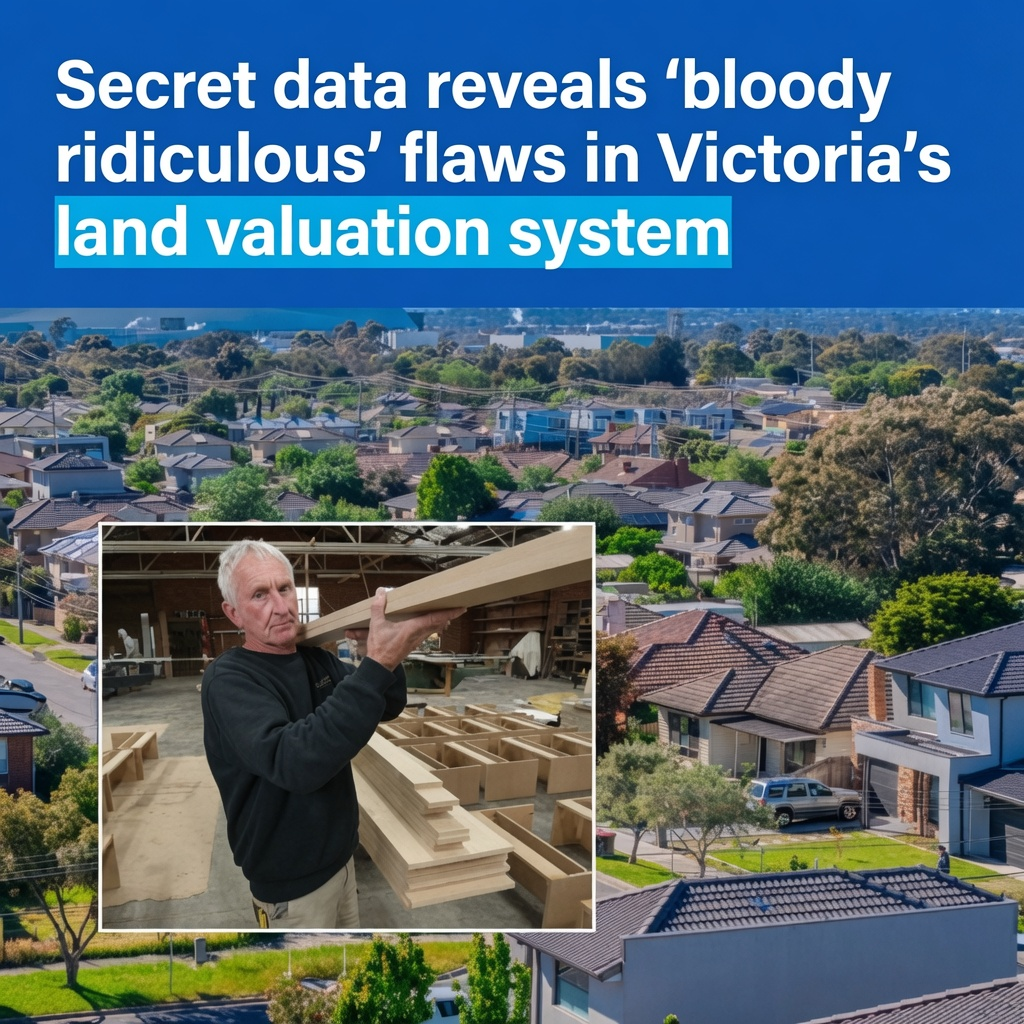
A cabinetmaker’s land tax bill jumped from $2,884 to $16,636
The experience of cabinetmaker Neil Bray has become one of the clearest examples in Kibby’s investigation.
Bray has operated from a Connell Road property for 32 years.
According to valuation data examined by the coalition, the site’s land value increased from $920,000 to $1.64 million over four years.
The capital improved value of the property, which includes the land and improvements such as buildings, began at $1.7 million and later reached $2.06 million.
But the movement between the two figures created an unusual result.
When the site value was subtracted from the capital improved value, the implied value of Bray’s buildings appeared to fall dramatically.
At one stage, the figures suggested the improvements were worth about $1.03 million.
The following year, the implied building value had fallen to approximately $370,000.
Bray said nothing significant had changed at the property that could explain such a dramatic collapse in the apparent value of the buildings.
“Nothing has changed since I started in business in ’94,” he said.
Meanwhile, the cost of materials used in his cabinetmaking business had increased.
Bray’s land tax bill moved in the opposite direction to the apparent building value.
It increased from $2,884 to $16,636.
That represents a rise of about 576 per cent.
“This is bloody ridiculous; this government, they are killing small business,” Bray said.
“How can you increase land tax by 500-odd per cent? It’s not a fair system.”
Bray employs two staff and said rising costs had forced him to consider the future of the business.
“I know so many people who are closing up because they can’t afford the costs,” he said.
“It’s made me think twice, but if I close it’s taking wages away from someone.”
“You never like paying tax but how can it be this much?”
Why site value matters so much to a land tax bill
To understand the controversy, it is important to distinguish between two different property valuations used in Victoria.
Each year, the Valuer-General provides a site value and a capital improved value for Victorian properties.
The site value is intended to represent the value of the land itself, excluding buildings and other capital improvements.
The capital improved value represents the market value of the property including the land and improvements.
For land tax purposes, the critical number is the site value.
The State Revenue Office uses site values supplied through the Victorian valuation system to calculate taxable land holdings.
For 2026 land tax assessments, the SRO is using valuations made as at January 1, 2025.
The more taxable land is valued at, the higher the potential land tax liability, with applicable rates increasing through the tax scale.
This means a sharp increase in site value can have a direct and substantial effect on a property owner’s tax bill.
A commercial building does not need to produce more income for the owner to face a larger land tax assessment.
The business operating from the property does not need to become more profitable.
The land does not need to be sold.
If the assessed site value rises, the tax liability can rise with it.
That is why Kibby focused so closely on the relationship between site values and capital improved values.
In simple terms, if a property is assessed as being worth $2 million in total and the land alone is valued at $1 million, the remaining value attributable to improvements is approximately $1 million.
If the total property value later moves only modestly but the site value surges, the implied value of the improvements can collapse.
That does not automatically prove an assessment is wrong.
Land and building values can move differently.
Older commercial buildings can depreciate, while strategically located industrial land can become much more valuable.
Changing development potential and market demand can also drive the value of land independently of structures built on it.
But valuation experts who examined the Connell Road patterns reportedly described the movements as “odd”, with one saying the figures “did not make sense”.
For Kibby, the fact that similar properties on the same street showed comparable patterns made the issue impossible to dismiss as a single unusual assessment.
Independent building estimates widened the questions
Kibby commissioned an architect to independently examine the buildings involved in his campaign.
He says the independent work estimated warehouse replacement costs of up to $2,600 per square metre.
By comparison, valuation figures he examined implied building values as low as about $480 per square metre.
Replacement cost is not necessarily the same as market value.
A building can cost more to replace than a buyer would pay for it as part of an existing property, particularly if it is old, specialised or functionally obsolete.
However, the size of the apparent gap has strengthened demands for a clearer explanation of the methodology behind the official valuations.
Kibby and people assisting his campaign were reportedly told that contractors could use historical sales, including sales from properties several suburbs away, when assessing site values.
Westlink Consulting, which valued Connell Road properties, has told property owners that vacant land sales, post-sale demolition properties and lightly improved sales can be used as primary evidence.
When approached about the broader concerns, the company referred questions to the Office of the Valuer-General.
The department’s response was that site values are based on independent assessments by the Valuer-General.
That answer has not satisfied Kibby.
He argues landholders should be able to understand the evidence used to produce a valuation that can dramatically increase their tax liability.
The controversy is therefore becoming about transparency as much as the final dollar figure.
If comparable sales are being used, owners want to know which sales are genuinely comparable.
If adjustments are being made for location, zoning, development potential or existing improvements, they want to understand those adjustments.
And if a building’s implied value falls dramatically from one assessment to the next, they want an explanation that can be tested against evidence.
Victoria now values more than 3.3 million properties every year
The scale of the Victorian valuation system is enormous.
Valuer-General Victoria’s 2025 revaluation covered approximately 3.34 million rateable and leviable properties.
The total assessed value of those properties was $3.12 trillion as at January 1, 2025.
Since July 2018, the Valuer-General has been responsible for annual valuations of all land in Victoria for council rates, land tax and the property-based emergency services levy system.
The move to annual valuations was intended to keep assessments more closely aligned with changing market conditions.
But annual revaluations also mean millions of property values must be assessed on a recurring basis.
Mass valuation systems inevitably rely on market data, property classifications and valuation methodologies capable of processing very large numbers of properties.
They do not involve a full physical inspection and bespoke valuation of every individual property each year.
That makes quality control and comparable sales evidence critically important.
A valuation system can be broadly accurate across millions of properties while still producing serious errors in individual cases.
The issue raised by the Connell Road Coalition is whether the patterns it identified point to isolated errors or a wider methodological problem.
Only a detailed independent examination of the data could establish that.
About half of 15,000 objections resulted in recommendations for change
The objection figures are adding to demands for scrutiny.
About 15,000 valuation objections were lodged last year, representing roughly 0.45 per cent of millions of valuations.
Approximately half resulted in recommendations that valuations be changed, according to the latest reporting.
Separately, between 7,000 and 8,000 Victorians each year object through the State Revenue Office, with some successful cases producing land tax reductions worth tens of thousands of dollars.
The relatively small percentage of total valuations challenged can be interpreted in different ways.
The government can point out that the overwhelming majority of millions of valuations are not formally disputed.
Critics can point to the high proportion of challenged assessments that ultimately attract a recommendation for change.
There is also the question of how many landholders understand the objection process or have the time and resources to challenge a valuation.
Under current SRO rules, a person disputing a site value used in a land tax assessment must generally lodge an objection within two months of service of the assessment.
The SRO then refers the valuation objection to the relevant valuation authorities for review.
The two-month deadline cannot be extended.
For a small business owner dealing with staff, customers, suppliers and rising operating costs, obtaining valuation evidence and preparing an objection within that period can be another administrative burden.
Kibby said he objected to his own site value about 10 months ago and was still waiting for an outcome when the investigation was published.
He said he was “bewildered” that assessing a block containing a decades-old Oakleigh warehouse could take so long.
The delay is particularly significant because owners continue to face tax obligations while valuation disputes work through the system.
Land tax revenue is forecast to reach $6.4 billion
The controversy is politically sensitive because Victoria has become increasingly reliant on land tax revenue.
The state budget forecasts land tax will raise approximately $6.4 billion in 2026–27.
Across four years, the government is forecast to collect about $27.4 billion.
By comparison, annual land tax revenue was just under $1.8 billion in 2015–16, the financial year after Labor returned to government.
Not all of that increase can be attributed to valuation changes.
The tax system itself has also changed.
Victoria widened the land tax base as part of its COVID Debt Repayment Plan, including reducing the general tax-free threshold from $300,000 to $50,000.
The shift to annual valuations has also meant property assessments are updated more frequently.
Property values have changed substantially over the past decade.
The Victorian Government’s own budget documents say land tax revenue is affected by movements in residential and non-residential property values.
But the growing revenue makes the accuracy of valuations even more important.
When site values directly influence billions of dollars in state revenue, even systematic valuation errors affecting a small portion of properties could have significant consequences for taxpayers.
Kibby argues that if site values have been materially overstated, the implications could extend beyond a handful of Oakleigh warehouses.
He said an adverse finding on the valuation methodology could call the state’s future revenue forecasts into question.
That claim remains untested.
But it explains why campaigners are demanding an inquiry rather than simply pursuing individual objections one property at a time.
The allegation of manipulation remains unproven
The most serious claim emerging from the investigation is that building values have been manipulated to increase site values and therefore land tax.
There is currently no independent finding establishing deliberate manipulation by the Valuer-General, government officials or contracted valuers.
No court or inquiry has found that Victoria’s valuation system is intentionally inflating site values to raise revenue.
The data identified by Kibby raises questions about valuation consistency and methodology.
It does not, by itself, prove a coordinated scheme to increase tax.
That distinction is essential.
Valuation is an expert assessment of market value, not an exact measurement produced by a single mathematical formula.
Two qualified valuers can reach different conclusions about the same property.
Commercial and industrial land can also be difficult to assess when there are limited genuinely comparable vacant sales.
Properties may differ in zoning, access, shape, development potential and location even when they appear similar from the street.
But those complexities are also why transparency matters.
If an official valuation produces an apparently counterintuitive result, the taxpayer should be able to understand the evidence supporting it.
The Victorian system already recognises that valuations can be disputed.
The question now is whether the number and nature of the discrepancies uncovered in Oakleigh justify broader scrutiny.
Small businesses say the tax increases are becoming impossible to absorb
For business owners such as Bray, the debate over valuation methodology has an immediate financial consequence.
A land tax bill is a cost that must be paid.
Businesses can attempt to absorb the expense, reduce other spending, increase prices or reconsider staffing and investment.
Commercial landlords may seek to recover higher ownership costs through rents where leases and market conditions allow.
That means the effect can move beyond the legal owner of the land.
A tenant operating a workshop, factory or retail business may ultimately face higher occupancy costs.
At a time when businesses are already dealing with wages, energy, insurance and financing costs, a sudden multi-fold increase in land tax can become a significant pressure.
Bray’s concern is that closing his business would not only affect him.
His employees would lose their jobs.
Customers would lose a long-established cabinetmaker.
Another small industrial operation would disappear from Melbourne.
“They are so far in debt they have got to recoup all this money,” Bray said of the Victorian Government.
That is his view and the government disputes claims that valuation decisions are being driven by a desire to artificially increase tax revenue.
A government spokesman said Victoria remained the nation’s leading state for home completions and approvals and argued inflation and interest rates were major drivers of changes to property sales and tax revenue forecasts.
The response does not resolve the specific valuation questions raised by Connell Road landholders.
Calls for an inquiry are likely to grow
Kibby’s investigation has turned six commercial properties on one Oakleigh street into a test case for a much larger system.
The central numbers are difficult to ignore.
Site values across the Connell Road Coalition rose by an average of about 60 per cent over four years.
Implied building values fell by 40 to 50 per cent.
Land tax bills increased by 600 to 1000 per cent.
One cabinetmaker saw his bill rise from $2,884 to $16,636 while the apparent value attributed to his building collapsed.
Independent estimates commissioned by Kibby produced dramatically different figures for warehouse replacement costs.
Valuation experts described some of the movements as odd.
And thousands of objections across Victoria continue to produce recommendations for valuation changes.
None of this proves deliberate manipulation.
It does establish a strong case for clear answers about how the figures are calculated and why apparently comparable properties can produce valuation movements that experienced business owners and valuation professionals struggle to understand.
For Kibby, the issue has moved beyond his own tax bill.
He has created the Connell Road Coalition to help other landholders examine their assessments and challenge values they believe are wrong.
For Bray, the question is more immediate.
After more than three decades making cabinets from the same Oakleigh property, he is looking at a land tax bill almost six times larger than it was four years earlier.
“It’s not a fair system,” he said.
Whether Victoria’s valuation system is merely producing correct but difficult-to-understand market assessments, suffering from inconsistent methodology, or facing a deeper systemic problem is now the question campaigners want independently examined.
With $6.4 billion in land tax revenue forecast for 2026–27, the answer matters not only to six businesses on Connell Road.
It matters to every Victorian landholder whose tax bill begins with a site value calculated by the same system.






